


.png)













.jpg)




















.jpg)





%20(1).jpg)



.png)














ServiceNow's Partner Program Overhaul Signals a New Era for AI-First Ecosystem Players in 2026


ServiceNow's redesigned Build Partner Program and simplified fee structure could dramatically lower the barrier for ISVs and technology partners building AI agents — while raising the distribution stakes in the ServiceNow Store.

ServiceNow’s Partner Program Overhaul Signals a New Era for AI-First Ecosystem Players in 2026
When ServiceNow took the stage at its Partner Kickoff in Las Vegas on January 20, 2026, the announcement wasn’t subtle: the company was ripping up its partner program and rebuilding it from the ground up for the AI agent era.
The revamped Build Partner Program, new four-tier structure, and dramatically simplified pricing weren’t just incremental updates — they signaled a strategic reset of how one of enterprise software’s largest ecosystems plans to win in the next phase of AI-driven automation.
For the more than 2,700 partners in ServiceNow’s global ecosystem, the implications are immediate. More than 1,000 partners — including SailPoint and AutomatePro — are already transitioning to the new structure. For everyone else watching from the outside, the message is clear: the race to build, certify, and distribute AI agents on the ServiceNow AI Platform is on.
As the broader shift toward Ecosystem-Led Growth (ELG) reshapes B2B GTM strategies, ServiceNow’s restructuring provides a revealing case study in how platform companies are repositioning their partner ecosystems as core AI distribution channels.
What is happening?
ServiceNow’s prior partner program had accumulated complexity over years of rapid growth.
Partners navigated overlapping tiers, fragmented pricing models, and unclear paths to visibility in the company’s app marketplace. For ISVs and technology partners trying to build on the ServiceNow AI Platform and reach the company’s 8,100+ enterprise customers, the friction was real.
The catalyst for change is unmistakably AI. As enterprises race to deploy AI agents that automate everything from IT workflows to HR processes to customer service, ServiceNow sees its platform — and its partner ecosystem — as the infrastructure layer for that transformation. The company’s partner program needed to match that ambition.
The January 2026 overhaul is the result of a deliberate rethink. Rather than patching an aging framework, ServiceNow redesigned it to reflect how modern technology partners build, go to market, and generate revenue in an AI-first world.
What actually changed?
The centerpiece of the January 2026 announcement is the new Build Partner Program, which overhauled how ISVs, developers, and technology partners access the ServiceNow AI Platform.
The most significant structural change is the new four-tier system: Registered, Select, Premier, and Elite. Each tier carries progressively stronger benefits and increased visibility in the ServiceNow Store, the company’s global marketplace for enterprise AI agents and certified applications. An all-new Access Tier — sitting below Registered — allows entry-stage partners to start building immediately with tools and training resources, without requiring full program enrollment.
On pricing, ServiceNow replaced its previous complex fee structure with a single annual membership fee. The stated goal: remove the financial and administrative friction that previously slowed partner onboarding and limited who could participate meaningfully in the ecosystem.
The investment portfolio was also significantly expanded. Partners now have access to a revamped Market Development Fund (MDF) with 100% reimbursement available for select activities, a new Strategic Investment Fund (SIF) for high-impact customer opportunities, and sell-through, deployment, and specialization incentives designed to reward partners for driving verified customer outcomes.
The ServiceNow Store’s AI agents category also launched alongside the program, creating a dedicated discovery and distribution channel for partner-built AI agents completing the certification process.
What does it mean for partners?
For partner and alliance teams, the January 2026 changes have three immediate implications.
The distribution opportunity in the ServiceNow Store just got larger. The new AI agents category creates a dedicated, searchable discovery surface for partner-built solutions in a marketplace that serves thousands of enterprise IT and operations buyers. Partners who get certified early gain first-mover visibility in a category that will become increasingly crowded as the year progresses.
The entry bar has been meaningfully lowered. The new Access Tier and simplified annual fee mean that earlier-stage ISVs and developer-focused teams can now enter the ServiceNow ecosystem without full program commitment. This expands the pool of potential co-sell partners — and for established players, it means more competition for buyer attention in the Store.
The economics of partnership are shifting toward outcomes. The expanded MDF, SIF, and specialization incentives reward partners for driving measurable customer outcomes — deployments, deal closings, certified specializations — rather than just for membership status.
As Crossbeam has consistently shown, partners generating the most partner-sourced revenue treat ecosystem relationships as data-driven, outcome-oriented motions—delivering results like deals that are 53% more likely to close, 46% faster time to close, and 58% less likely to churn.
ServiceNow’s new program architecture aligns incentives with exactly that model.
Why ServiceNow is restructuring its partner program around Ecosystem-Led Growth?
ServiceNow’s partner program restructuring is part of a broader shift in how enterprise software companies are rethinking partner ecosystems as strategic growth infrastructure — not just distribution channels.
What’s notable about ServiceNow’s trajectory is that the company isn’t just redesigning its partner program — it’s already practicing what it preaches.
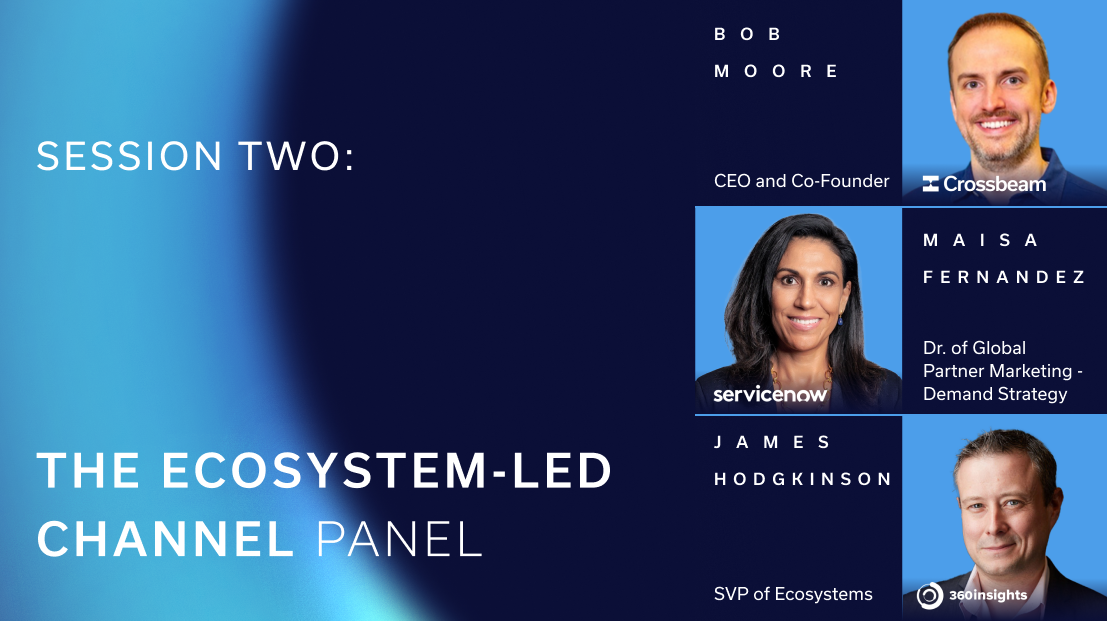
At the ELG Summit 2025, ServiceNow shared how it partnered with 360insights and Crossbeam to overhaul its own partner GTM — building a composable, data-driven architecture that uses Ecosystem Intelligence to identify the right partners, surface the right signals, and drive the right plays at scale.
“Crossbeam is helping us identify the right partners with the right certifications, the right engagements, and the right people in the buying center.” — Maisa Fernandez, Director of Global Partner Marketing – Demand Strategy, ServiceNow
Instead of a giant data dump, Crossbeam becomes a contextual signal layer, embedded directly into the motions ServiceNow and partners already follow. “Crossbeam is the CRM for the new sales funnel,” said James Hodgkinson, Chief Strategy Officer at 360insights.
Working with 360insights and Crossbeam, ServiceNow rebuilt its partner GTM around a composable architecture that unifies the partner experience under a single “front door” — replacing the fragmented system that had accumulated over years of rapid ecosystem growth.
For partner teams working within the ServiceNow ecosystem, that creates a uniquely aligned opportunity: ServiceNow’s leadership understands ELG and is actively investing in it.
What to watch next?
In the next 6–12 months, partner teams should monitor several signals to gauge how this restructuring plays out.
The most immediate indicator will be the pace of AI agent certifications on the ServiceNow Store. The AI agents category launched with a phased rollout — how quickly the Store populates with certified, discovery-ready agents will signal whether the simplified Build Program is actually lowering friction for builders.
Also worth watching: how competitors respond. Microsoft, Salesforce, and SAP each run major partner ecosystems with their own certification and marketplace infrastructure. ServiceNow’s move to simplify fees and expand AI-specific distribution channels puts pressure on these programs to evolve similarly.
Finally, partner teams should watch for details on the SIF (Strategic Investment Fund) criteria — the specifics of what qualifies as a “high-impact customer opportunity” will reveal a lot about where ServiceNow is prioritizing its co-sell investment.
Ready to leverage the ServiceNow ecosystem? Sign up for Crossbeam for free to see how you can leverage Ecosystem Intelligence and accelerate your growth within the security and IT Infrastructure ecosystem.

FAQ
Q: What are the new ServiceNow partner program tiers announced in 2026?
ServiceNow’s revamped partner program introduces four tiers — Registered, Select, Premier, and Elite — replacing the previous tier structure. A new Access Tier gives entry-stage partners immediate access to tools and training without requiring full program enrollment. Each tier carries progressively stronger benefits and visibility in the ServiceNow Store.
Q: How does the new single annual membership fee change things?
The new single annual membership fee replaces ServiceNow’s previous multi-component pricing structure. It’s designed to create a simpler, more equitable structure so partners can focus on building and going to market rather than navigating complex program costs.
Q: What is the ServiceNow Store’s AI agents category?
The AI agents category on the ServiceNow Store is a dedicated discovery and distribution channel for partner-built AI agents that have completed ServiceNow’s security certification process. It launched in January 2026 with a phased rollout as more agents complete certification.
Q: How should partner teams prioritize their response to these changes?
Partners already in the ServiceNow ecosystem should immediately assess which new tier they qualify for and review updated MDF and SIF funding criteria. Teams not yet enrolled should explore the new Access Tier as a lower-commitment entry point for building and testing on the platform.


