






.png)















.jpg)






























%20(1).jpg)






.png)
















Earning Buy-In at Enterprise Scale: How a Global MarTech Software Leader Turned Partner Data into a Field Sales Advantage


Learn how Adobe operationalized Ecosystem-Led Growth with Crossbeam to align sales and partners, uncover hidden pipeline, accelerate deals, and turn partner data into predictable revenue.
.jpg)
Company profile:
- Industry: MarTech, Digital Marketing, Digital Media, Software
- Employees: 30,000+
- Revenue: $22.6B
- Number of partners: 3,171
- Partner team size: 51 - 100
- Customer since: 2020
According to the 2025 Future of Revenue Report by Crossbeam and Pavilion, misalignment has a measurable cost: teams that don’t share data, insights, or mutual goals are 70% more likely to face longer sales cycles and lose track of warm opportunities during handoffs.
And while most CROs say partnerships should influence 20–30% of their revenue, few can actually quantify that impact because the infrastructure, incentives, and workflows to do so simply don’t exist.
The same report found that organizations investing in ecosystem data and partner collaboration are 24% more likely to exceed their revenue targets, largely because partner-involved deals are faster, larger, and stickier.
That’s the promise of Ecosystem-Led Growth (ELG), and it’s exactly what the Technology Partner Program team at this enterprise-scale MarTech and digital experience company is working to operationalize.
When you work inside a 30,000-person enterprise MarTech software company, even the best partnership ideas can stall in spreadsheets and ownership debates. The team behind this company’s Technology Partner Program is tackling that head-on — turning partner overlap from a static list into a repeatable field motion that helps sellers progress deals and leaders buy into the model.
“Without Crossbeam, we wouldn’t even be able to begin the partner discussion,” the Senior Manager of the Technology Partner Program shared. “Now I can say, this partner can influence many of our customers and opportunities. I can find some deals that are stuck and then leverage our partners to try to get a conversation going. That data is enabled by Crossbeam.”
Want to learn how they build and drive adoption for their ELG sales motion? Keep reading
The Challenge: Data Hygiene + Team Alignment
For this enterprise software leader, the hardest part of scaling Ecosystem-Led Growth wasn’t strategy, it was data and behavior.
1. Data hygiene in a complex environment
With customer and opportunity data spread across multiple systems and teams, even basic questions like, “Where is our master customer list?” weren’t straightforward. Their data environment is enormous and distributed. While powerful, it doesn’t natively display Crossbeam data where sellers work, making field adoption harder and slowing down feedback loops.
The partner team had to stitch together datasets, rebuild flows, and collaborate across ops groups to create a unified view, a process that’s improving quarter by quarter but remains a heavy lift.
“Getting the data right has been a colossal effort,” the Senior Manager of the Technology Partner Program shared. “But now it’s accurate enough that we can keep moving.”
2. Team alignment in a compensation model built for competition
BDRs and partners were both compensated for bringing deals to Stage 3, unintentionally putting them in competition. That overlap created protective behavior, with sellers keeping deals close to avoid losing credit.
“If a partner brought in a deal, some field teams saw it as a threat,” a leader on the Technology Partner Program shared. Even when Crossbeam showed clear overlap, activation lagged because the incentives weren’t aligned.
The approach: Proving value with data and human stories
The company’s strategy for getting leadership buy-in follows a simple but powerful structure:
1. Build the case with data and a bigger narrative
The first step is quantifying opportunity.
The tech partnerships team pushes opportunity, and customer sets into Crossbeam to uncover what they call the “ghost pipeline” — deals that had partner overlap but no partner engagement.
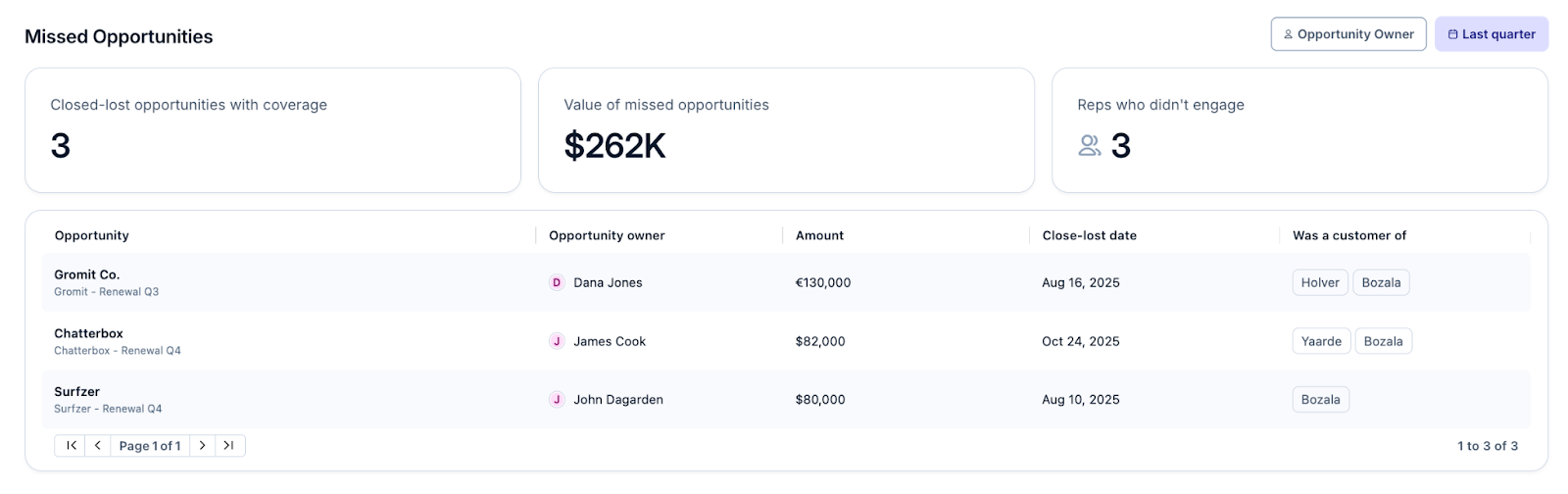
“We push all of our opportunity data into Crossbeam,” the Senior Manager of the Technology Partner Program shared. “It shows the dollar amount in pipeline that has known overlap. We have internal stats that show that when a partner is involved, we close it bigger, faster, and it’s retained longer.”
But raw numbers aren’t enough to win executive attention. So, their tech partnerships team built a presentation to tell a bigger story, one that contextualized Crossbeam as part of their long-term growth engine, not just another dashboard.
The deck became a great tool for internal evangelism. It included:
- What is Crossbeam?: A simple overview for leaders unfamiliar with the platform.
- The data flow process (and security): How data moves safely across systems like Snowflake, with controls for privacy and compliance.
- Crossbeam’s use cases by persona: Showing what each team, from partner managers to account executives, could gain.
- Reports and ownership: Who owns which reports, and how they align to business units.
- The growth impact: Data showing open pipeline with partners vs. without partners.
- Scaling partner impact: A roadmap for expanding the motion across teams.
- Their existing partner programs: How this connects to current GTM structures.

Each version of the deck was customized for its audience, from senior executives who needed a strategic narrative to frontline managers who needed tactical clarity.
“To get buy-in at a company this size,” the Senior Manager of the Technology Partner Program shared, “You can’t just show data. You have to tell a story that makes people feel how much faster, cleaner, and more aligned their world could be if we did this together.”
2. Tell the story
Numbers open the door, but stories move people.
They started using specific deal examples to make the case real. The Senior Manager of the Technology Partner Program calls it ‘one person, one struggle, one partner, one outcome.’
Example one:
A rep had demoed to a prospect in April and then heard nothing for months. The opportunity sat stuck in Stage 2 (out of 7). One day, the rep asked her partner manager if [Partner A] might have connections inside the account. Normally, this would trigger a long chase through outdated spreadsheets.
This time, the tech partnerships team was there. They pulled up the prospect’s name in Crossbeam and instantly revealed that partner A and other two partners were already active within the account.
“I showed her not only that Partner A had the state as a customer, but that several of our tech partners were also already inside,” the Senior Manager of the Technology Partner Program shared. “She was mind blown.”
That insight changed the strategy overnight. Instead of cold-following an unresponsive buyer, the seller could reach out through existing partner relationships — a trusted bridge that reopens conversations and moves the deal forward.
“Had the rep known this in April,” the Senior Manager of the Technology Partner Program shared, “the deal almost certainly would have progressed.”
Example two:
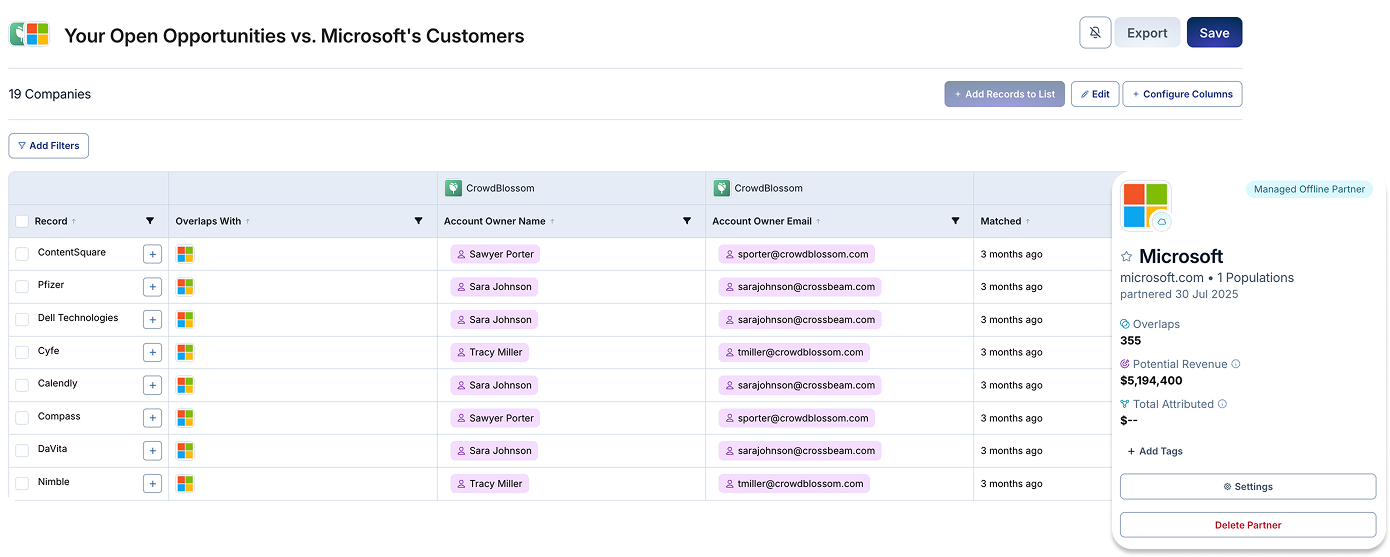
In another case, a high-value deal had been progressing slowly. One of their service partners couldn't access Crossbeam directly, so the tech partnerships team created an offline partner record to upload their customer list manually.
The next day, automated Crossbeam alerts fired to two field partner managers showing that Partner B had a strong relationship with the account in question. Those managers reached out to confirm, and Partner B quickly validated they were indeed embedded with the prospect’s team.
With that confirmation, the partner was brought directly into the deal to provide services and co-design demos, accelerating progress to Stage 4 in their sales cycle.
“For our partner to be endorsed by our company on that deal was huge for them,” the Senior Manager of the Technology Partner Program shared. “And it was great for us, because we could immediately leverage their relationship instead of waiting six months for another vendor to build trust.”
Human stories like these ones are the centerpiece of their internal buy-in narrative. They made the abstract concept of “partner influence” tangible.
3. Codify the motion
Once leadership was paying attention, the tech partnerships team turned wins into a system:
- Sales-team-specific Crossbeam reports organized by leader and segment.
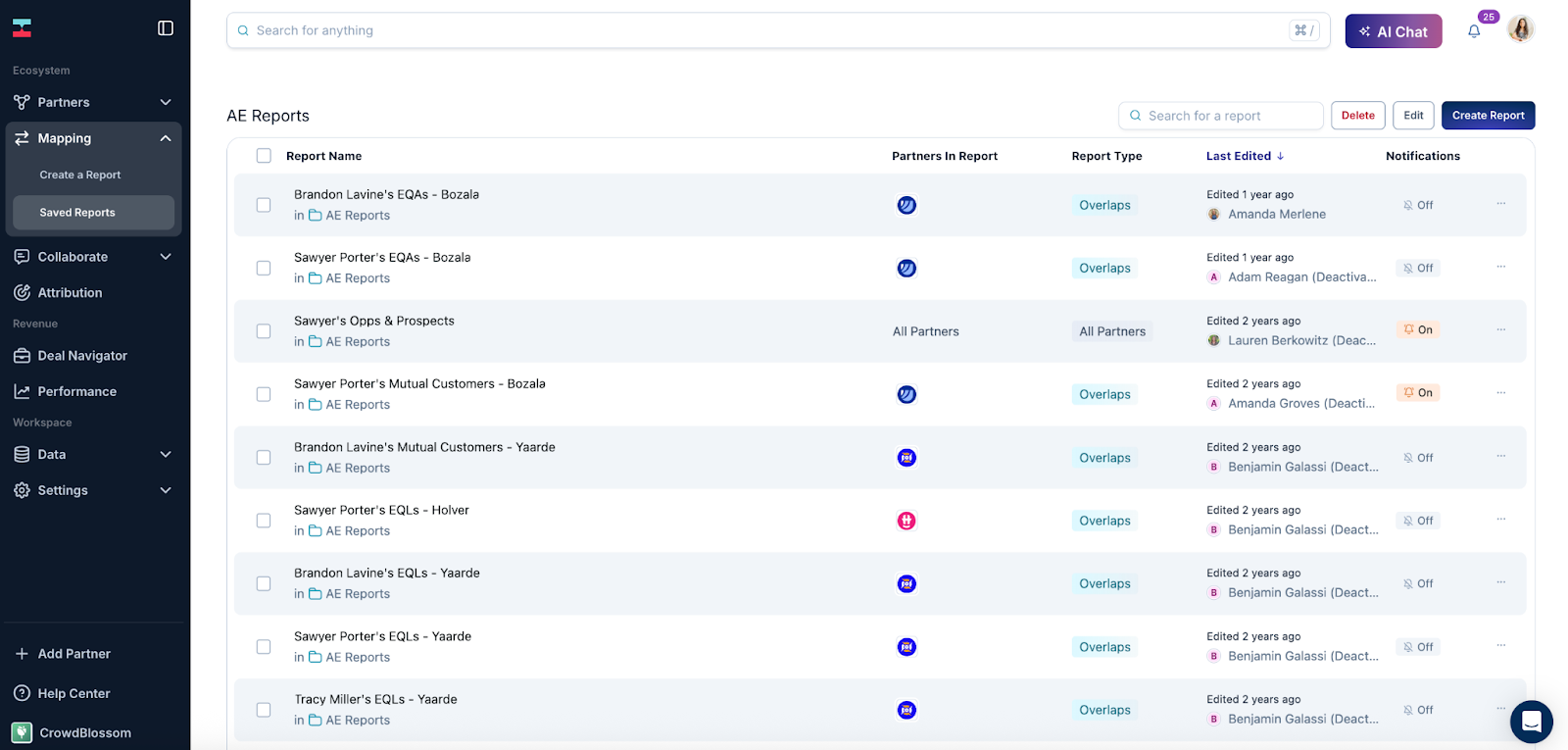
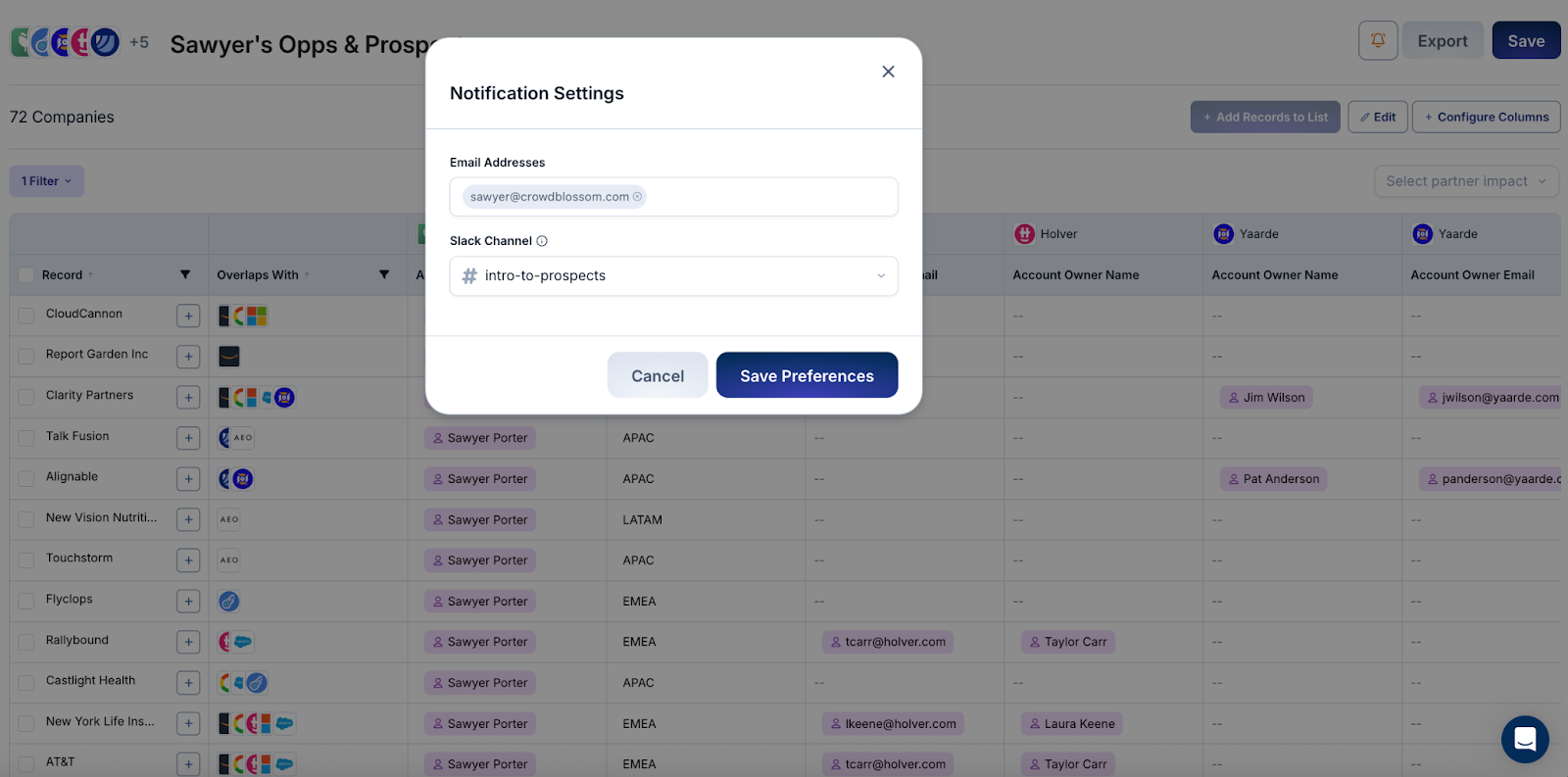
- Automated alerts that notify partner managers when an overlap is found.
- Offline partner workflows for partners who can’t connect directly.
- Training sessions and enablement decks that teach partner managers how to spot overlaps, identify greenfield opportunities, and coordinate intros.
- Defined ownership models, each sales leader knows their assigned partner manager and how to collaborate securely.
“Once you connect the dots between data, motion, and human outcomes,” the Senior Manager of the Technology Partner Program shared. “Buy-in follows naturally. People stop asking ‘why are we doing this?’ and start asking ‘how can I get access to it?’”
Building a system where sales and partners win together
Data and stories got the motion off the ground, but incentives and trust will determine whether it scales. “The next step to avoid the sales and partners competition is our new pilot program,” the Senior Manager of the Technology Partner Program shared. “The objective is to give our solution-led business the tools they need to get partner support on their deals, even at the very early stage.”
This new motion will allow BDRs and partners to collaborate on “Greenfield” accounts — any assigned account where their company doesn’t yet do business and share success instead of fighting for credit.
The goal: build a framework that’s reliable, predictable, and scalable. By empowering partners to assist earlier in the cycle, they can smooth revenue fluctuations, accelerate pipeline, and free up internal resources.
“We’re exploring putting overlap data directly in the partner portal, with messaging controlled so sellers aren’t inundated,” the Senior Manager of the Technology Partner Program shared. Their long-term vision also includes surfacing overlap directly inside their CRM and creating a partner portal view that allows partners to see where they can help, without overloading sellers with inbound requests.
Turning partnership potential into predictable revenue
The MarTech giant’s journey shows that Ecosystem-Led Growth isn’t about dashboards or data hygiene alone; it’s about building repeatable trust, incentives, and shared wins across every layer of the business.
The tech partnerships team is proving that the right thing to do is to move partnerships from “strategy” to “field execution”.
To other partnership leaders, here are three core pieces of advice from the Senior Manager of the Technology Partner Program:
- Start with fit, not tooling: “It starts with the nature of the partnership, not the tech. I call it partner product-market fit. You have to make sure your partner's product market fit is there, and if it is, you can fill those use cases together that you wouldn't be able to apart. Then that's when Crossbeam can really accelerate and pour the fire on your go-to-market motion, and you reduce the latency between your sales teams.”
- Let sales and partners work directly: “Find a way to build rules of engagement between your sales teams that respect each other, so they can work directly, with partner teams enabling without being a bottleneck.”
- Scale trust through visibility: By building a system where data and collaboration are shared safely — whether through the CRM or the partner portal — everyone wins faster. “We’re just at the beginning of the impact… There will be better stories in a year.”
Ready to write your own story? Book a meeting with our team to see how Crossbeam can help you operationalize partner data, align your GTM teams, and turn ecosystem overlap into revenue outcomes.


