

Everything You Need to Know About ELG Marketing


ELG marketing (formerly called Nearbound Marketing) reaches buyers through your partner ecosystem instead of ads or cold outbound, and AI tools like Crossbeam MCP now put that ecosystem data to work in real time. Here's what it is, how it works, and how to build it into your GTM strategy.
A few years back, "nearbound" was the word for this. It described a marketing motion built on your ecosystem instead of only ads or cold outbound, and for a while it did its job. The idea has since matured into something bigger, with a name that better matches the scope: Ecosystem-Led Growth, or ELG.
This guide covers what ELG marketing actually is, why the data backs it up, and how to build it into your GTM plan, including where AI now fits into the picture, instead of leaving it as the thing your partnerships team does in the background while marketing runs the real campaigns.
What is ELG marketing?
ELG marketing reaches and influences buyers through your partner ecosystem, using the trust your partners have already earned with their own customers. Instead of only buying attention with ads or interrupting someone with cold outbound, ELG marketing shows up where a partner already has credibility.
The logic is simple: buyers trust a recommendation from someone they already work with far more than they trust an ad or a cold email. ELG marketing is what happens when you build an actual system around that fact instead of hoping it happens accidentally.
Why this needed its own category
Traditional marketing strategy splits into inbound (the buyer finds you) and outbound (you find the buyer). Both assume the buyer is either actively searching or willing to engage with something unsolicited. Neither accounts for the fact that most B2B buyers are already surrounded by a network of vendors and partners whose opinions carry real weight, whether your outbound sequence exists or not.
ELG treats that surrounding network as a distinct channel. Not inbound, since the buyer didn't necessarily come looking for you. Not outbound, since you're not the one cold-messaging them. It's the motion that happens near the buyer, through relationships they already trust.
The best way to explain it is by using Omdia's Chief Analyst Jay McBain model.
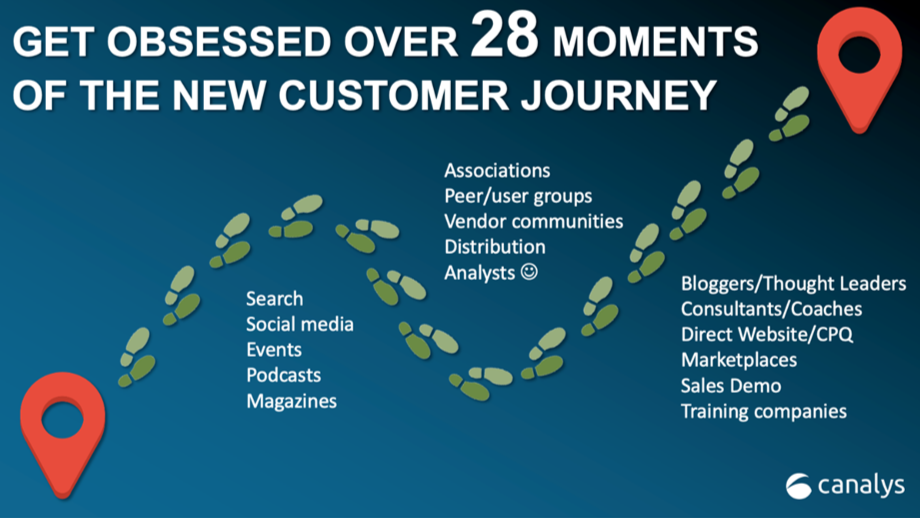
Jay has spent decades tracking how B2B deals actually happen, and his numbers make the case for ELG better than any positioning slide could. He puts the average considered B2B purchase at seven partners and 28 touchpoints before a buyer ever talks to a vendor directly.
These can include a Slack message from a colleague, a review site, a conversation with an integration partner, and a case study a reseller forwarded. None of that shows up in your CRM.
Jay also puts a number on trust. Winning a deal, in his view, takes three to four trusted voices around the buyer. The stakes go beyond any single deal: he estimates that 75% of the world's $94 trillion in commerce still moves through indirect channels rather than direct transactions.
He sums up the trend line plainly in a recent conversation with Crossbeam's ELG Summit: "Partnering gets more important every year for the next 20 years."
For marketing, the implication is uncomfortable if you're used to owning the funnel. Most of the moments that decide a deal happen where you're not looking, driven by partners you may not be actively working with yet. ELG marketing is the discipline of showing up in those 28 moments on purpose, instead of leaving them to whichever partner happens to care enough to bring you up unprompted.
How ELG marketing works
ELG marketing isn't one tactic you launch and measure. It usually breaks into four separate mechanisms, and each one reaches a buyer at a different point in the 28 non-transactional moments covered above.
Some require you to actively work with a partner's marketing team. Others just mean your ecosystem shows up in the right place at the right time, without a campaign behind it at all.
Here's what each one looks like in practice:
Co-marketing with partners. Joint webinars, joint content, joint case studies, or even featuring each other in podcasts or events. Each carries an implicit endorsement that the solo version doesn't.
For example: a webinar on "how to close deals faster" hosted with a CRM partner reaches an audience that already trusts both brands walking in, which is a different starting point than a solo webinar promoted through paid ads or organic search.
Partner-sourced intros. When a partner's customer success or sales teams already trust your product, a warm introduction happens in a way no cold sequence replicates. This works best when the partner's team actually understands your ICP and has a real reason to bring you up mid-conversation, which is why the strongest intros come from partners you've equipped with talk tracks and proof points, not just a logo on a partner directory page.
Ecosystem content. Content addressing the intersection of your product and a partner's, how to use both together, reaches an audience already primed to care.
For example: a piece titled "How to connect [Partner] and [Your Product] for [use case]," published on both sites, ranks for a narrower and more qualified search term than either product's generic content, and it reaches a reader who's already evaluating your partner's tool.
Third-party and community presence. Buyers increasingly research vendors through integration directories, community threads, and partner marketplaces before ever filling out a form.
For example: listing in an integration marketplace, a helpful answer in a partner's community Slack, or a mention in a G2 comparison thread all count as ELG marketing moments, even when no one on your team hit publish.
Building an ELG marketing motion
- Pick your highest-trust partners. Not every partner relationship earns the same ELG investment. Start with partners who share your ICP and have real credibility with that audience.
- Find the actual overlap. Account mapping tells you which accounts you share with a partner. Without that data, ELG marketing is a guess dressed up as a strategy. (More on exactly what this unlocks for targeting below.)
- Build content together, not alongside each other. Co-branded webinars and guides carry two trusted names instead of one.
- Equip partners to talk about you. Give partner teams the talk tracks and proof points to bring you up naturally in their own conversations.
- Track it like a channel, because it is one. ELG marketing needs to show up in attribution, not as a vague "partnerships helped somehow" footnote. AI tools connected to your ecosystem data (see below) can help surface that attribution without a manual pull every quarter.
How account mapping and overlap data sharpen your ICP and your campaigns
Account mapping shows you exactly which accounts overlap with a partner, so you're targeting accounts that are actually in play instead of every account that happens to fit a lookalike audience.
That overlap data does more for marketing than most teams give it credit for:
- Sharper ICP definition. Instead of guessing at firmographics, you can see which of your prospects are already customers or open opportunities for your best partners, and use that pattern to decide who to invite as a webinar speaker, which events to sponsor, which partner to co-host a workshop with, and who makes a credible guest for your blog.
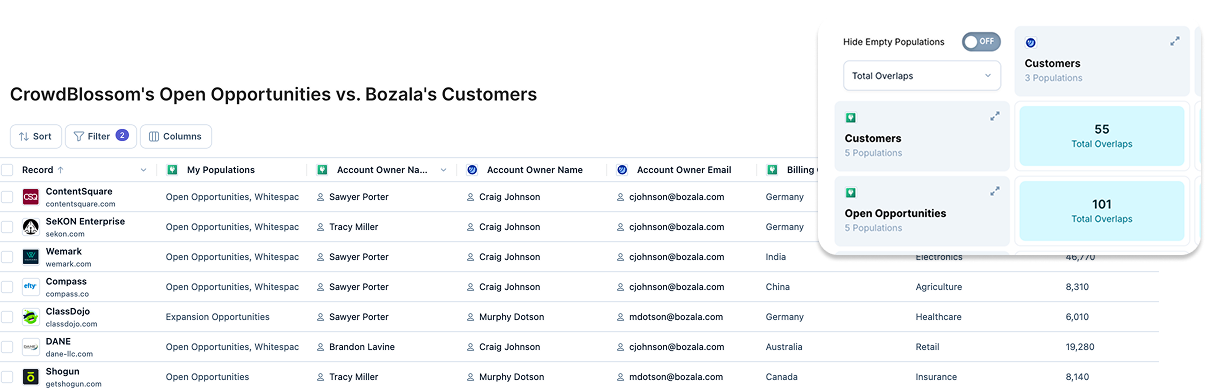
- High-intent lead lists. Pipeline Generation surfaces net-new accounts sitting in a partner's CRM that fit your ICP but haven't hit your database yet. In practice, that's your invite list for a lunch-and-learn or the seed list for a paid social campaign, built from accounts with a documented reason to convert instead of a cold, purchased list.
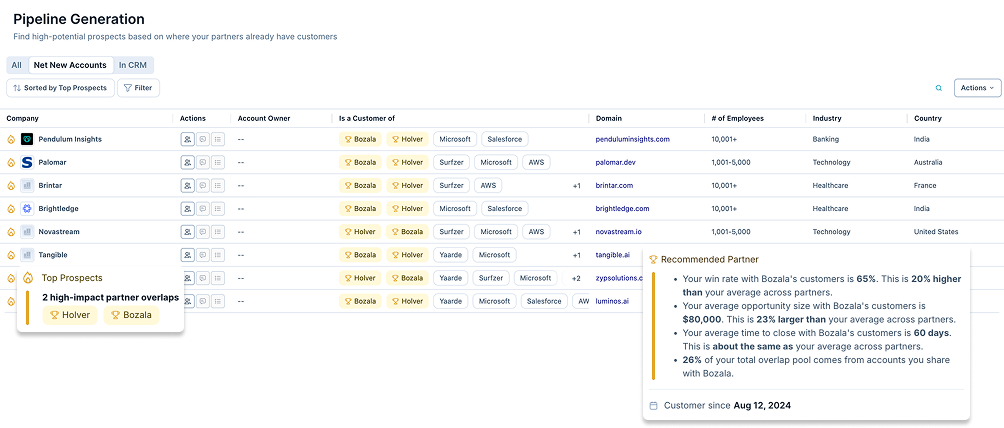
- Smarter ABM. Knowing which partners are active with your target accounts, and what's in their tech stack, lets you personalize outreach around a real relationship instead of a generic pain point, the way RollWorks and Drift built their integration launch around second-party data from Crossbeam instead of static third-party lists. They synced mutual customer overlaps into RollWorks to power hyper-targeted programmatic ads, then drove clicks to a short, ungated eGuide with an embedded Drift chatbot. The result was 60.9% higher engagement and 68% of total integration adoption.
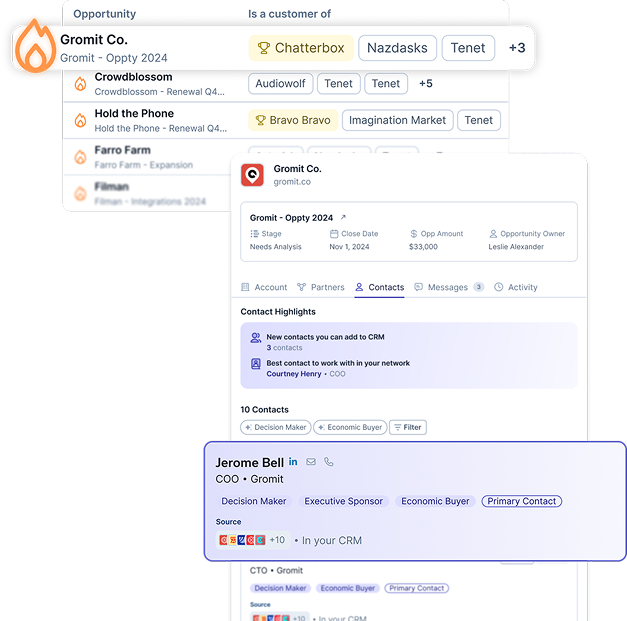
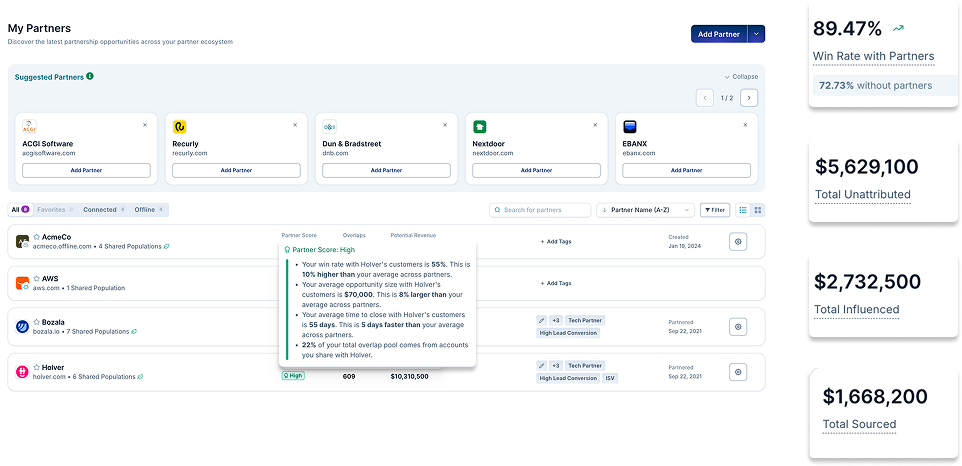
- Power co-marketing. Shared Lists turn "which partner should we co-market with" from a guess into a decision backed by data: pull the overlap, check Partner Impact scores to see which partner relationships actually convert, and use that to decide who co-hosts your next webinar, who gets a joint ebook, and where your MDF budget goes furthest. FullStory used exactly this pattern for its "better together" campaigns and saw a 50% increase in new pipeline from co-selling and co-marketing plus a 5x year-over-year increase in partner-attached closed-won deals.
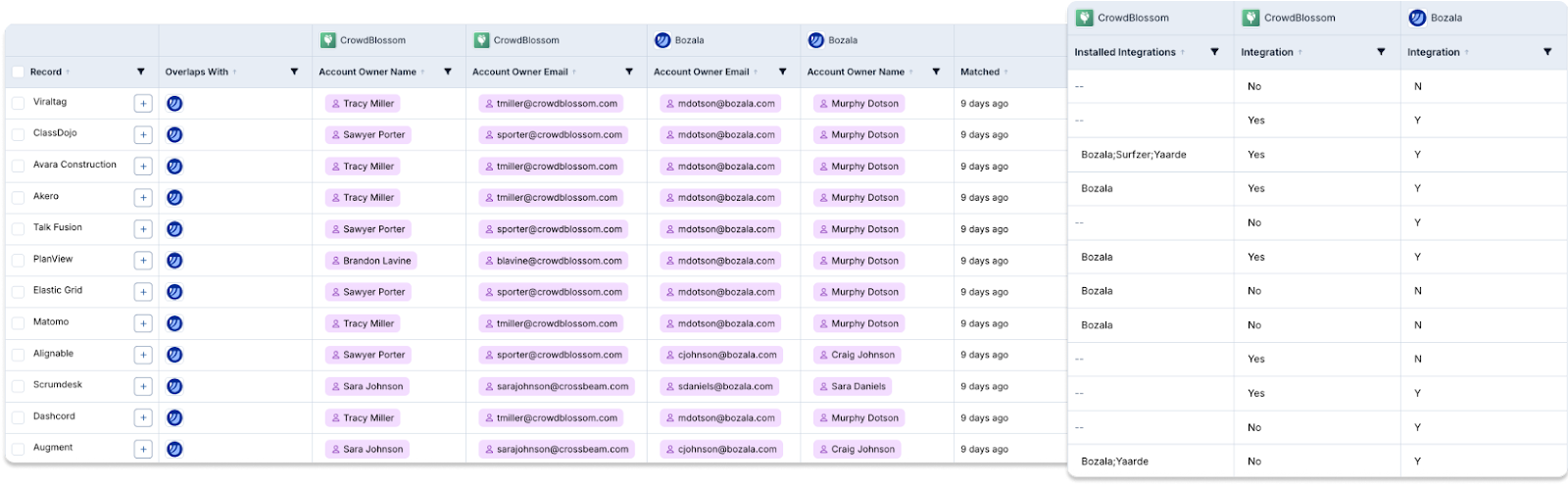
- Enriched martech, without manual work. Overlap and partner signals can flow into your CRM and email tools directly. That's what lets JustCall's team flag customers who already use a newly integrated partner tool the same day a feature ships, dropping them into a targeted adoption sequence instead of the general nurture track, a pattern that helped push integration adoption from roughly 50% to nearly 60% of its customer base.
Pro tip:
Leverage ELG marketing to move into new territory: partners who already work with the buyer you're targeting can tell you how to expand into a new persona or vertical with grace instead of learning it the expensive way.
Putting AI to work: Crossbeam MCP for ELG marketing
Account mapping data used to live in a dashboard you had to remember to check. Crossbeam's MCP (Model Context Protocol) server changes that by piping the same overlap and ecosystem signals directly into the AI tools your team already has open, including Claude, ChatGPT, and Glean.
For marketing specifically, that turns a database into something closer to a research assistant sitting inside your existing workflow:
- Build target account lists conversationally. Ask which accounts on your prospect list overlap with a specific partner, and turn he answer into a co-sell deck or a campaign list in the same conversation.
- Find Ecosystem-Qualified Leads. Ask which accounts show the strongest recent buying signals across your ecosystem, so you're prioritizing leads with a partner already in the account instead of chasing every ICP-fit account equally.
- Enrich agents. Point an agent at your prospect list and have it flag ICP-fit accounts the moment a partner opens an opportunity there, so outreach can go out the same day instead of waiting for the next pipeline review.
The data behind these answers is Crossbeam's Network Signals: consented, second-party data shared directly by partners, not inferred from anonymous web traffic the way third-party intent data is.
ELG vs. traditional partner marketing
Traditional partner marketing often stops at a co-branded logo and an occasional joint webinar. ELG marketing goes further because it's built on live overlap data: you know exactly which accounts you share with a partner, so the effort targets accounts actually in play, not every account that happens to share a partner tag.
How Crossbeam supports ELG marketing
Crossbeam's founders wrote the book on Ecosystem-Led Growth, literally; Bob Moore's book on the topic is where a lot of the category's language comes from.
The Crossbeam Network of 30,000-plus companies is what makes ELG marketing possible at scale: instead of guessing which partners and accounts matter, you see the real overlaps and put co-marketing effort where a partner relationship can actually move a deal.
That same network is now available inside the AI tools your team already uses through Crossbeam MCP, so the overlap that used to require a dashboard login is a prompt away.
See where your ecosystem overlaps with your buyers. Register for free to find the accounts where ELG marketing and AI will have the biggest impact.
Frequently asked questions
Is ELG marketing the same as nearbound marketing?
Yes. ELG, Ecosystem-Led Growth, is the current name for the strategy originally called nearbound. The underlying idea, using your ecosystem to reach buyers, hasn't changed.
Who owns ELG marketing inside a company?
Usually a split between partnerships and marketing, since it needs both ecosystem data and campaign execution.
Do you need account mapping to do ELG marketing?
You don't strictly need it, but without it you're guessing which partners and accounts to prioritize instead of knowing.
Can AI tools use Crossbeam data for ELG marketing?
Yes. Crossbeam's MCP connects Claude, ChatGPT, Glean, Superhuman, and your own agents to your live partner overlap and ecosystem signals, so marketing can build target lists, spot high-intent accounts, and personalize campaigns from inside the AI tools you already use.