


From Noise to Numbers: Turning Partnerships into Real Revenue




For many companies, partnerships are supposed to be the “growth engine” of the business.
But in reality? Too often, they’re just noise.
Slack notifications pile up, dashboards get ignored, and sales leaders see no measurable pipeline coming from partner programs. Thanks to that, your CFOs start asking the hard questions: Why is the partnerships department costing so much without delivering clear results?
“CFOs look at their numbers and ask, why are we paying for this again?” said Alex Buckles, CEO of Forecastable. “They know partnerships can be a low-cost acquisition channel, but when they don’t see the pipeline or closed-won results, to them, partnerships is expensive noise.”
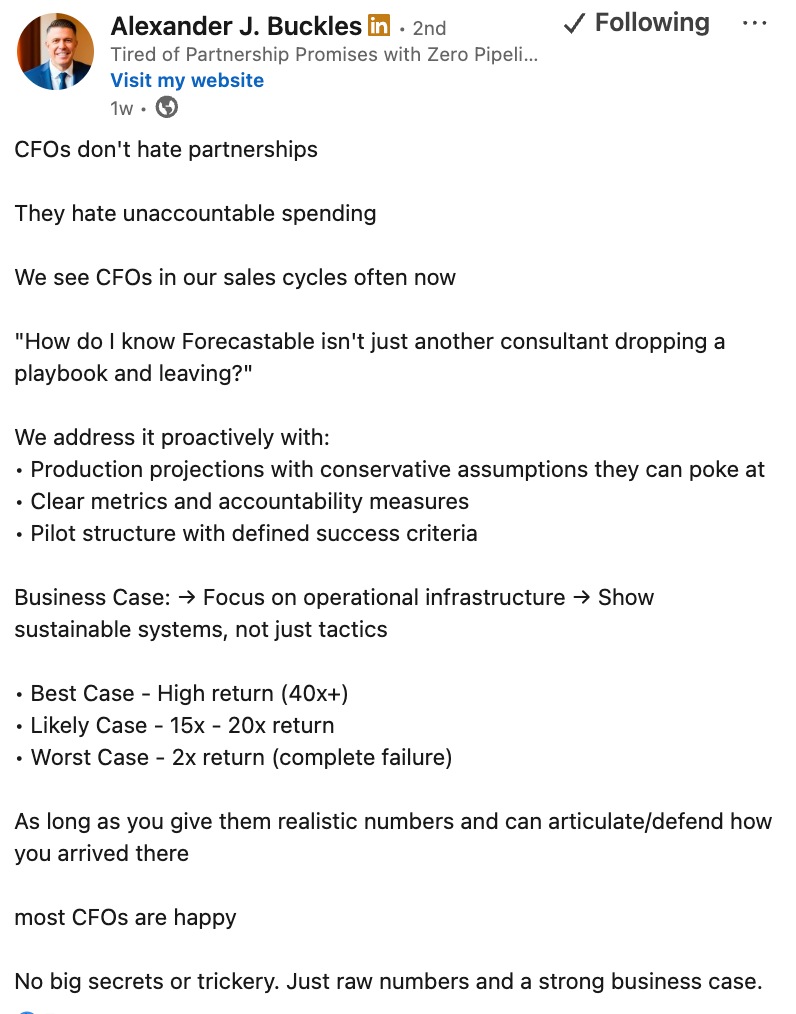
This is the gap between the promise of partnerships and the reality inside revenue organizations. The good news? It doesn’t have to be this way.
To help us close this gap, we sat down with Alex Buckles, who gave us the formula to turn partnerships from noise to numbers.
But first, let’s understand one thing…
Why sales leaders tune partnerships out
Alex has spent over 20 years in enterprise sales, building and leading revenue teams. From his perspective, sales leaders’ skepticism about partnerships comes from experience.
“When I was selling in the SAP ecosystem, I learned quickly that reps weren’t going to give me deal flow unless I was doing something for them,” he explained. “And partner managers? They were perceived as just getting in the way by most sales reps. So for sales leaders I personally know, partnerships feels like a distraction, fluffy meetings, lots of talk, but no pipeline. To them, it’s just noise.”
This explains why sales and finance leaders often disengage from partner teams. The CFO sees high costs without measurable outcomes. The CRO sees distraction without revenue. And the frontline seller sees yet another notification or dashboard with a lot of information, that yes, might help, but they don’t know how to act on or interpret.
“The last thing a sales rep wants is another notification in their life. That notification could be filled with gold, and they’ll still ignore it, because sometimes, they just don’t know what that means or what to do with that information” Alex said.
Until partnerships can deliver something tangible for sellers, they’ll continue to be sidelined.
The silver platter approach
So how do you turn noise into something your sellers actually want? Alex calls it the “silver platter” model.

The most important thing about the silver platter approach is to think like your sales team:
Would you want to sit through endless notifications? Even if they contain relevant data, if the context isn’t clear, how are you supposed to make sense of your ecosystem?
“Your reps want the ops team to monitor partner data, identify the signals that impact their accounts, and serve up clear next steps. That means creating workflows, assigning tasks, and setting reasonable follow-up reminders on tasks that reps actually “want” to complete, translating raw data into actionable insights they can use to break into their top accounts or accelerate deals,” Alex explained.
This means creating repeatable motions around co-sell scenarios. To do this, start by building reports in Crossbeam such as:
- Your Opportunities + Your Partner’s Opportunities
- Your Prospects + Your Partner’s Prospects
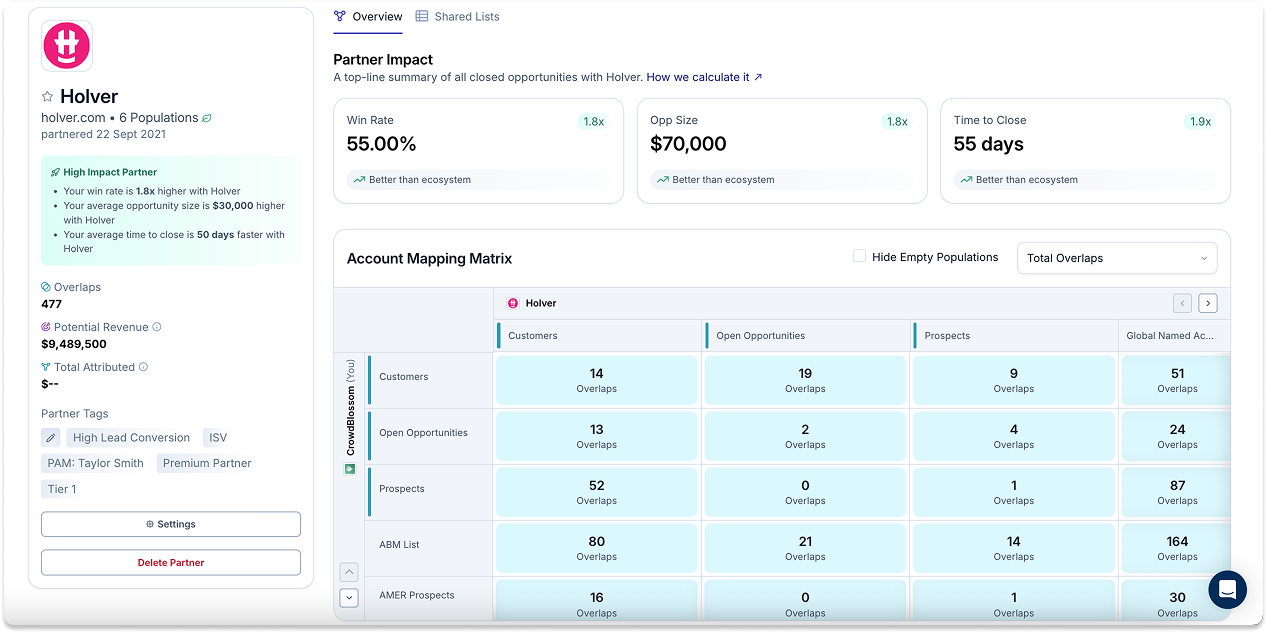
“Your reps don’t need months of enablement to start co-selling. With Crossbeam data, you can activate accounts in under a week,” said Alex. “Just decide what you’re optimizing for — net-new, expansion, or retention — and point your team to the right Ecosystem Intelligence.”
Additionally to the number of overlaps, there are other insights (Ecosystem Intelligence) that could be valuable for your team:
- An open opportunity overlaps with a partner’s customer
- A target account already uses two of your integration partners
- A deal in-flight could be influenced by a partner with executive alignment
In each case, the “silver platter” is not just raw data — it’s an account-specific plan. And just as important is where these plans and insights surface. Sellers won’t log into more tools; they want to work inside their CRM, check Slack, or use Crossbeam’s Copilot Chrome extension. The real value comes from showing actionable Ecosystem Intelligence directly in the tools they already use every day.
Alex recommends assigning ownership to an operations or value consulting function that does the monitoring, validates the overlap, and presents sellers with ready-to-go actions, such as:
- Book a meeting with the right prospects by narrowing your ICP. Check out BEMO’s story to see how they boosted meetings booked by 900%.
- Use a partner joint value proposition to capture the attention of open opportunities. Learn how Aircall leveraged the HubSpot ecosystem to achieve 20% higher MRR per opportunity.
- Send a pre-drafted email enriched with Ecosystem Intelligence, such as the tech stack your prospect is already using. See how Crossbeam leverages Ecosystem Intelligence to craft these emails.
- Ask for an intro to break into a new market, reach high-level decision makers, connect with high-value leads, build trust with skeptical prospects, or re-engage stalled opportunities. Use these proven intro templates to get started.
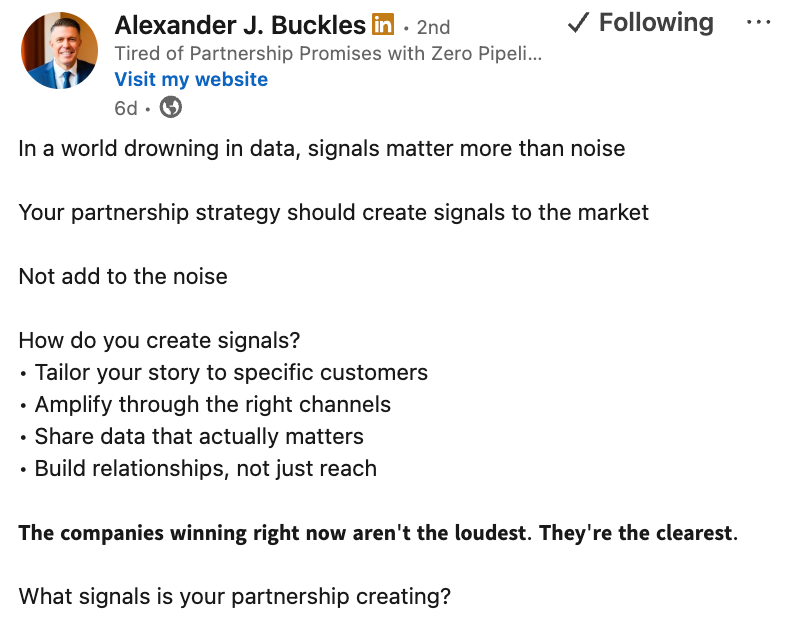
“It’s daily monitoring and actioning,” Alex explained. “Most of your reps aren’t going to figure it out, not because they’re incapable, but it’s not a good use of their time, given other day-to-day closing responsibilities They should just be told: here’s the scenario, here are the talking points, and here’s the partner who can help push the needle forward. Team up with your ops team and serve Ecosystem Intelligence up on a silver platter.”
Quick wins over perfect programs
There’s one common mistake partnership teams make, and is trying to build a perfect partner infrastructure before proving value.
“Most partner pros spend six to twelve months building infrastructure, PRMs, dashboards, reports, before they ever show sales a win. That’s backwards,” Alex said.
Instead, he recommends starting small:
For sales reps, seeing one deal move faster or bigger because of a partner is enough to shift their mindset. Once they’ve experienced the difference, they’ll want more.
“It’s not hard to get that first win,” Alex emphasized. “If you can’t get it, you’re not trying hard enough. Show a rep how to use partner insights on one of their top five accounts, and you’ll change the way they work forever.”
Accountability over activity
One of the strongest challenges partnership teams face is the lack of accountability in their programs.
“Most partner programs lack accountability. Rescheduled meetings, kicking the can down the road, and no sense of urgency to deliver outcomes. Sales reps can’t operate like that, they have quotas. They need wins. Partnerships need that same accountability and sales rigor.”
Alex addresses this by treating every partner like a buying committee. Each partnership gets a partner success plan (modeled after mutual action plans in enterprise sales) that defines who is responsible for what actions, with clear timelines.
“If a partnership can’t show pipeline in 60 days or less, something’s wrong,” Alex said. “People will tell you partnerships take a year to show results. I can prove that’s false. With a strong value story, you should have pipeline inside 60 days.”
If you want to make your partnerships team accountable, you need to fit your strategy into the three buckets of impact:
- Net-New: breaking into target accounts with partner insight or introductions.
- Expansion: driving bigger deal sizes by weaving in partner stories.
- Retention: using ecosystem alignment to make customers stickier.
“Partnerships aren’t just a cost center,” Alex said. “When you tie them to these outcomes, suddenly CFOs and CROs start paying attention.”
From theory to execution
So, what does it take for a sales leader to move from theory to execution? Alex says it comes down to commitment and focus:
“Sales leaders don’t want new training programs or long partner enablement sessions. They’ve been disappointed by partnerships too many times before. What they need is a commitment to test small plays that can actually show results.”
Alex starts by working with reps on their top five accounts.
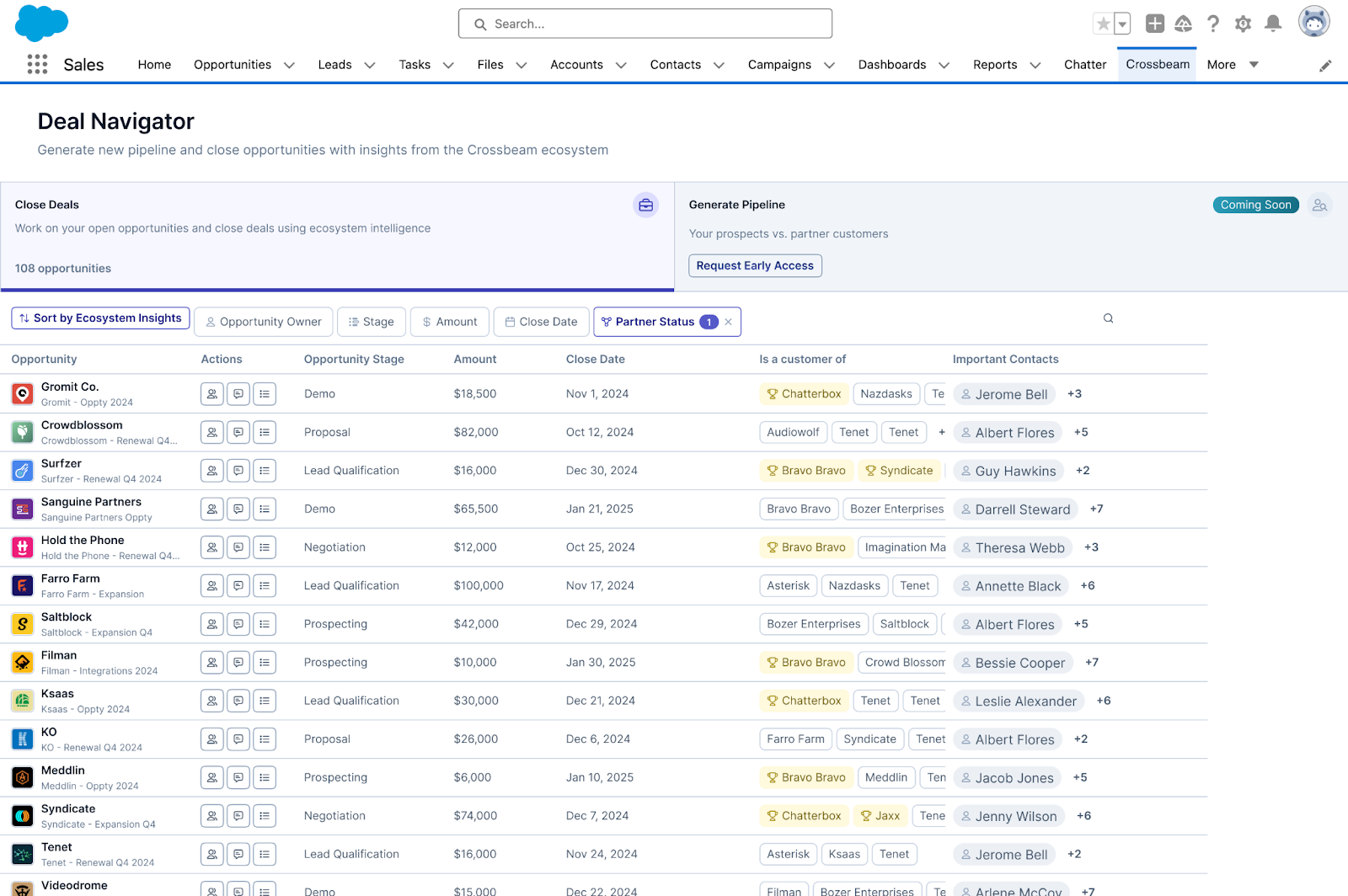
Together, they identify specific partners, plan co-sell motions, and execute them in real time. Within weeks, reps can feel the difference in their cycles.
“When reps feel how much easier it is to break into accounts this way, they’ll never want to go back to cold calling,” Alex said. “It’s eye-opening.”
According to Alex, training should take place as a team, this means joining pipeline reviews and walking reps through how to use partner data on real accounts. “It’s on-the-job training,” Alex explained. “We’ll sit down and say, okay, today we’re focusing on Coca-Cola. Who do we know? What overlaps do we see? What’s the best path in? And reps realize: I don’t have to cold call that stakeholder,I can get an intro from a partner who already has a relationship.”
Once your motion is in place, make sure you ask for feedback:
- Since Partner “A” got involved, how would you rate the impact—1 to 10?
- Has it accelerated the deal, increased your win rate, or both?
That’s how theory becomes execution and how partnerships become a respected and repeatable revenue driver.
Story first, signals second
Finally, Alex stressed that while partner signals matter, they only create value when turned into compelling stories.
“Signals are important, but they’re just inputs. What wins deals is the story,” said Alex. “When you go to a buyer with a believable value story about the outcomes you can deliver, price becomes irrelevant. Cycles get faster. Deals get bigger. You beat the competition.”
At Forecastable, that means doing the math with clients:
- How many partner reps can be activated?
- How many deals they can influence?
- How can signals translate into in revenue?
For example, you sit with a CFO and activate six frontline teams from your partners. Let’s say that’s 48 reps. If 25% engage, that’s 12 active reps feeding you deals. Based on their average quarterly output and ACV, that’s X pipeline.
And suddenly, a $90,000 investment in a couple of tools to implement your partner program doesn’t feel expensive, it feels like an achievable path to $2.6 million in revenue.
That’s the kind of math and the kind of story that turns partnerships into numbers.
The bottom line
Partnerships don’t have to be noise. With intentionality, accountability, and a focus on quick wins, they can become one of the most effective levers for accelerating revenue.
Or as Alex put it, “Show me one rep, one partner, and one account. We’ll win it, and then watch how fast the rest of the team wants in.”
Ready to move from theory to execution? Book a meeting with our team and learn how Forecastable and Crossbeam can help turn your partnerships into real, measurable pipeline.


