{  "@context": "https://schema.org",  "@graph": [    {      "@type": "Article",      "headline": "Top Tools for CRM Enrichment",      "description": "CRM enrichment tools fill in missing account and contact data automatically. Here's a breakdown of the five main categories, the tools worth evaluating in each, and how to connect them into one clean CRM record.",      "keywords": "crm enrichment, CRM enrichment tools, CRM data enrichment software, contact enrichment tools",      "author": { "@type": "Organization", "name": "Crossbeam" },      "publisher": {        "@type": "Organization",        "name": "Crossbeam",        "logo": { "@type": "ImageObject", "url": "https://cdn.jsdelivr.net/gh/taiesha-crossbeam/crossbeam-web-assets@main/img/logo-white.svg" }      },      "mainEntityOfPage": { "@type": "WebPage", "@id": "PLACEHOLDER: replace with live URL once this article is published" }    },    {      "@type": "FAQPage",      "mainEntity": [        {          "@type": "Question",          "name": "How is ecosystem enrichment different from firmographic or intent data?",          "acceptedAnswer": {            "@type": "Answer",            "text": "Ecosystem enrichment comes from a direct, consented relationship with your own partners, rather than being inferred or aggregated from third-party sources, which makes it more reliable and unique to your business."          }        },        {          "@type": "Question",          "name": "Should CRM enrichment run automatically or on demand?",          "acceptedAnswer": {            "@type": "Answer",            "text": "Automatically, whenever possible. Manual, on-demand enrichment tends to fall behind as new records enter the CRM faster than anyone remembers to enrich them."          }        },        {          "@type": "Question",          "name": "Is it worth paying for multiple enrichment tools across categories?",          "acceptedAnswer": {            "@type": "Answer",            "text": "Often yes, since no single provider covers firmographic, contact, technographic, and ecosystem data equally well. Most mature RevOps stacks combine two or three specialized tools."          }        }      ]    }  ]}

How Sendoso Empowers its Sales Team to Close Deals 28 Days Faster
Nearbound Daily #497: Use These Questions To Uncover Nearbound Marketing Opportunities
Nearbound Daily #496: Avoid 2 Common Buy-In Pitfalls
An open letter to partnerships, from sales
How a Sales Leader and a Head of Partnerships Get Buy-in and Drive Results Across Netskope’s Revenue Org
An Outside-In GoToMarket = GoToEco
Nearbound Daily #495: How To Take Ecosystem Partners Out of A Channel Hole
Howdy Partners #64 - Unlocking Success in Channel Partnerships - Rob Sale
Friends with Benefits #28 - Creating the Life You Want: Morgan J. Ingram's Guide to Breaking Through the Noise
Nearbound Daily #494: How to Bridge the Gap With Your Sellers
Nearbound Daily #493: Step-By-Step Guide to Winning Budget for Partner Tech
Barbara Treviño: Empower Your Go-To-Market Teams With Partner Data | Supernode 2022
Nearbound Weekend 01/06: 3 Trends I'm Watching in 2024
Nearbound Daily #488: Your 2024 Guide to Nearbound Marketing
Nearbound Podcast #146 - From the Vault: Navigating the Partner Ecosystem - Norma Watenpaugh
Nearbound Daily #487: Complete Guide to Nearbound Product in 2024
Nearbound Daily #486: Nearbound GTM — Everything You Need To Know For 2024
Nearbound Weekend 12/30: Partner Pros are Sculpting History
Nearbound Daily #485: How Zapier Scales Partner Success
Howdy Partners #63 - Unveiling the playbook for GTM success - Matt Dornfeld
Nearbound Daily #484: Enhance Your 2024 Events Strategy
5 Ways to Align Customer Success Teams with Your ELG Strategy
Nearbound Podcast #145 - From the Vault:The Art of Channel Partnerships with Bobby Napiltonia
Building in an Ecosystem: Why Hapily is Shipping Products Entirely on HubSpot by Scott Brinker and Connor Jeffers
Nearbound Daily #481: 'Twas the Night Before a Partner Deal
Nearbound Weekend 12/23: It's a wonderful partner pro life
Howdy Partners #62 - The Nearbound Playbook: Proven Strategies for Success - Will Taylor & Isaac Morehouse
Friends with Benefits #27 - Building Trust and Adding Value in Partnership Programs - Bryan Williams
The nearbound email template hub
Nearbound Podcast #144 - The rise of the chief partner officer - Asher Mathew
Nearbound #477: Don't Get Blinded By The Shine 😵
Nearbound Daily #476: How to Find the Right Rumble 👂
Nearbound Weekend 12/16: Do We Have A New Funnel? 🎀
Nearbound Daily #475: Co-sell, Co-keep, Co-grow
Howdy Partners #61: How Partnerships Can Drive Customer Advocacy - Will Taylor
How to Measure Partnerships ROI
Nearbound Daily #474: Nearbound, Allbound, Glory-bound 🙌
Friends with Benefits #25 - Building Exceptional Relationships - Matt Quirie
Brandon Balan and McKenzie Jerman: We replaced our mid-market sales with Ecosystem-Led Growth. This is what happened. | Supernode 2023
Nearbound Podcast #143 - Cracking the Nearbound Code: Secrets to Successful Nearbound Plays - Isaac Morehouse and Will Taylor
Nearbound Daily #471: Uncover Your Shadow Partner Program
Nearbound Weekend 12/09: Fruit Ninja Influencer Drives 600k in Revenue
The Future of Revenue: What You Need to Know
Nearbound Daily #470: Yes, It Really Is That Easy
Nearbound Daily #469: No BS Guide to Revenue 💰
Nearbound Daily #468: Some triggering advice from Jason Lemkin 🤐
Key takeaways: The 2023 state of partner-led growth report
Nearbound Podcast #142 - The Kobe Bryant Approach to Partnerships: A Conversation with Rohan Batra
Nearbound Daily #467: Overcome partnerships negativity
Nearbound Daily #466: Ecosystem revenue times infinite 💰
Nearbound Weekend 12/02: Nearbound synergy 👩‍🔬
Howdy Partners #59: The Secret to Building a Successful Partnership Strategy - Katie Landaal
Friends with Benefits #23: The Power of Storytelling - Priya Sam
Nearbound Podcast #141 - Unleashing the Nearbound Mindset - Jared Fuller
Getting to "All In": Achieving Cross-Functional Buy-In for Your Ecosystem Strategy and Plan
Nearbound Podcast #140- - Revenue Over Relationships: How to Make Money in Every Partnership - Rasheité Calhoun
With ELG, Your Sales Team Needs Fewer Opportunities to Hit Quota
The Future of Revenue 2023
Nearbound Daily #454: Why your GTM determines co-sell strategy 💪
Nearbound Daily #453: TrustRadius on how buyers think and purchase 💰
Cold Outbound Isn’t Dead. Here’s What Sales Leaders Say are the Most Cost-Effective Sales Strategies in 2023
Nearbound Weekend 11/11: Good language produces results
Friends with Benefits #21: A Masterclass in Purposeful Networking - Scott Leese
Session two. Why Sales Teams Need Nearbound by Bobby Napiltonia and Jared Fuller
Session twelve. Phone a Friend: How Nearbound Social Warms Up Cold Calls by Daisy Chung, Avi Mesh, and Adam Sockel
Session three. When the Buzzword Meets the Road: Does Co-Selling Have to be So Hard? by Sam Yarborough, Stephanie Pennell, Xiaofei Zhang, and Rasheité Calhoun
Session thirteen. Beyond the Data: Henry Schuck’s Journey from Bootstrapped to Billions by Henry Schuck and Simon Bouchez
Session ten. Public Ecosystems and Private Ecosystems by Harbinder Khera, Theresa Caragol, and Kevin Linehan
Session six. Level Up Your 2024 Results: The Big Partner Bet by Judd Borakove
Session seven. Go To Network & The 3 Nearbound Sales Plays by Scott Leese
Session one. The Challenge for CROs Thinking Nearbound by Mark Roberge and Jill Rowley
Session nine. The Antidote to More: How Nearbound Rewrites the Better Together Story by Latané Conant
Session fourteen. 30 Minutes to President's Club LIVE at the Nearbound Summit by Nick Cegelski and Armand Farrokh
Session four. Operational Rigor in the Nearbound Era by Cindy Zu and Graham Younger
Session five. When Partner Attach Goes Wrong and How to Coach Your Way Out of It by Aaron McGarry and Cory Bray
Session eleven. Turning Your Company’s Network Into Pipeline by Joshua Perk
Session eight. Real Templates You Can Use to Run Nearbound Sales Today by Will Allred and Jared Fuller
Nearbound Daily #448: 👊 A never-before-seen lineup of top marketers
Session two. Nearbound Surround: How to Reach Buyers in the 'Who' Economy by Isaac Morehouse
Session twelve. The 3 Best Event Types for Driving Revenue by Kate Hammitt and Emily Wilkes
Session thirteen. The Future of ABM: How to Elevate Your GTM Strategy with Intent Data & AI by Deeksha Taneja and Yiz Segall
Session ten. How People-First GTM and Nearbound Will Forever Change How You Grow Pipeline and Revenue by Mark Kilens and Nick Bennett
Session seven. Event Led Growth: Partner Events at Scale by Justin Zimmerman
Session one. The End of the Demand Waterfall bySidney Waterfall
Session nine. The Data is In: It's About 'Who' not 'How' by Vinay Bhagat
Session fourteen. LIVE Freestyle Performance by Harry Mack
Session four. People Trust People: How to Drive Pipeline with Personalities by Adam Ryan and Daniel Murray
Session five. How To Scale Revenue Through Pay-For-Performance Partnerships by Michael Cole and Adam Glazer
Session eleven. What is Nearbound Social? by Logan Lyles
Session fifteen. Marketing Against the Grain LIVE at the Nearbound Summit by Kipp Bodnar and Kieran Flanagan
Session eight. Revenue Renaissance: Why Marketing & Partnerships Will Lead Revenue in 2024 by Tyler Calder
Session two. How Our Product Team Is Thinking About Partnerships in 2024 by Simon Bouchez
Session two. Bringing Champions Into Your Nearbound GTM by Jeff Reekers
Session three. Empty Platform Promises: Delivering on 1+1 = 3 by Chris Trudeau and Russell Dwyer
Session seven. An Ecosystem Strategy to Evolve from a Product to a Platform by Kenny Browne and Cody Sunkel
Session one. Unleashing the Power of Partnerships: Driving Product Innovation and Performance by Katie Landaal and Sophie Cheng
Session one. You Work for the Customer: Remembering the 'Why' of Partnerships by Jill Rowley and Jared Fuller
Session four. Partner Led Product Strategy by Bryan Williams and Ben Wright
Session four. How to Attach Partners to Customers so Everyone Wins by Jen Spencer and Rich Gardner
Session eight. Platform Vs. Product: How Product and Partner Teams Can Shape the Future of an Ecosystem by Karen Ng and Kelly Sarabyn
Ecosystem Operations and Alignment

Top Tools for CRM Enrichment

by
Andrea Vallejo
SHARE THIS

CRM enrichment tools fill in missing account and contact data automatically. Here's a breakdown of the five main categories, the tools worth evaluating in each, and how to connect them into one clean CRM record. 

by
Andrea Vallejo
SHARE THIS

In this article

Join the movement

Subscribe to ELG Insider to get the latest content delivered to your inbox weekly.

A CRM is only as useful as the data inside it, and most CRMs have gaps: missing job titles, outdated firmographic details, and blank fields where key account information should be. CRM enrichment tools close those gaps automatically, without requiring a manual research project every time a new lead comes in.

Here's a breakdown of the main categories of CRM enrichment tools, what each one is good for, and what to look for when choosing one.

What to look for in a CRM enrichment tool

Before comparing categories, a few things matter regardless of which type of enrichment you're prioritizing:

  • Native CRM integration. Enrichment that requires manual export and import defeats the purpose. Look for tools that write directly into Salesforce, HubSpot, or whichever CRM your team lives in.
  • Automatic. The best tools enrich records as they enter the CRM, and re-enrich periodically as data changes, rather than requiring manual triggers.
  • Data reliability over data volume. A tool that fills every field with low-confidence guesses doesn’t solve the problem. Verified, sourced data matters more than raw completeness.
  • Field-level control. Teams need to choose which fields get enriched and from which sources, rather than accepting a one-size-fits-all overwrite of existing data.

What are the main categories of CRM enrichment tools

CRM enrichment breaks down into five categories, each closing a different kind of gap in the data. Here's what each one covers and which tools are worth evaluating.

Firmographic enrichment tools

These tools fill in company-level details: industry, employee count, revenue, headquarters, and similar attributes. 

This is the most commonly used category of CRM enrichment and the easiest to evaluate, since the data is relatively standardized across providers. The main differentiator between providers is coverage and update frequency, since firmographic details like employee count and revenue change more often than most CRMs reflect. 

Some platforms you can use to obtain firmographic data are ZoomInfo, Clearbit (now folded into HubSpot's Breeze Intelligence), Crunchbase, and Trace are common names in this category.
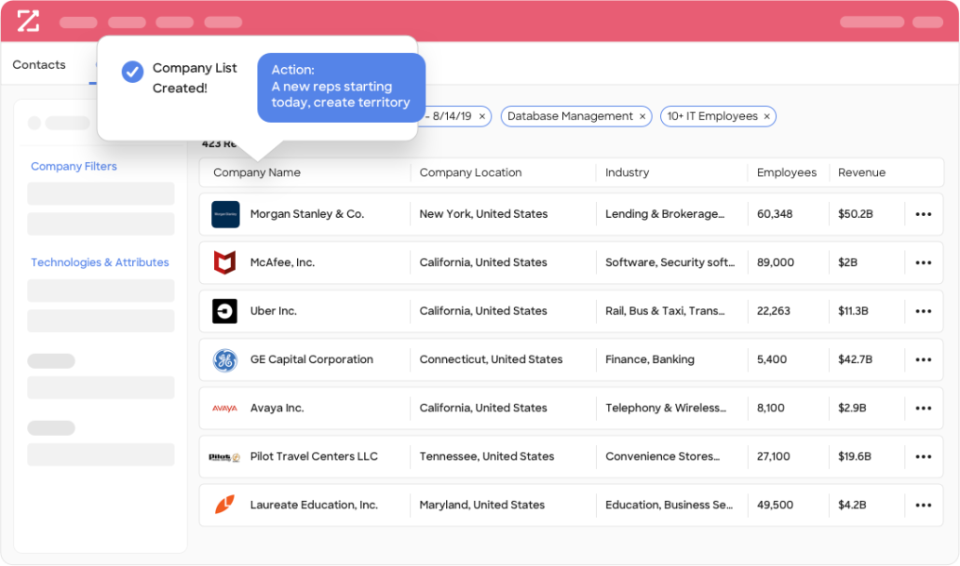
ZoomInfo’s platform. 

Contact enrichment tools

These focus on the people, not the company: job titles, seniority, direct emails, and verified contact details. 

Accuracy matters more here than in almost any other category, since an outdated title or a bounced email actively wastes a rep's time rather than just leaving a gap. Look for providers with strong verification processes (not only large databases). 

ZoomInfo, Apollo, and Cognism are frequently used for this layer.
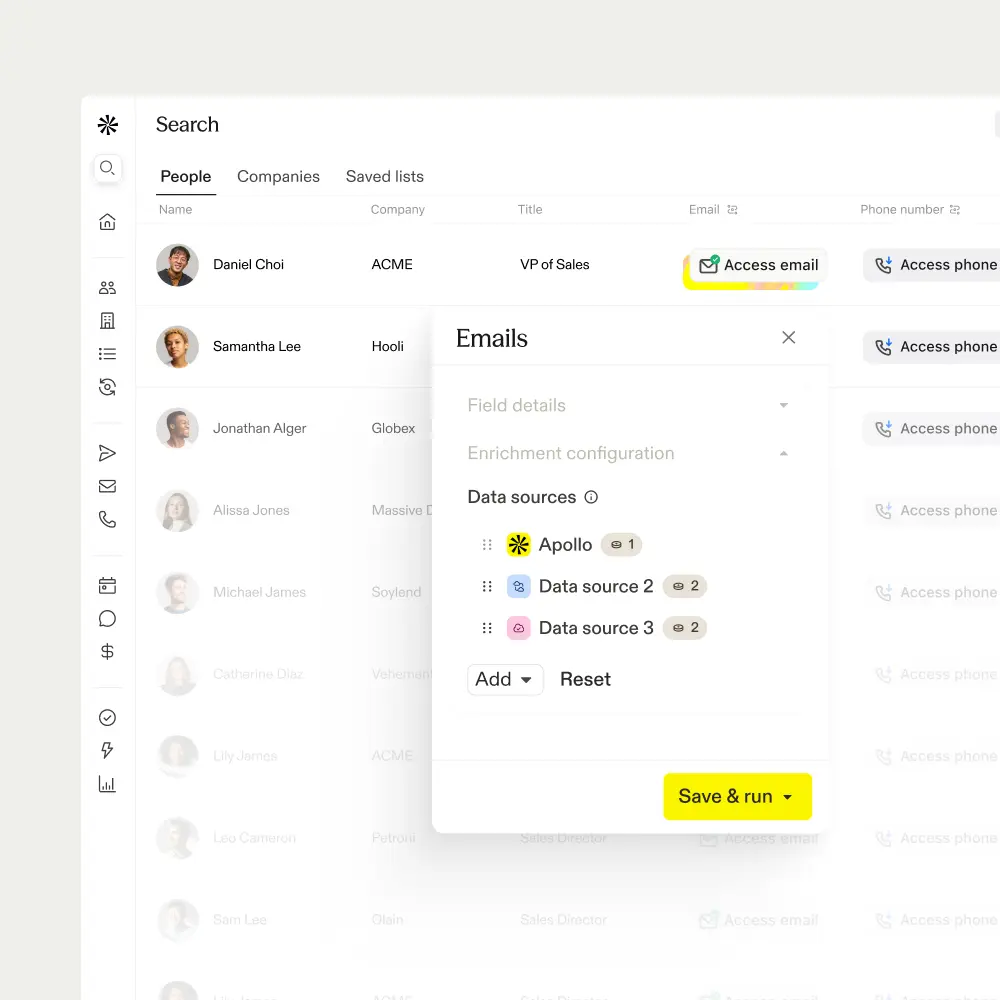
Apollo’s platform. 

Technographic enrichment tools

These identify what tools and platforms a target account already uses, useful for spotting integration opportunities or competitive displacement plays. 

Coverage varies significantly by category and vendor, so it's worth checking whether a given tool has strong visibility into the specific tech stack layer relevant to your product. 

Trace is one example: it detects a company's live tech stack alongside its partner ecosystem and hiring signals, so a technographic read comes with ecosystem context attached rather than as an isolated data point.
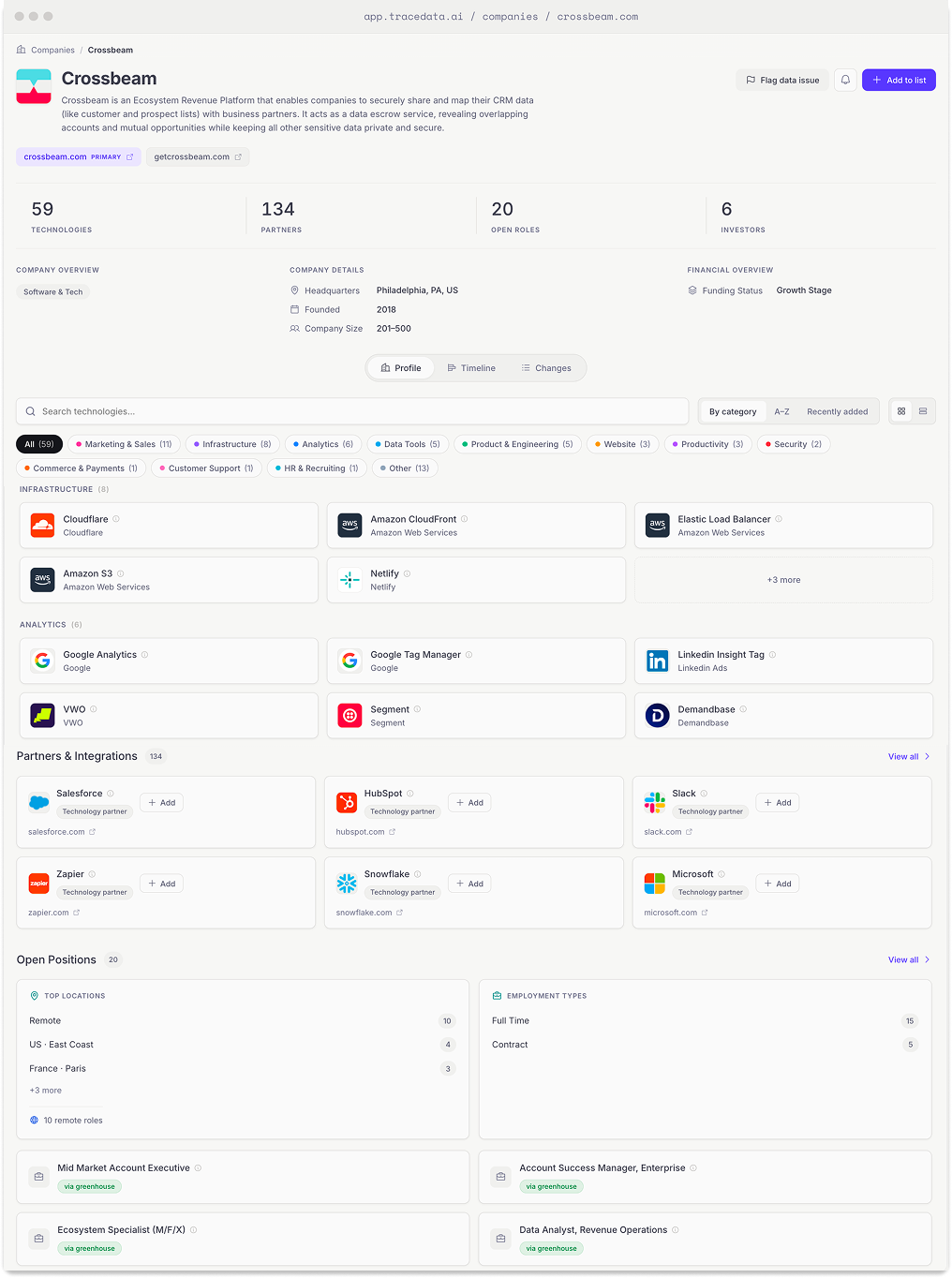
Trace’s platform.

Intent data tools

These surface signals that a company may be actively researching a solution in your category, typically inferred from aggregated behavioral data across many websites. 

Intent data can be a useful directional signal, but it's inferred rather than confirmed, and it's sold to every company that buys the same dataset, so it shouldn't be treated as a differentiated advantage on its own. 

Bombora and 6sense are the two names most teams evaluate, Bombora as a raw topic-surge signal that feeds into other tools, and 6sense as a fuller platform that wraps intent into account scoring and orchestration.
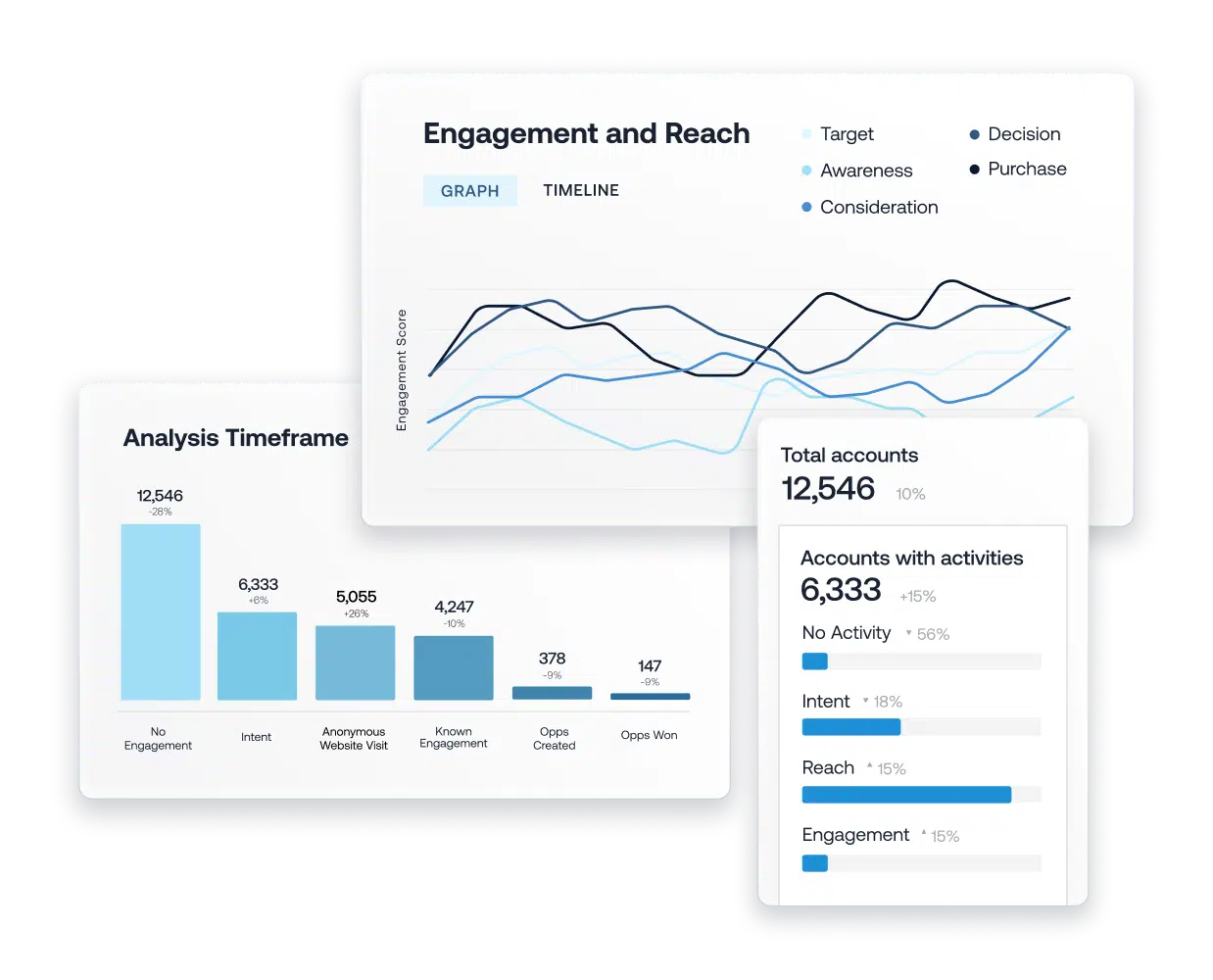
Examples of intent data provided by 6sense.

Ecosystem enrichment tools

This is the category most CRM enrichment strategies overlook entirely: enrichment based on your own partner ecosystem. Instead of only purchasing firmographic or intent data, ecosystem enrichment tells you whether a target account already has a relationship with one of your partners, and what that relationship looks like.

This is fundamentally different from every other category on this list, because it's not inferred or purchased from a broker. It comes from a real, verified relationship, which makes it both more reliable and impossible for a competitor to simply buy the same dataset and match it. That distinction is worth understanding on its own terms. 

Crossbeam sits in this category. It gives your agents second-party data: live data about accounts, contacts, and relationships direct from your partners' CRMs. Instead of your team hunting for overlap manually, Crossbeam surfaces which target accounts already overlap with a trusted partner, and puts that signal wherever you and your agents work, in the CRM and now via MCP.
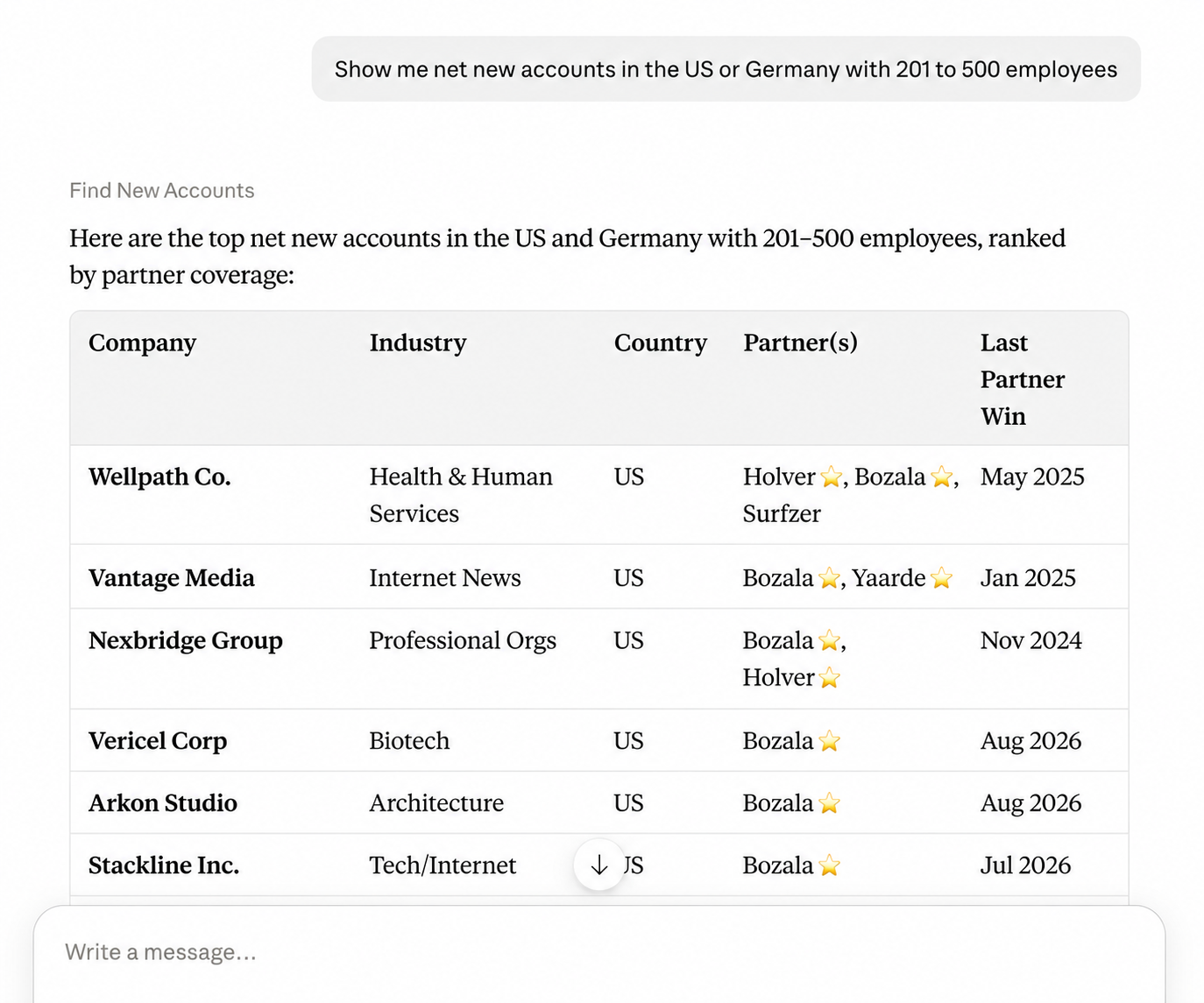
Example of a prompt you can use to surface net new accounts with Crossbeam’s MCP. 

How to combine categories effectively

These categories aren't interchangeable. They each answer a different question, and skipping one leaves a blind spot the others can't cover:

  • Firmographic and technographic: Is this account worth pursuing at all?
  • Contact: Who do I actually reach out to? (This one decays fastest, so it needs the most upkeep.)
  • Intent: Is now a reasonable time? Weak on its own, useful as a tiebreaker.
  • Ecosystem: is there an advantage here no one else has? 

The harder part is usually plumbing, not picking tools. Stacking four or five enrichment categories means either building a native integration for each one or finding a layer that connects them for you.

Clay is the tool most RevOps teams reach for here. It works as a waterfall across 100+ data providers, so instead of maintaining separate integrations for a firmographic tool, a contact tool, and an intent tool, Clay tries each source in sequence until a field is filled, then writes the finished record to the CRM. It already connects to Crossbeam too, which means partner overlap data can flow into the same enrichment workflow as everything else, rather than living in a separate report someone checks manually.

For teams with a data warehouse already in place, routing enrichment through something like Snowflake before it hits the CRM is worth considering, especially once more than a couple of sources are in play. Landing every provider's output in one place first makes it easier to de-duplicate conflicting fields, decide which source wins when two providers disagree, and only push the resolved record downstream, instead of letting each tool write to the CRM independently and fight over the same fields.

For Salesforce users, another path is opening up: Crossbeam is now listed in Salesforce's "AI agents and tools" category on AgentExchange, announced at Dreamforce 2026, giving Salesforce agents a direct line to live partner CRM data for every account.

See what your partner ecosystem could add to your CRM. Register free to enrich your accounts with second-party data your competitors can't access.

Frequently asked questions

How is ecosystem enrichment different from firmographic or intent data?

Ecosystem enrichment comes from a direct, consented relationship with your own partners, rather than being inferred or aggregated from third-party sources, which makes it more reliable and unique to your business.

Should CRM enrichment run automatically or on demand?

Automatically, whenever possible. Manual, on-demand enrichment tends to fall behind as new records enter the CRM faster than anyone remembers to enrich them.

Is it worth paying for multiple enrichment tools across categories?

Often yes, since no single provider covers firmographic, contact, technographic, and ecosystem data equally well. Most mature RevOps stacks combine two or three specialized tools.


You’ll also be interested in these

First-Party vs. Second-Party vs. Third-Party Data: What's the Difference?
What Is Second-Party Data (and Why It Matters for GTM)?
The 2026 Complete Guide to Account Mapping