{  "@context": "https://schema.org",  "@graph": [    {      "@type": "Article",      "headline": "Top Tools for CRM Enrichment",      "description": "CRM enrichment tools fill in missing account and contact data automatically. Here's a breakdown of the five main categories, the tools worth evaluating in each, and how to connect them into one clean CRM record.",      "keywords": "crm enrichment, CRM enrichment tools, CRM data enrichment software, contact enrichment tools",      "author": { "@type": "Organization", "name": "Crossbeam" },      "publisher": {        "@type": "Organization",        "name": "Crossbeam",        "logo": { "@type": "ImageObject", "url": "https://cdn.jsdelivr.net/gh/taiesha-crossbeam/crossbeam-web-assets@main/img/logo-white.svg" }      },      "mainEntityOfPage": { "@type": "WebPage", "@id": "PLACEHOLDER: replace with live URL once this article is published" }    },    {      "@type": "FAQPage",      "mainEntity": [        {          "@type": "Question",          "name": "How is ecosystem enrichment different from firmographic or intent data?",          "acceptedAnswer": {            "@type": "Answer",            "text": "Ecosystem enrichment comes from a direct, consented relationship with your own partners, rather than being inferred or aggregated from third-party sources, which makes it more reliable and unique to your business."          }        },        {          "@type": "Question",          "name": "Should CRM enrichment run automatically or on demand?",          "acceptedAnswer": {            "@type": "Answer",            "text": "Automatically, whenever possible. Manual, on-demand enrichment tends to fall behind as new records enter the CRM faster than anyone remembers to enrich them."          }        },        {          "@type": "Question",          "name": "Is it worth paying for multiple enrichment tools across categories?",          "acceptedAnswer": {            "@type": "Answer",            "text": "Often yes, since no single provider covers firmographic, contact, technographic, and ecosystem data equally well. Most mature RevOps stacks combine two or three specialized tools."          }        }      ]    }  ]}

Building Successful Partnerships with Phil McKennan from Qualtrics
Chapter 2: Nearbound Defined
Session two. GTM Unplugged: 5 Easy-to-Use Frameworks That Make GTM Simple by Sangram Vajre and Lindsay Cordell
Session twelve. The Top 10 Biggest Mistakes I See Revenue Leaders Making in 2023/2024 by Jason Lemkin
Session three. Alliances: Becoming a Number 1 App Partner as a Startup by Mike Stocker, Marc Ginsberg, and Madelyn Wing
Session ten. Play Bigger with Nearbound: A Conversation with the Best Selling Author of "Play Bigger" by Kevin Maney and Isaac Morehouse
Session six. Venture Capital Through the Nearbound Lens by Justin Gray, Josh Wagner, and Sean kester
Session nine. Collaborative Growth: Building a Fast-Growth, High Margin Business Through Partnerships by Peter Caputa
Session four. Nearbound Starts with You: Why Personal Networks are the Backbone of the 'Who' Economy by Mac Reddin
Session five. Build, Buy, or Partner: How to Navigate Strategic Growth Decisions by Laura Padilla, R.J. Filipski, and Iris Ng
Session eleven. How Far are We into the 'Decade of Ecosystems'? by Jay McBain
Nearbound Daily #445: The Summit keynote breakdown 😎
Howdy Partners #58: Navigating Big-Fish Small-Fish Partnerships - Juraj Pal
Leverage AI to Build Your Partner Program
Download the PartnerHacker Handbook
Don’t Waste Your Prospect’s Time on Discovery. Speed Up the Sales Qualification Process With Partners.
Nearbound Daily #440: All aboard the influence train 🚂
Howdy partners #56: Unleashing partner tech- Greg Portnoy
The Official 2023 ‘Boundie Award Nominees!
You've Got a Friend in Crossbeam: Tips for Finding Your Next Best Partner
The Perfect Storm: The Demise of “Growth At All Cost” & The Rise Of Ecosystem-Led Growth
Roadmap Review: See What's New and Upcoming at Crossbeam
Playbook: How Twilio 8x’d Partner-Sourced Pipeline with a Single Partner
Playbook: How Everflow’s Ecosystem-Led Referral Marketing Wins 37% More Customers in 2023
Capture Every Dollar: Strategies to Optimize Partner-Influenced Revenue
Attn Ex-Salespeople: Here Are Four Ways to Change From a Sales to Partnerships Mindset
Before you build: The Crossbeam guide to launching integrations people want
Nearbound Daily #437: Be a partner-worthy company 👊
Friends with Benefits #20: The Power of Networks and Relationships - Justin Gray
How to Reference Your Prospects' Tech Stacks in Your Outbound Sales Emails
How to Properly Leverage a Rebrand To Expand Your Ecosystem
Nearbound Podcast #133: Navigating Strategic Alliances - Xiaofei Zhang
Howdy Partners #55: Taking an Entrepreneurial Approach to Partnerships - Dorian Kominek
Friends with Benefits #18: Scaling Partnerships - Jill Dignan
The ultimate KPI smackdown: Partner-sourced vs. partner-attached
Nearbound Daily #428: Always factor in the humanity 💞
Nearbound Podcast #132: Making Outbound and Nearbound Work Together - Leslie Venetz
The Future of Revenue Preliminary Findings | Crossbeam x Pavilion
Nearbound Daily #427: Products & platforms in the nearbound era 👨‍💻
The State of Sales
Nearbound Daily #426: The state of startups is grim ☠️
Nearbound Marketing #34: Building Trust in the Age of Data Overload - Dan Sanchez
Nearbound Daily #425: Mathematician or not, nearbound math is easy 🔢
Howdy Partners #52: Building a Program with No Budget or Tools
Nearbound Daily #424: Beyoncé, the platform genius? 🤔
Nearbound Podcast #131: Navigating the Changing SaaS Landscape - Alexandra Zagury
This CRO Uses ELG to Increase ARPU by 23% and Reduce Churn to Nearly Zero
Nearbound Daily #421: Grow better, together 💪
Nearbound Weekend 09/30: How to use nearbound to position your company in market
Nearbound Daily #420: Sangram Vajre on the undeniable shift in GTM
Friends with Benefits #17: Relationships Over Revenue
Nearbound Daily #419: What got you here won't get you there
Need a Steady Momentum of High-Quality Leads? Look No Further Than Your Partner Ecosystem
Nearbound Daily #418: Study shows trust in influencers has grown
How to Be the Perfect Partner: An Agency Perspective
Nearbound Podcast #130 - Strategy and Evangelism - Jill Rowley
Nearbound Daily #417: This company killed its website
The Nearbound Summit is Near - Four Days You Don't Want to Miss
Nailing your Nearbound Sales Math
The Nearbound Mindset: Part Two
Nearbound Marketing #32: Two Ways to Drive Intros with New Partners - Sam Dunning
Nearbound Daily #415: Microsoft and Facebook +$100M alliance
Nearbound Daily #414: Build a more competitive GTM
Why Every Partnership Leader Should Care About Net Revenue Retention
Nearbound Daily #413: Rand Fishkin and nearbound
Partner Attach: The great debate
Nearbound Podcast #129: Unlocking Sales Success with a Nearbound Mindset - Matt Cameron
Nearbound Daily #411: WARNING this email contains trigger words for partner pros
Nearbound Marketing #31: Three Nearbound Marketing Tactics to Start Using Now
Nearbound Daily #149: AI just killed SEO
Friends with Benefits #16: How to do Dreamforce Right
Welcome to Supernode
Tobin Bennion: How Snowflake Does Customer Centered Partnerships | Supernode 2023
The State of the Partner Ecosystem 2023
Tech Ecosystem Maturity: How to Co-Sell Like a Supernode
The 15+ Questions That Accelerate Co-Selling
Sara Du: How I Built a Partner Program With No Experience | Supernode 2022
Sara Du: How Top Partnership Leaders Get Integrations Built 2x Faster | Supernode 2023
Quick Tips for Crossbeam Account Management and Data Hygiene | Connector Summit 2022
Polina Marinova Pompliano: Taking Risks in Times of Uncertainty | Supernode 2023
Pamela Slim: Build Ecosystems, Not Empires | Supernode 2022
Michelle Geltman: Ways to Shift Your Sales Team’s Mindset | Supernode 2023
How to Forecast and Manage Sourced and Influenced Pipeline in Crossbeam | Connector Summit 2022
Crossbeam explains: How Oyster grew its partner ecosystem and team in one year
Crossbeam Explains: Goodbye Cold Outreach, Hello Ecosystem-Led Sales
Crossbeam and Reveal are Joining Forces to Disrupt Go-To-Market Strategy As We Know It
Braydan Young: How to Get Your C-Suite to Care | Supernode 2023
Bob Moore, Lindsey DeFalco, Adam Michalski, Amanda Groves: Unleashing ELG with Crossbeam: Attribution, Revenue, Education | Supernode 2023
Ben Warshaw: RevOps to the Rescue: The Secret Ingredient to Scaling Your ELG Motion | Supernode 2023
Ask Me Anything with Crossbeam Experts
Andrew Lindsay and Bob Moore: AI, The Market, & How to Thrive | Supernode 2023
Alyshah Walji: It’s Time To Develop An Ecosystem Ideal Customer Profile | Supernode 2022
Allan Adler: Aligning your organization for ecosystem success | Supernode Conference 2022
Allan Adler: Aligning Your Organization for Ecosystem Success | Supernode 2022
Allan Adler, Jill Rowley, Kevin Kriebel: ELG and the C-Suite | Supernode 2023
The 2023 State of the Partner Ecosystem Report
No Opportunities Lost: The Crossbeam Guide to Co-Selling With Tech Partners
How to Buy a Partner Ecosystem Platform
4 Easy Wins: The Crossbeam Guide to Account Mapping
Whale Watching: The Inside Story of the +$100M Microsoft and Facebook Alliance
Ecosystem Operations and Alignment

Top Tools for CRM Enrichment

by
Andrea Vallejo
SHARE THIS

CRM enrichment tools fill in missing account and contact data automatically. Here's a breakdown of the five main categories, the tools worth evaluating in each, and how to connect them into one clean CRM record. 

by
Andrea Vallejo
SHARE THIS

In this article

Join the movement

Subscribe to ELG Insider to get the latest content delivered to your inbox weekly.

A CRM is only as useful as the data inside it, and most CRMs have gaps: missing job titles, outdated firmographic details, and blank fields where key account information should be. CRM enrichment tools close those gaps automatically, without requiring a manual research project every time a new lead comes in.

Here's a breakdown of the main categories of CRM enrichment tools, what each one is good for, and what to look for when choosing one.

What to look for in a CRM enrichment tool

Before comparing categories, a few things matter regardless of which type of enrichment you're prioritizing:

  • Native CRM integration. Enrichment that requires manual export and import defeats the purpose. Look for tools that write directly into Salesforce, HubSpot, or whichever CRM your team lives in.
  • Automatic. The best tools enrich records as they enter the CRM, and re-enrich periodically as data changes, rather than requiring manual triggers.
  • Data reliability over data volume. A tool that fills every field with low-confidence guesses doesn’t solve the problem. Verified, sourced data matters more than raw completeness.
  • Field-level control. Teams need to choose which fields get enriched and from which sources, rather than accepting a one-size-fits-all overwrite of existing data.

What are the main categories of CRM enrichment tools

CRM enrichment breaks down into five categories, each closing a different kind of gap in the data. Here's what each one covers and which tools are worth evaluating.

Firmographic enrichment tools

These tools fill in company-level details: industry, employee count, revenue, headquarters, and similar attributes. 

This is the most commonly used category of CRM enrichment and the easiest to evaluate, since the data is relatively standardized across providers. The main differentiator between providers is coverage and update frequency, since firmographic details like employee count and revenue change more often than most CRMs reflect. 

Some platforms you can use to obtain firmographic data are ZoomInfo, Clearbit (now folded into HubSpot's Breeze Intelligence), Crunchbase, and Trace are common names in this category.
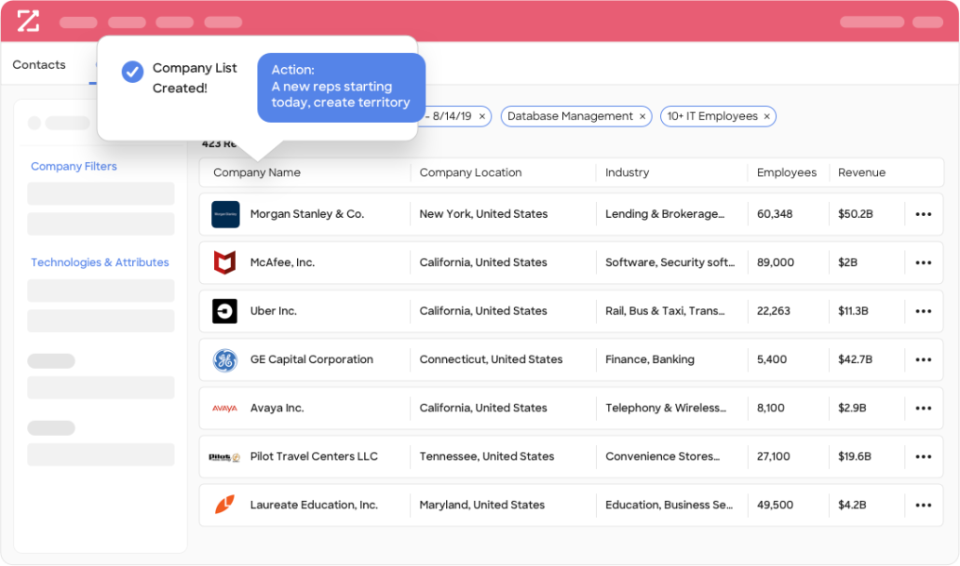
ZoomInfo’s platform. 

Contact enrichment tools

These focus on the people, not the company: job titles, seniority, direct emails, and verified contact details. 

Accuracy matters more here than in almost any other category, since an outdated title or a bounced email actively wastes a rep's time rather than just leaving a gap. Look for providers with strong verification processes (not only large databases). 

ZoomInfo, Apollo, and Cognism are frequently used for this layer.
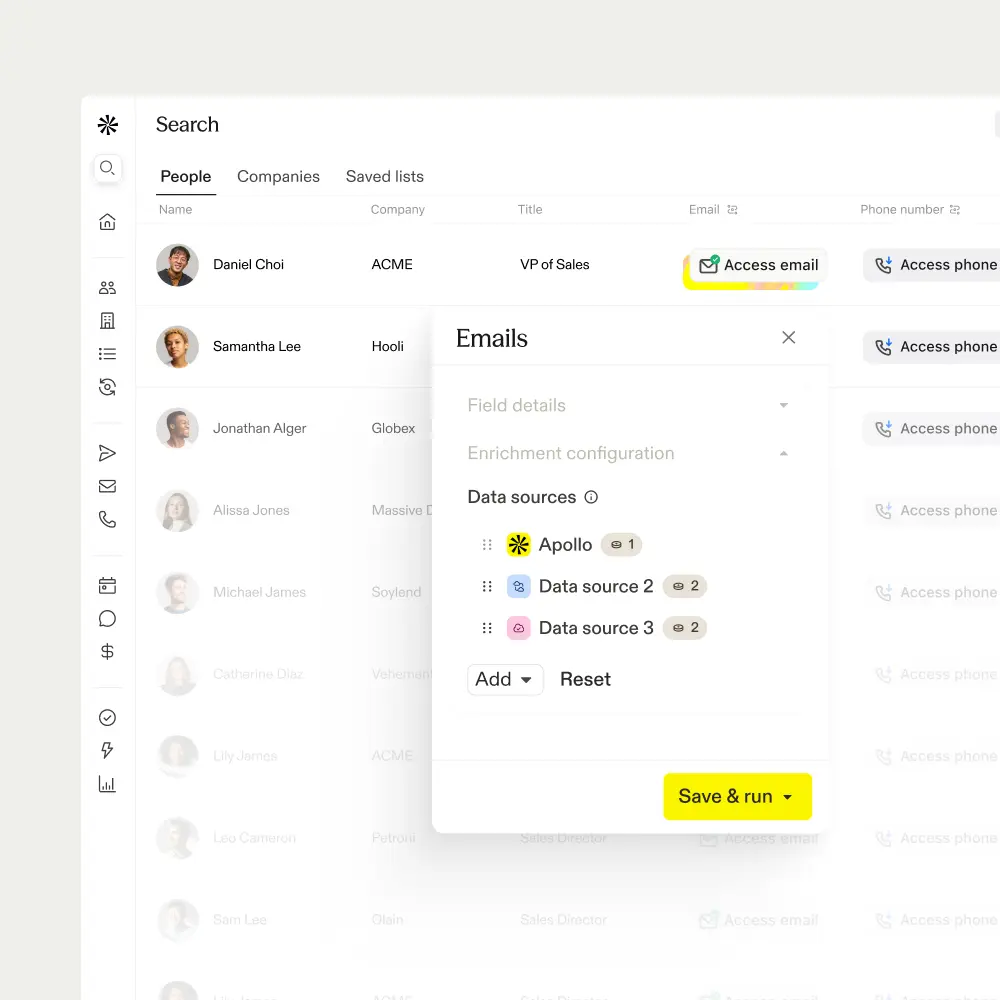
Apollo’s platform. 

Technographic enrichment tools

These identify what tools and platforms a target account already uses, useful for spotting integration opportunities or competitive displacement plays. 

Coverage varies significantly by category and vendor, so it's worth checking whether a given tool has strong visibility into the specific tech stack layer relevant to your product. 

Trace is one example: it detects a company's live tech stack alongside its partner ecosystem and hiring signals, so a technographic read comes with ecosystem context attached rather than as an isolated data point.
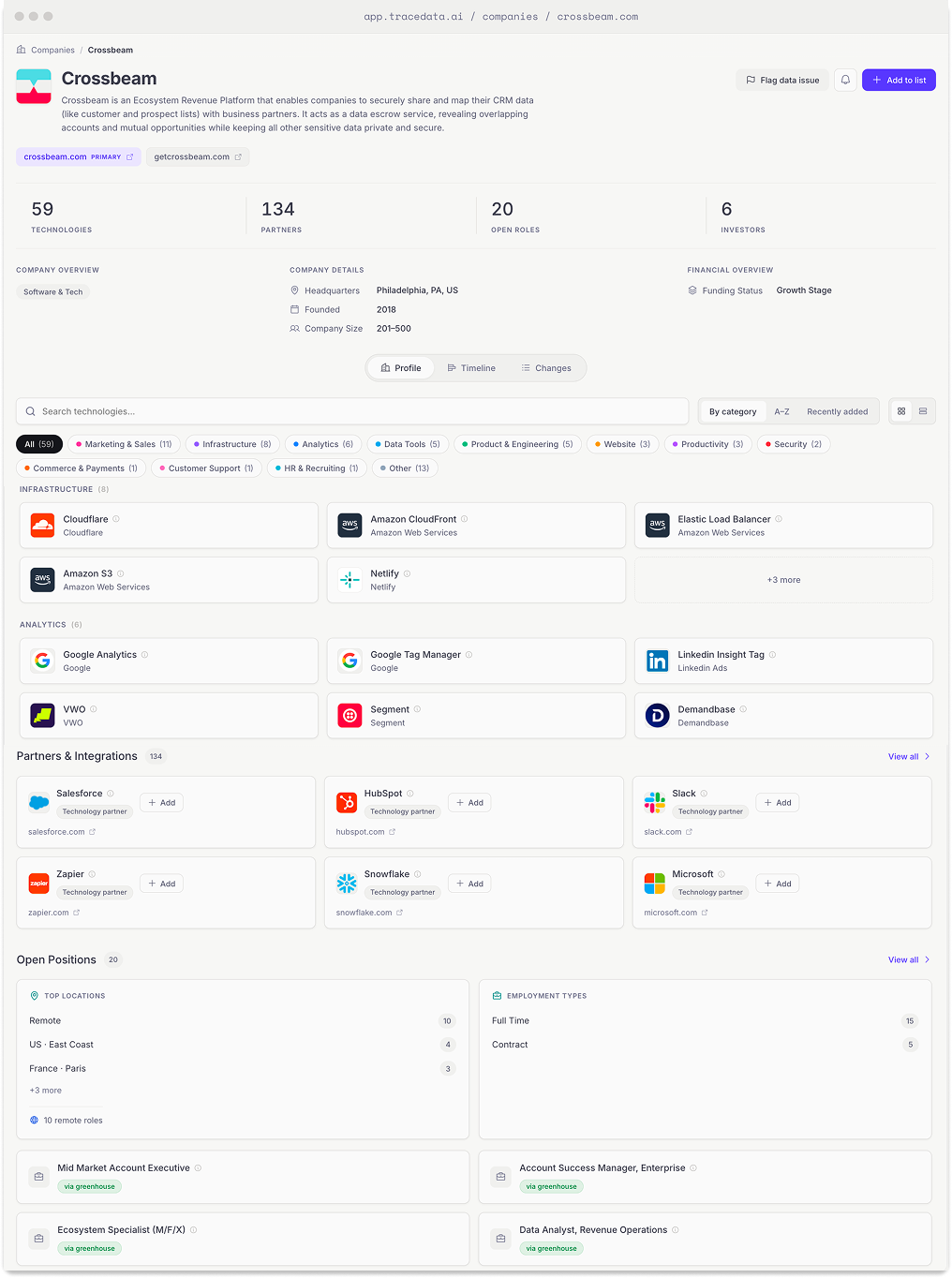
Trace’s platform.

Intent data tools

These surface signals that a company may be actively researching a solution in your category, typically inferred from aggregated behavioral data across many websites. 

Intent data can be a useful directional signal, but it's inferred rather than confirmed, and it's sold to every company that buys the same dataset, so it shouldn't be treated as a differentiated advantage on its own. 

Bombora and 6sense are the two names most teams evaluate, Bombora as a raw topic-surge signal that feeds into other tools, and 6sense as a fuller platform that wraps intent into account scoring and orchestration.
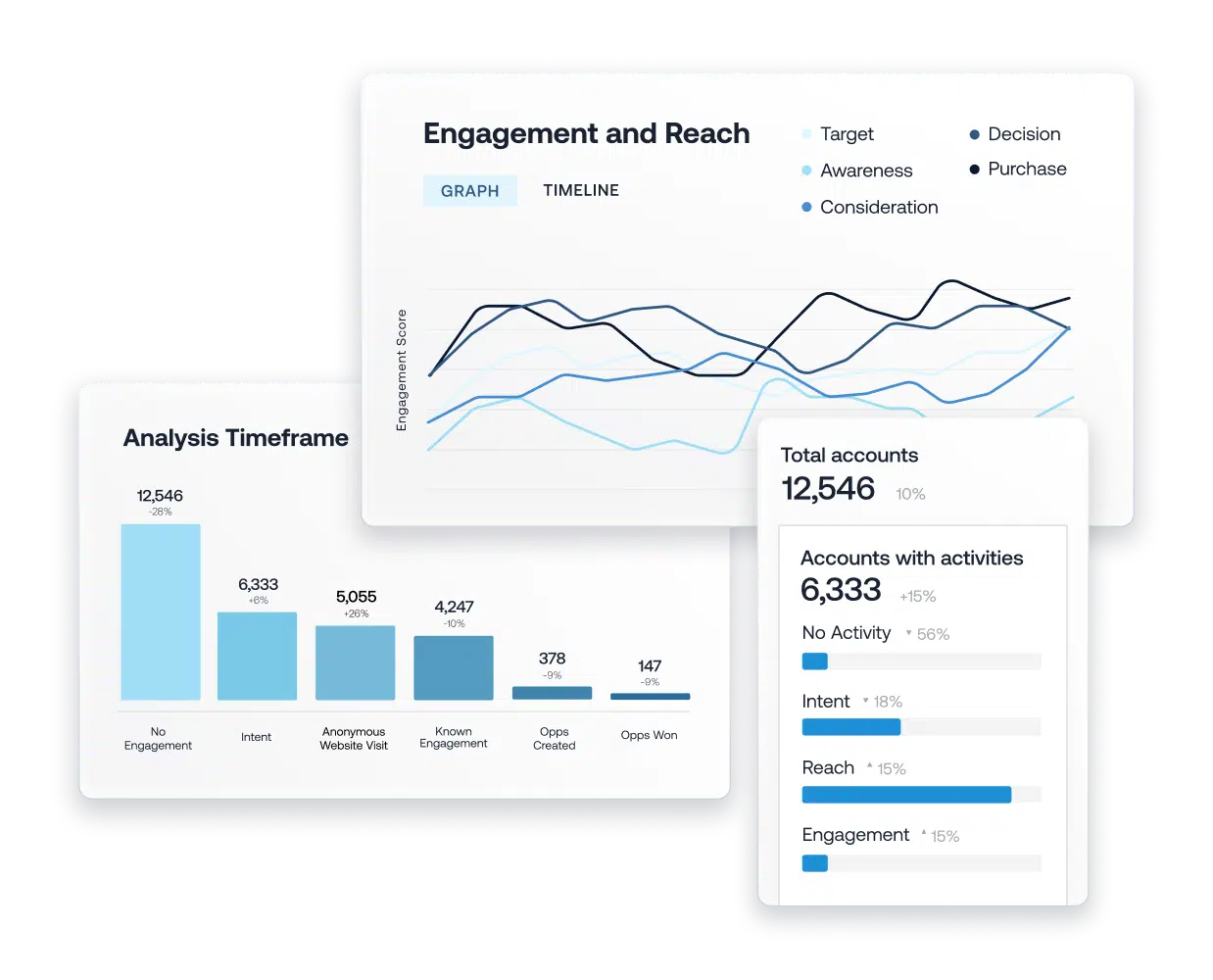
Examples of intent data provided by 6sense.

Ecosystem enrichment tools

This is the category most CRM enrichment strategies overlook entirely: enrichment based on your own partner ecosystem. Instead of only purchasing firmographic or intent data, ecosystem enrichment tells you whether a target account already has a relationship with one of your partners, and what that relationship looks like.

This is fundamentally different from every other category on this list, because it's not inferred or purchased from a broker. It comes from a real, verified relationship, which makes it both more reliable and impossible for a competitor to simply buy the same dataset and match it. That distinction is worth understanding on its own terms. 

Crossbeam sits in this category. It gives your agents second-party data: live data about accounts, contacts, and relationships direct from your partners' CRMs. Instead of your team hunting for overlap manually, Crossbeam surfaces which target accounts already overlap with a trusted partner, and puts that signal wherever you and your agents work, in the CRM and now via MCP.
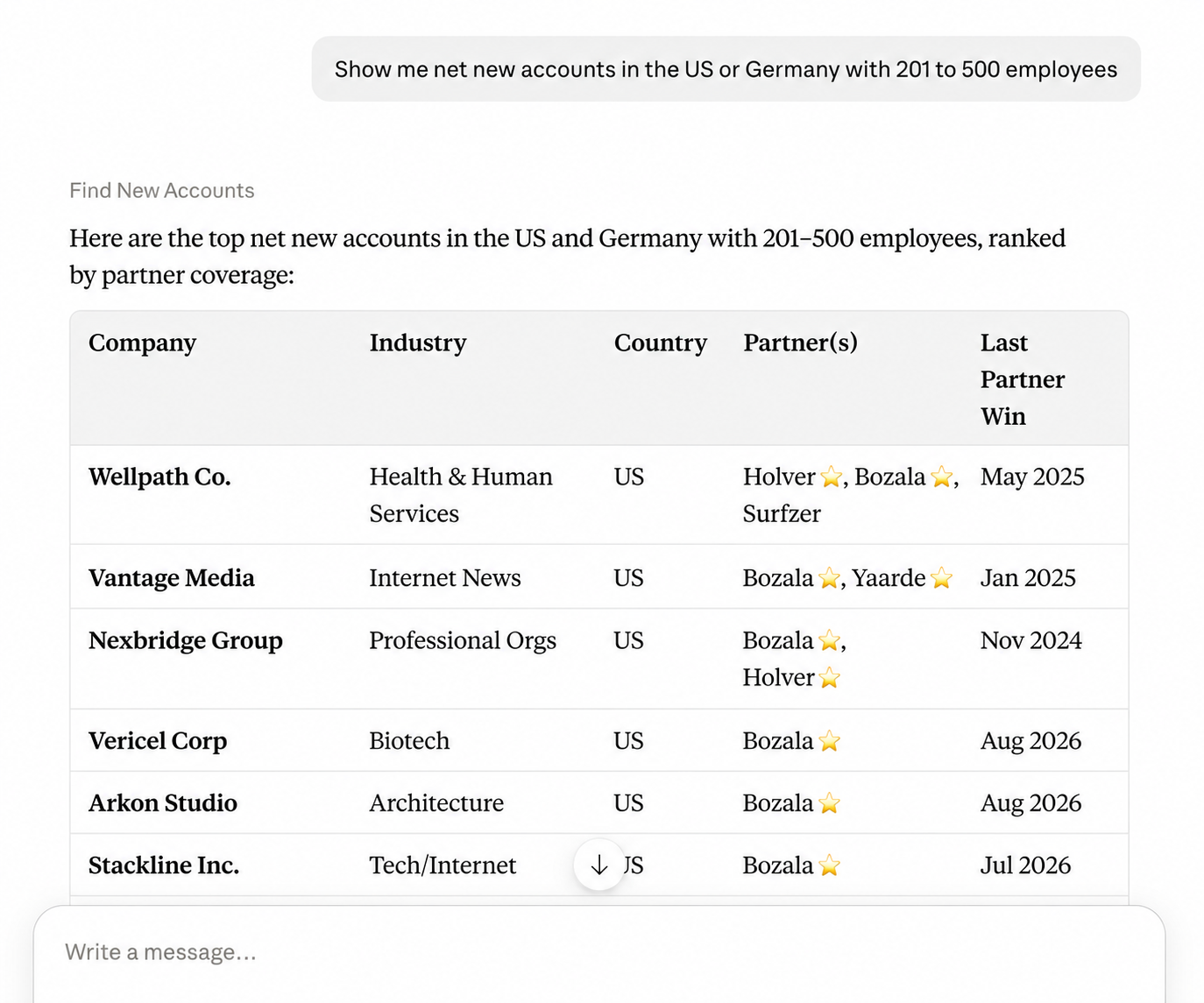
Example of a prompt you can use to surface net new accounts with Crossbeam’s MCP. 

How to combine categories effectively

These categories aren't interchangeable. They each answer a different question, and skipping one leaves a blind spot the others can't cover:

  • Firmographic and technographic: Is this account worth pursuing at all?
  • Contact: Who do I actually reach out to? (This one decays fastest, so it needs the most upkeep.)
  • Intent: Is now a reasonable time? Weak on its own, useful as a tiebreaker.
  • Ecosystem: is there an advantage here no one else has? 

The harder part is usually plumbing, not picking tools. Stacking four or five enrichment categories means either building a native integration for each one or finding a layer that connects them for you.

Clay is the tool most RevOps teams reach for here. It works as a waterfall across 100+ data providers, so instead of maintaining separate integrations for a firmographic tool, a contact tool, and an intent tool, Clay tries each source in sequence until a field is filled, then writes the finished record to the CRM. It already connects to Crossbeam too, which means partner overlap data can flow into the same enrichment workflow as everything else, rather than living in a separate report someone checks manually.

For teams with a data warehouse already in place, routing enrichment through something like Snowflake before it hits the CRM is worth considering, especially once more than a couple of sources are in play. Landing every provider's output in one place first makes it easier to de-duplicate conflicting fields, decide which source wins when two providers disagree, and only push the resolved record downstream, instead of letting each tool write to the CRM independently and fight over the same fields.

For Salesforce users, another path is opening up: Crossbeam is now listed in Salesforce's "AI agents and tools" category on AgentExchange, announced at Dreamforce 2026, giving Salesforce agents a direct line to live partner CRM data for every account.

See what your partner ecosystem could add to your CRM. Register free to enrich your accounts with second-party data your competitors can't access.

Frequently asked questions

How is ecosystem enrichment different from firmographic or intent data?

Ecosystem enrichment comes from a direct, consented relationship with your own partners, rather than being inferred or aggregated from third-party sources, which makes it more reliable and unique to your business.

Should CRM enrichment run automatically or on demand?

Automatically, whenever possible. Manual, on-demand enrichment tends to fall behind as new records enter the CRM faster than anyone remembers to enrich them.

Is it worth paying for multiple enrichment tools across categories?

Often yes, since no single provider covers firmographic, contact, technographic, and ecosystem data equally well. Most mature RevOps stacks combine two or three specialized tools.


You’ll also be interested in these

First-Party vs. Second-Party vs. Third-Party Data: What's the Difference?
What Is Second-Party Data (and Why It Matters for GTM)?
The 2026 Complete Guide to Account Mapping