{  "@context": "https://schema.org",  "@graph": [    {      "@type": "Article",      "headline": "Top Tools for CRM Enrichment",      "description": "CRM enrichment tools fill in missing account and contact data automatically. Here's a breakdown of the five main categories, the tools worth evaluating in each, and how to connect them into one clean CRM record.",      "keywords": "crm enrichment, CRM enrichment tools, CRM data enrichment software, contact enrichment tools",      "author": { "@type": "Organization", "name": "Crossbeam" },      "publisher": {        "@type": "Organization",        "name": "Crossbeam",        "logo": { "@type": "ImageObject", "url": "https://cdn.jsdelivr.net/gh/taiesha-crossbeam/crossbeam-web-assets@main/img/logo-white.svg" }      },      "mainEntityOfPage": { "@type": "WebPage", "@id": "PLACEHOLDER: replace with live URL once this article is published" }    },    {      "@type": "FAQPage",      "mainEntity": [        {          "@type": "Question",          "name": "How is ecosystem enrichment different from firmographic or intent data?",          "acceptedAnswer": {            "@type": "Answer",            "text": "Ecosystem enrichment comes from a direct, consented relationship with your own partners, rather than being inferred or aggregated from third-party sources, which makes it more reliable and unique to your business."          }        },        {          "@type": "Question",          "name": "Should CRM enrichment run automatically or on demand?",          "acceptedAnswer": {            "@type": "Answer",            "text": "Automatically, whenever possible. Manual, on-demand enrichment tends to fall behind as new records enter the CRM faster than anyone remembers to enrich them."          }        },        {          "@type": "Question",          "name": "Is it worth paying for multiple enrichment tools across categories?",          "acceptedAnswer": {            "@type": "Answer",            "text": "Often yes, since no single provider covers firmographic, contact, technographic, and ecosystem data equally well. Most mature RevOps stacks combine two or three specialized tools."          }        }      ]    }  ]}

ELG Insider Daily #640: Do not let anybody ghost you
ELG Insider Daily #639: Do not be an ordinary seller, instead do this!
ELG Insider Daily #638: The secret to customer retention
ELG Insider Daily #636: Speed up deals with this warm intro email template
ELG Insider Daily #635: How to Make the Right Noise at INBOUND
ELG Insider Daily #632: To win in sales, Always Be Collaborating
ELG Insider Daily #631: How to turn frenemies into power partners
Everything You Need to Know to Build a Reseller Program
ELG Insider Daily #630: Give your prospects the gift of time
ELG Insider Daily #628: Boost integration adoption by knowing your customers tech stack
ELG Insider Daily #627: 3 tips to master co-selling with partners
ELG Insider Daily #623: Cold email is not dead, it is just not partner-led
ELG Insider Daily #626: Shorten your enterprise sales cycles by 44%
ELG Insider Daily #625: The sales vet who turned an ecosystem into a revenue machine
The Crossbeam x Reveal merger: Watch Bob Moore and Simon Bouchez give the inside scoop
The story behind the merger: A recap from ELG Con London
ELG Insider Daily #622: To the infinity and beyond of channel partners
ELG Insider Daily #620: Focus on market trends, not just on product demand
ELG Insider Daily #620: How Cloud GTM is Transforming Legacy Partnerships
ELG Insider Daily #619: The GTM Attribution Conundrum
ELG Insider Daily #616: Rollworks' Crawl-Walk-Run Approach to Achieve Time To Value Faster
ELG Insider Daily #618: Get the Exclusive Story of the Crossbeam x Reveal Merger
ELG Idols: A Channel Sales Leader’s 10 Lessons for SaaS Orgs Transitioning to Partner Implementations
ELG Insider Daily #617: The Darling of 2010s Marketing Died. Who Did It?
Nearbound Weekend 06/22: Steal This Framework For Strategic Alliances
ELG Insider #679: Build a revenue-driven partner ecosystem
Nearbound Podcast #168: The BIG Announcement
Nearbound Daily #613: Reveal and Crossbeam Got Married—The Dawn of a New Era
Crossbeam Explains: Co-Selling
Nearbound Daily #614: BREAKING NEWS: Crossbeam and Reveal are Joining Forces
Is Your SaaS Org an Ecosystem Business?
Nearbound Daily #611: How To Best Use Account Mapping At The Expand/Engage Phase of the Bowtie
Nearbound Daily #610: Nelson Wang #1 Lesson Working With Resellers
Nearbound Daily #609: Five Ways To Create Nearbound Sales Champions
Nearbound Podcast #167: Building SaaS Credibility in a Skeptical World - Bobby Napiltonia
Nearbound Daily #608: Validate Your Partnerships Strategy with 'WOW' Moments
My #1 Lesson in Reseller Strategy that led to $250M+
Nearbound Daily #607: Find and Leverage Signals for Partnerships
Nearbound Weekend 06/15: The Soul of Nearbound
Howdy Partners #70: Generating $5 Million Through Partnerships with Pedro Mattos
Nearbound Daily #605: Are You Utilizing All Four Channels For Intros?
Nearbound Daily #604: The #1 Lesson Every Partner Leader Should Learn From Walmart's Sam Walton
Nearbound Podcast #166: Pete Caputa's Return: The Partner Led Startup Story
Nearbound Daily #603: Steal This Play to Engage Customers With Partners
Nearbound Daily #602: We Can Do Better With Partner Onboarding
Breaking News Roundup: Microsoft Exec Becomes CTO, HP's Business Model, and Cisco Investing $100 Million in Partners
Nearbound Daily #601: Doing Events The Nearbound Way
Nearbound Weekend 06/08: Use the ICE Framework to "Partner Pill" Every Department
Nearbound Daily #600: 5 Common Mistakes to Avoid When Starting Your Partner Program
The GTM Partners x Reveal partnership
Nearbound Daily #599: Steal This Partnership Value Model
A Deep Dive Into the Nearbound Book, With Mike Midgley
Nearbound Podcast #165: From Zero to $400M in Revenue - Finding Success in a Crowded SaaS Market with Jeff Cheal
Nearbound Daily #598: American Airlines' Recent Mistake Validates The Nearbound Era
Partnership Value Modeling
Nearbound Daily #597: Robert Cialdini On How To Influence Partners To Give You More
Nearbound Daily #596: How to Apply For a Job Like a Pro
How Bynder doubled the size of their tech ecosystem in just six months with ELG
Nearbound Weekend 06/01: How to Solve B2B Marketing with Nearbound
Your ELG buy-in playbook: How to bring your org’s key players on board
Nearbound Daily #593: Partners Are Not Your Glorified BDRs
Nearbound Daily #592: Tap Into Partners To Help Close a Deal In The Final Stages.
Nearbound Daily #591: Great Partners Are Like Diamonds
Top takeaways from the 2024 Ecosystem-Led Growth Conference
Nearbound Daily #590: How to Expand Into New Markets Through Partners
Nearbound Podcast #162: "I Built My Entire Business on Nearbound Principles" - with Tim Chermak
How Sales Teams Use Ecosystem-Led Sales to Hit Revenue Goals
Nearbound Daily #581: Partner Fleet Shares Their 9-Step Guide to Buy-In
Nearbound Daily #579: Metadata.io Kills Their CS Team (And Why It All Points To Nearbound)
The Era of Ecosystem Orchestration is Finally Here
Nearbound Daily #580: How Fullstory Increased Their Renewal Rate by 14%
How Fivetran Powers its Ecosystem-Led Sales with Data
Meet the RevOps-Turned-Partnerships Leader Who Transformed LeanData's Sales and Attribution Processes
Nearbound Weekend 04/27: My Key Takeaways from Goldenhour
Nearbound Daily #574: Steve Jobs On Buyer Preferences (And How It Relates to Nearbound)
Nearbound Daily #573: Meet NearBOT, Your Handy Nearbound Assistant
Nearbound Daily #571: Sapphire Ventures’ Guide to Building an Effective Partner Strategy Framework
Setting strategy and getting buy-in: Braze’s ELG Sales Tetrahedron
Nearbound Daily #570: Use Chris Lavoie's 2x2 Matrix To Prioritize Partners
Data Sharing Best Practices: How to Talk with your B2B Tech Partners
Chelsea Graham: The Unglamorous Art of Winning Your Sales Team’s Trust | Supernode 2022
Nearbound Daily #565: Here's How To Do Co-Marketed Events Better Using Nearbound Data (Step-By-Step)
Nearbound Daily #564: An Email Checklist to Make Better Impressions
Nearbound Podcast #161: 3 Things You Need to Know: Attribution Crisis, Early Majority, and the Consolidation of Tech with AI
Nearbound Daily #563: Every Stat to Help You Prove the Value of Partnerships
Nearbound Daily #562: How Oneflow Saw a 190% Surge in HubSpot-related Opportunities
Nearbound Daily #561: Get The Respect of Your Sales Team in 60 Days (Resources)
Nearbound Weekend 04/13: The Only Way To Create A Nearbound Culture
What’s an IPP—and (when) do you need one?
Nearbound Daily #560: How Pigment Increased Win Rates 5-10% with a Nearbound Overlay & Reveal
Nearbound Daily #559: Clari's CEO Complete Guide To Run The Best Meetings
Nearbound Podcast #160: How Open Source Unlocked Our Ecosystem - with Clint Oram
Unleashing the power of ELG The stats you need to know
Howdy Partners #68: Automating Revenue Generating Partnerships with Rob Rebholz
Nearbound Daily #557: Alexis Petrichos' Quick Start Guide To SaaS Partnerships
Partner Professionals Need to Pick a Career Path—It’s Either Partnering or Ecosystems
Nearbound Daily #556: The Circle-Back Play: How To Get Meetings With Top-Level Execs
How nearbound can help keep and win back customers
Nearbound Weekend 04/06: Revenue Leaders (Want To) Believe In You
Nearbound Daily #555: The Back-A$$ward Way To Do Community
Ecosystem Operations and Alignment

Top Tools for CRM Enrichment

by
Andrea Vallejo
SHARE THIS

CRM enrichment tools fill in missing account and contact data automatically. Here's a breakdown of the five main categories, the tools worth evaluating in each, and how to connect them into one clean CRM record. 

by
Andrea Vallejo
SHARE THIS

In this article

Join the movement

Subscribe to ELG Insider to get the latest content delivered to your inbox weekly.

A CRM is only as useful as the data inside it, and most CRMs have gaps: missing job titles, outdated firmographic details, and blank fields where key account information should be. CRM enrichment tools close those gaps automatically, without requiring a manual research project every time a new lead comes in.

Here's a breakdown of the main categories of CRM enrichment tools, what each one is good for, and what to look for when choosing one.

What to look for in a CRM enrichment tool

Before comparing categories, a few things matter regardless of which type of enrichment you're prioritizing:

  • Native CRM integration. Enrichment that requires manual export and import defeats the purpose. Look for tools that write directly into Salesforce, HubSpot, or whichever CRM your team lives in.
  • Automatic. The best tools enrich records as they enter the CRM, and re-enrich periodically as data changes, rather than requiring manual triggers.
  • Data reliability over data volume. A tool that fills every field with low-confidence guesses doesn’t solve the problem. Verified, sourced data matters more than raw completeness.
  • Field-level control. Teams need to choose which fields get enriched and from which sources, rather than accepting a one-size-fits-all overwrite of existing data.

What are the main categories of CRM enrichment tools

CRM enrichment breaks down into five categories, each closing a different kind of gap in the data. Here's what each one covers and which tools are worth evaluating.

Firmographic enrichment tools

These tools fill in company-level details: industry, employee count, revenue, headquarters, and similar attributes. 

This is the most commonly used category of CRM enrichment and the easiest to evaluate, since the data is relatively standardized across providers. The main differentiator between providers is coverage and update frequency, since firmographic details like employee count and revenue change more often than most CRMs reflect. 

Some platforms you can use to obtain firmographic data are ZoomInfo, Clearbit (now folded into HubSpot's Breeze Intelligence), Crunchbase, and Trace are common names in this category.
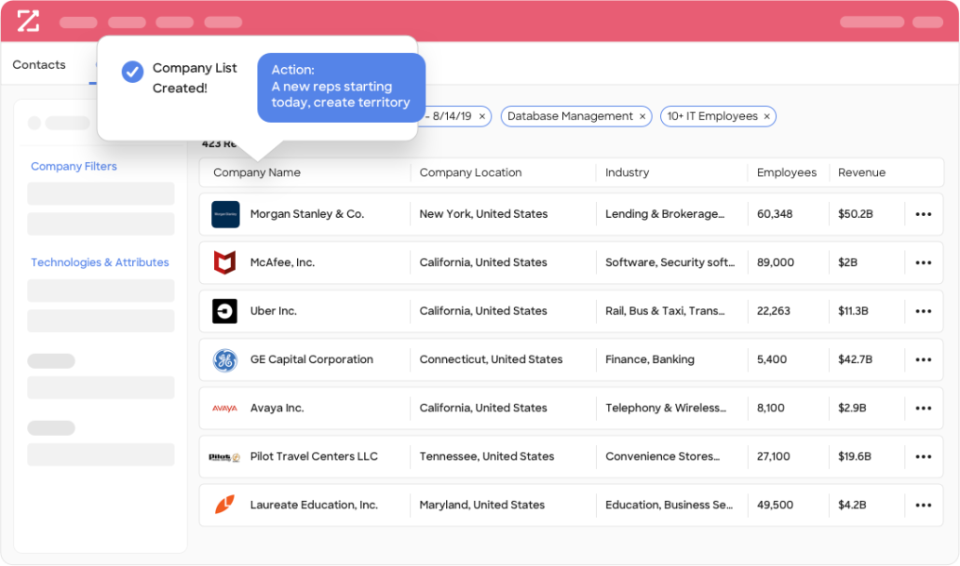
ZoomInfo’s platform. 

Contact enrichment tools

These focus on the people, not the company: job titles, seniority, direct emails, and verified contact details. 

Accuracy matters more here than in almost any other category, since an outdated title or a bounced email actively wastes a rep's time rather than just leaving a gap. Look for providers with strong verification processes (not only large databases). 

ZoomInfo, Apollo, and Cognism are frequently used for this layer.
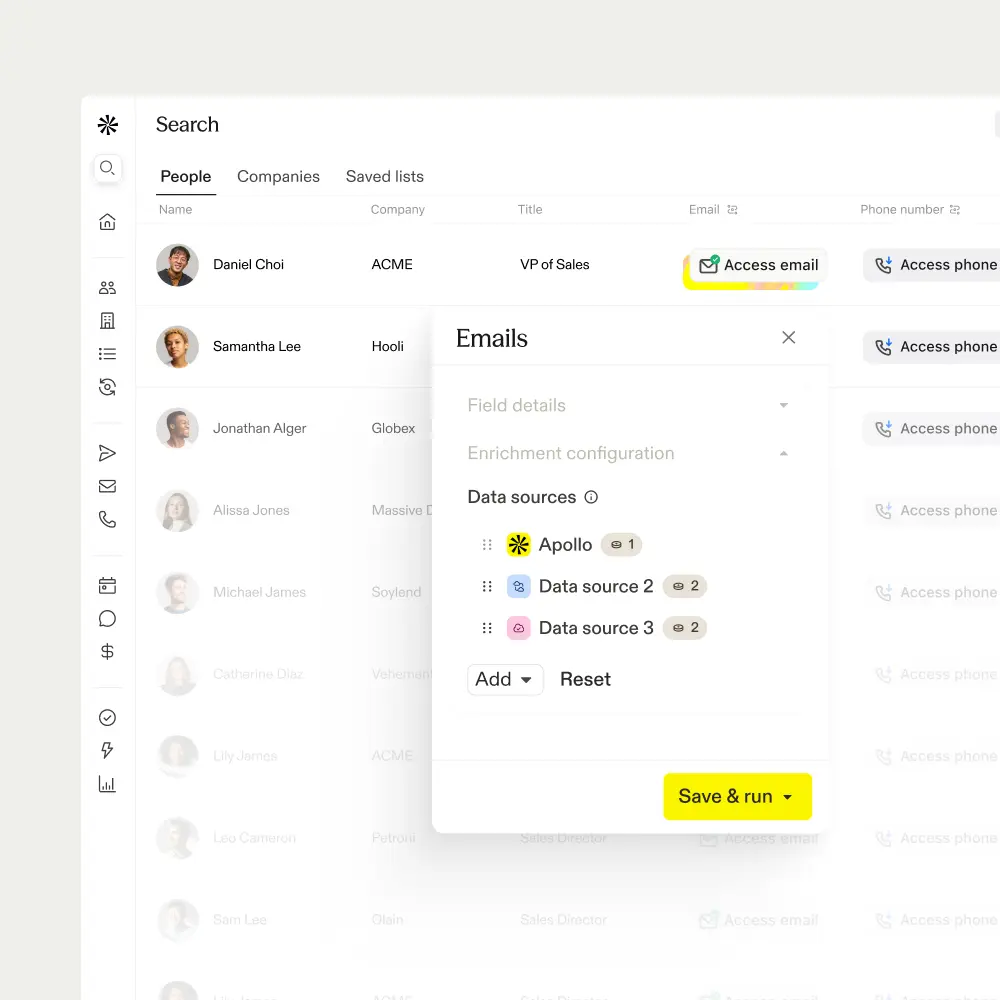
Apollo’s platform. 

Technographic enrichment tools

These identify what tools and platforms a target account already uses, useful for spotting integration opportunities or competitive displacement plays. 

Coverage varies significantly by category and vendor, so it's worth checking whether a given tool has strong visibility into the specific tech stack layer relevant to your product. 

Trace is one example: it detects a company's live tech stack alongside its partner ecosystem and hiring signals, so a technographic read comes with ecosystem context attached rather than as an isolated data point.
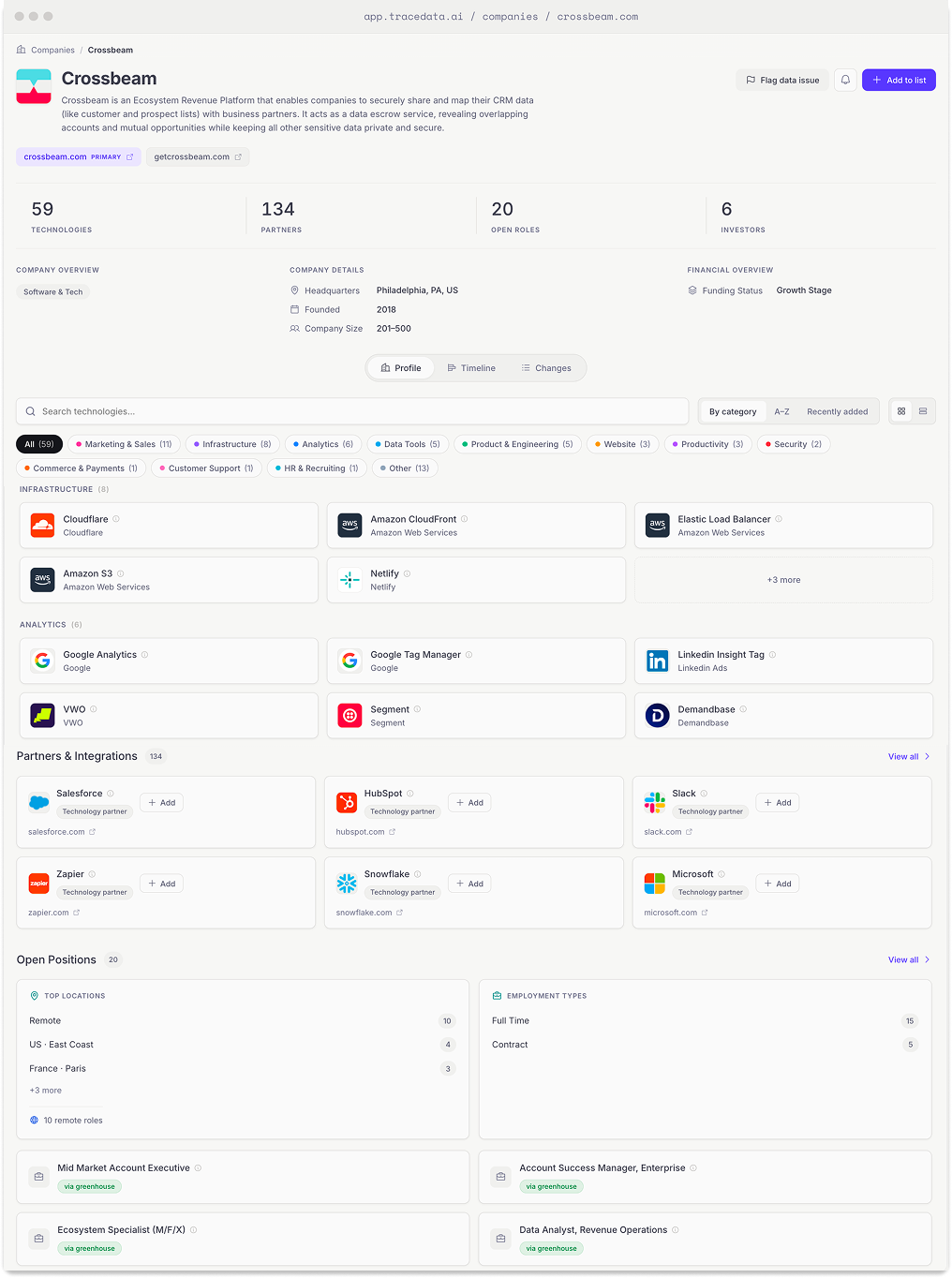
Trace’s platform.

Intent data tools

These surface signals that a company may be actively researching a solution in your category, typically inferred from aggregated behavioral data across many websites. 

Intent data can be a useful directional signal, but it's inferred rather than confirmed, and it's sold to every company that buys the same dataset, so it shouldn't be treated as a differentiated advantage on its own. 

Bombora and 6sense are the two names most teams evaluate, Bombora as a raw topic-surge signal that feeds into other tools, and 6sense as a fuller platform that wraps intent into account scoring and orchestration.
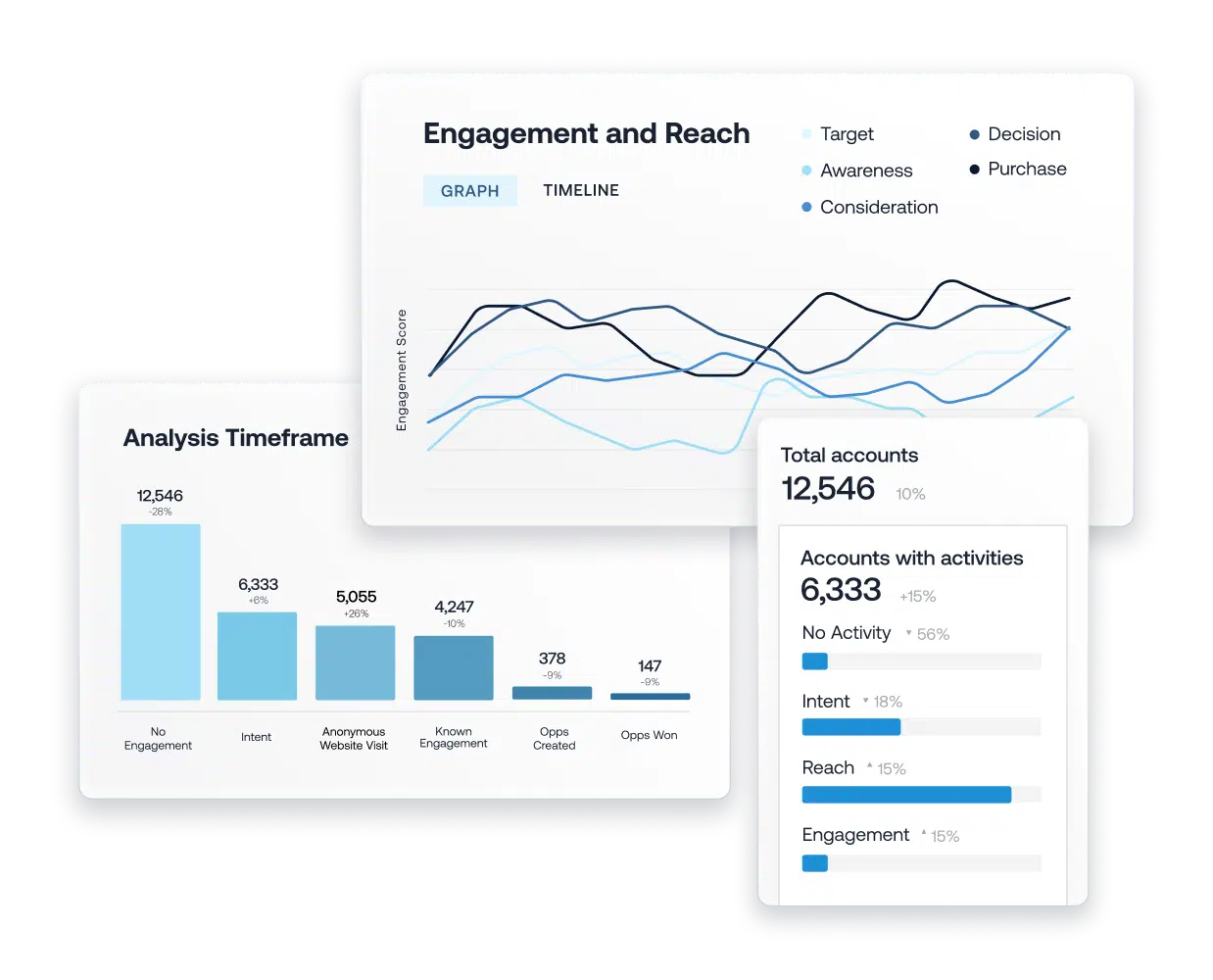
Examples of intent data provided by 6sense.

Ecosystem enrichment tools

This is the category most CRM enrichment strategies overlook entirely: enrichment based on your own partner ecosystem. Instead of only purchasing firmographic or intent data, ecosystem enrichment tells you whether a target account already has a relationship with one of your partners, and what that relationship looks like.

This is fundamentally different from every other category on this list, because it's not inferred or purchased from a broker. It comes from a real, verified relationship, which makes it both more reliable and impossible for a competitor to simply buy the same dataset and match it. That distinction is worth understanding on its own terms. 

Crossbeam sits in this category. It gives your agents second-party data: live data about accounts, contacts, and relationships direct from your partners' CRMs. Instead of your team hunting for overlap manually, Crossbeam surfaces which target accounts already overlap with a trusted partner, and puts that signal wherever you and your agents work, in the CRM and now via MCP.
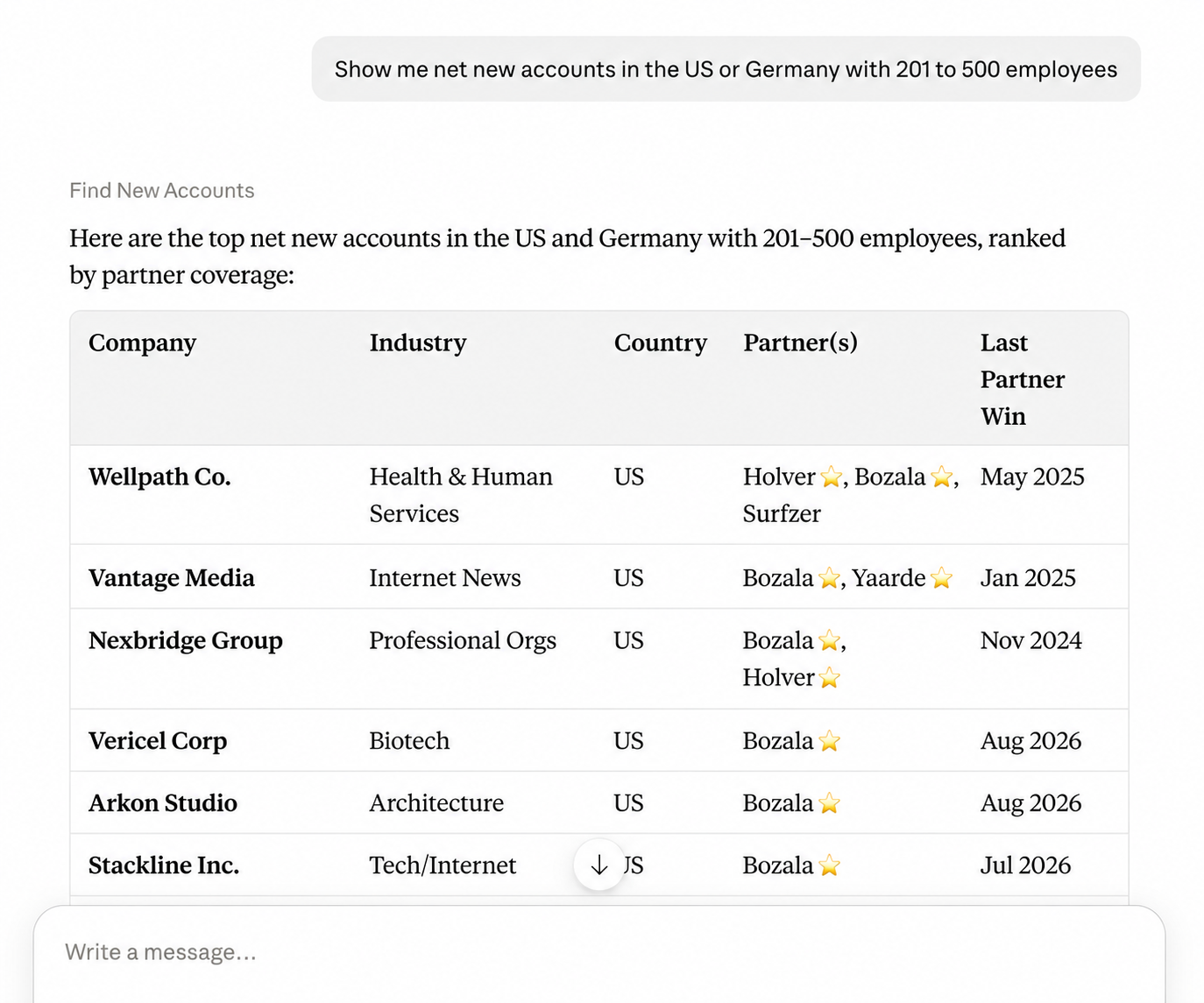
Example of a prompt you can use to surface net new accounts with Crossbeam’s MCP. 

How to combine categories effectively

These categories aren't interchangeable. They each answer a different question, and skipping one leaves a blind spot the others can't cover:

  • Firmographic and technographic: Is this account worth pursuing at all?
  • Contact: Who do I actually reach out to? (This one decays fastest, so it needs the most upkeep.)
  • Intent: Is now a reasonable time? Weak on its own, useful as a tiebreaker.
  • Ecosystem: is there an advantage here no one else has? 

The harder part is usually plumbing, not picking tools. Stacking four or five enrichment categories means either building a native integration for each one or finding a layer that connects them for you.

Clay is the tool most RevOps teams reach for here. It works as a waterfall across 100+ data providers, so instead of maintaining separate integrations for a firmographic tool, a contact tool, and an intent tool, Clay tries each source in sequence until a field is filled, then writes the finished record to the CRM. It already connects to Crossbeam too, which means partner overlap data can flow into the same enrichment workflow as everything else, rather than living in a separate report someone checks manually.

For teams with a data warehouse already in place, routing enrichment through something like Snowflake before it hits the CRM is worth considering, especially once more than a couple of sources are in play. Landing every provider's output in one place first makes it easier to de-duplicate conflicting fields, decide which source wins when two providers disagree, and only push the resolved record downstream, instead of letting each tool write to the CRM independently and fight over the same fields.

For Salesforce users, another path is opening up: Crossbeam is now listed in Salesforce's "AI agents and tools" category on AgentExchange, announced at Dreamforce 2026, giving Salesforce agents a direct line to live partner CRM data for every account.

See what your partner ecosystem could add to your CRM. Register free to enrich your accounts with second-party data your competitors can't access.

Frequently asked questions

How is ecosystem enrichment different from firmographic or intent data?

Ecosystem enrichment comes from a direct, consented relationship with your own partners, rather than being inferred or aggregated from third-party sources, which makes it more reliable and unique to your business.

Should CRM enrichment run automatically or on demand?

Automatically, whenever possible. Manual, on-demand enrichment tends to fall behind as new records enter the CRM faster than anyone remembers to enrich them.

Is it worth paying for multiple enrichment tools across categories?

Often yes, since no single provider covers firmographic, contact, technographic, and ecosystem data equally well. Most mature RevOps stacks combine two or three specialized tools.


You’ll also be interested in these

First-Party vs. Second-Party vs. Third-Party Data: What's the Difference?
What Is Second-Party Data (and Why It Matters for GTM)?
The 2026 Complete Guide to Account Mapping