Discover how to co-sell with AI and automation. From CRM foundations to AI-driven triage, learn how aligned teams, clean data, and Partner Ops leadership unlock faster, higher-value partner revenue.
How to Co-Sell with AI and Automation
Most teams talk about co-selling as a growth lever while treating it like a side project.
The reality is that ecosystem GTM stalls when programs lack clear ownership and integration into the central GTM rhythms of the company. Partners start to lose faith, visibility weakens, and attribution breaks down.
Everyone working in partnerships already knows the inherent value of a well-defined and supported ecosystem framework: partner-attached business closes more often, at a faster rate, and with higher overall value. Research is now starting to support this as well. Partner-sourced leads are 53% more likely to close at a 46% faster rate. Companies with mature ecosystem motions see win rates up to 50% higher than those selling solo. Yet, most teams can’t capture that value because of dirty CRM data, inconsistent attribution, and fragmented partner tech.
According to a Sherpa’s Partner Marketing Ecosystem Benchmark Report, 75% of partner teams lacked marketing automation, and nearly half couldn’t manage digitally qualified leads.
The result is predictable - strong partnerships held back by weak operations.
That’s where AI and automation come in: not to replace the human relationships at the heart of co-selling, but to reduce friction, surface insights faster, and automate what slows teams down.
To help you with that, Aaron Howerton, RevOps Architect at Go Nimbly, unpacks what it really takes to operationalize co-selling and where AI and automation can actually help (today, not in sci-fi land).
Let’s begin.
The first obstacle isn’t tech, it’s buy-in
Partnerships cut across every department in the organization. This includes Sales, CS, PS, Finance, Product, Marketing, and Legal. That means budgets, KPIs, and attribution models get involved, and people can feel threatened. And according to Aaron, the biggest challenge you typically face when implementing a co-selling motion with AI is buy-in.
“The hard thing with partner operations is getting upstream into RevOps is difficult,” said Aaron. “Because RevOps is where all the big decisions live, and that's really where you have to do a lot of coordination to be able to be successful.”
Without clear executive sponsorship and a plan to show value for each stakeholder, you end up in a loop:
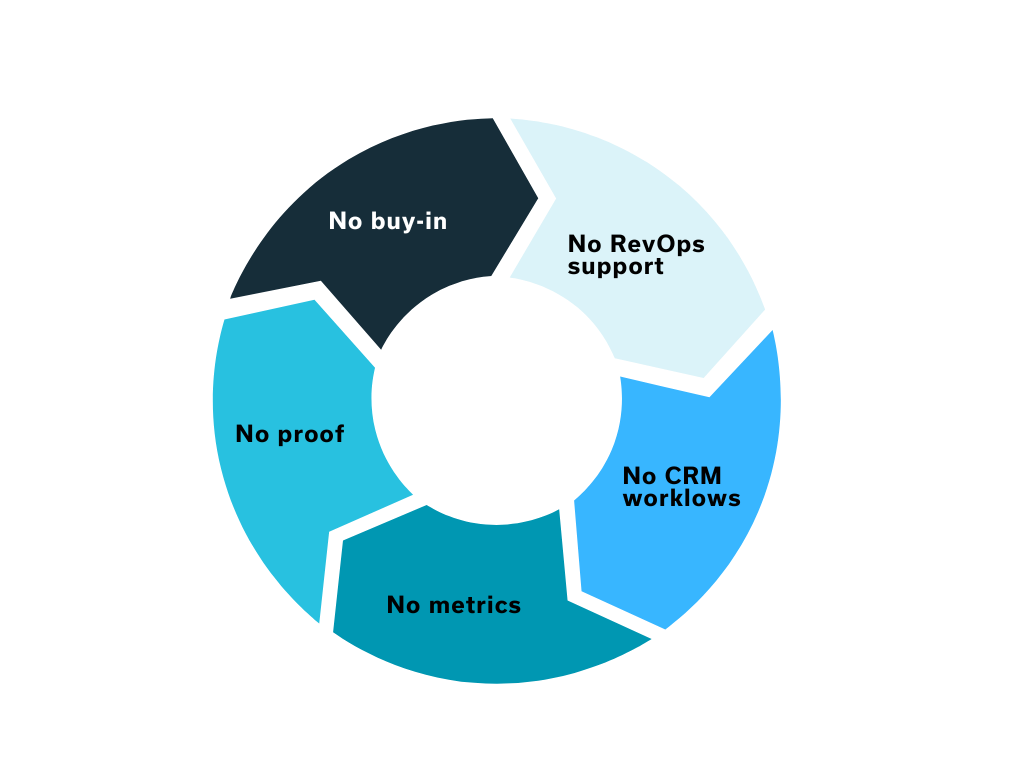
Here are three tips from Aaron to break the loop:
- Start with stakeholders, not systems: Map who is affected (AEs, BDRs, CS, PS, Marketing, Legal, Product). Based on your co-selling strategy, document what they gain and what they fear losing (for example: commission dilution, attribution credit, capacity).
- Make “partner” a GTM question, not a partner-team question: At the end of every project or deal review, ask: “What about partners?”
- Instrument for proof. Even lightweight tracking beats none. You’ll refine the model, but you need a starting measurement to fund the next step.
“Anybody in partnerships will tell you, partners help you sell faster, they help you sell upstream, and they close larger deals,” said Aaron. “All those things can be true when you have an established process. Are you going to build resale? Get yourself some buy-in.”
Now that you have the buy-in, it’s time to…
Build the foundation in your CRM (it’s not “just a field”)
“There isn’t a CRM that holds core partner tech out of the box. You have to build it,” said Aaron. The good news is that there are a lot of integrated solutions that can help with that.
Aaron’s approach is system-agnostic and focused on getting more from what you already have: your CRM, chat, call intelligence, and enrichment tools. Start by cleaning your CRM data; it’s tedious but essential. Once that foundation is solid, other tools can supplement more efficiently because they are driven by program-specific needs or be specifically targeted to drive the Direct and Ecosystem GTM rhythms. A new standard in that field is ensuring you connect an Ecosystem-Led Growth (ELG) platform to your CRM.
Add account mapping and a secure data-sharing layer, but only buy net-new tools when your current stack can’t deliver the outcomes you need.
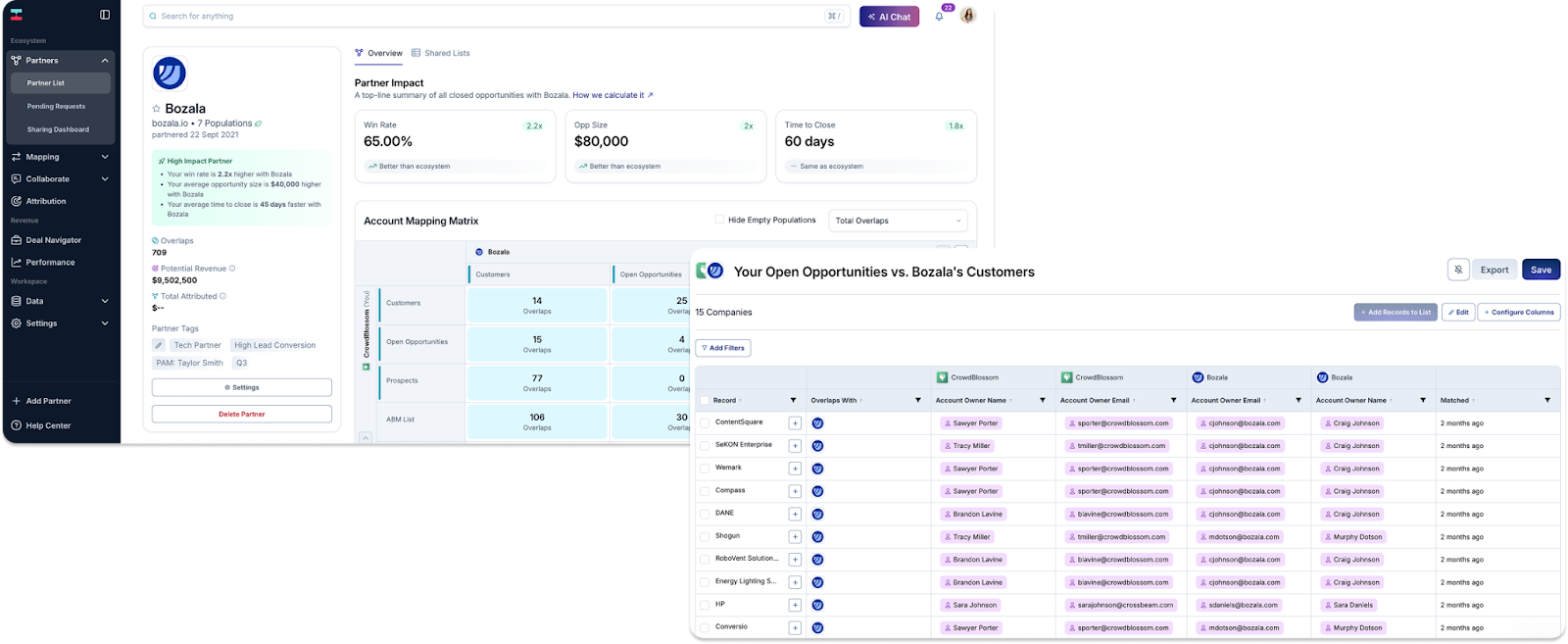
A PRM can help later, but only after your data is reliable. Most GTM teams need partner workflows long before they have a PRM budget.
One top tip from Aaron is to treat partnership programs like a product with clear offerings: referral, resale, tech, and services, and model them accordingly. That’s the essence of a minimum viable partner architecture: connected systems and a product mindset.
To create a minimum viable partner architecture in your CRM, you need:
- Program object(s): Program type, terms, incentives, eligibility, commissioning rules.
- Partner company and contacts: Roles, capabilities, certifications, territories.
- Associations to core GTM data: Link partners to accounts, opportunities, and activities (with many-to-many where needed).
- Deal registration entity: Source partner, customer identifiers, status, decisioning notes, conflicts, SLAs.
- Attribution and payouts: How partners influence/assist maps to revenue credit and comp.
Now, you may be asking yourself, Why can’t I start with just a checkbox on Opportunity inside my CRM? Because you’ll quickly need to answer: Which program? Which terms? Which conflicts? Which stage gates?
And sooner rather than later, you’ll realize that a single field won’t scale.
Work like product: backlog first, tooling second
Aaron operates with Scrum/Agile habits: define outcomes, write requirements, maintain a backlog, and prioritize. That mindset keeps you from buying tools to solve undefined problems.
Here are some backlog categories to start with:
- Visibility: Can AEs and partner managers see partner-relevant signals where they work (CRM/Slack)?
- Process: Have we defined how deal reg, conflict checks, and approvals flow?
- Data: What do we need to capture for measurement and payouts?
- Enablement: Do field teams know when and how to bring a partner in?
Where AI helps today (and where it doesn’t, yet)
Think of AI as a well-coached assistant. It can be useful and fast, but without trusted data you run a high risk with regard to outputs, forcing ongoing review before any final decisions are made and information is shared.
Table-stakes AI: your internal Partner Agent
“Companies need to figure out where AI can make the biggest difference,” said Aaron. “AI right now is just not as advanced as it really needs to be to solve complex co-sell problems. I think the best advice I've heard is to think about AI like an assistant.”
There are so many things AI can help you with; however, to optimize your co-selling motion, you might need to take some time to train your private agent on:
- Program guides and terms
- Active partner lists and capabilities
- Compensation rules and approval SLAs
- CRM schema and definitions
- “Who owns what” across your tech stack
All those training sessions can be helpful with the following co-selling questions:
- Who should I pull in on this deal?
- What are the program rules for service partners in EMEA?
- Do we already have a tool that does X?
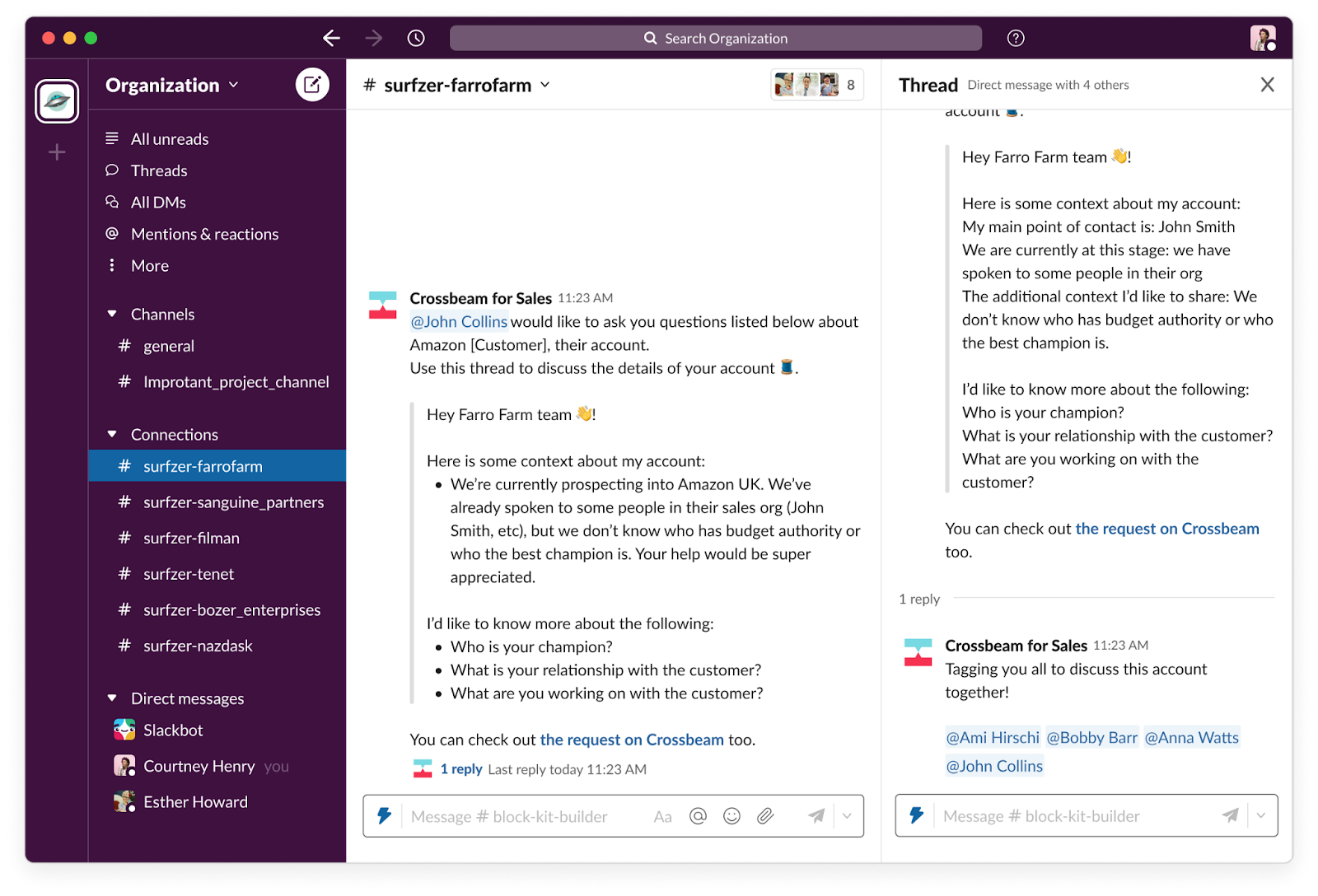
Aaron’s take: more AI interaction will live in Slack Connect (or your chat layer). Imagine a shared partner channel where:
- The partner asks, “What’s my program discount tier?” Agent answers from your program docs.
- A new deal reg triggers an agent post with the AI Summary.
- Mutual account questions are validated against CRM and program rules.
High-impact use case: AI-assisted deal-registration triage
AI doesn’t approve deals; it prepares humans to approve faster. When a partner submits a registration, trigger an AI summary that:
- Validates required fields and basic compliance (restricted countries)
- Surfaces potential customer matches in your CRM (dedupe hints)
- Flags conflicts (existing opps, other partner regs, open contracts)
- Recommends next steps (request more info, route to AE, schedule partner sync)
This alone can save 40–60 minutes of manual research per registration and it’s a safer, contained task for AI.
“I don't have a high trust factor in AI's results at this point. I use it every day, to get information and ask questions and help summarize things, but that's a starting point for deeper research and deeper information,” said Aaron. “So if you think about that in terms of workflows, I don't know that I would want to put AI in charge of deeply critical resale workflows for notifications and similar stuff, but summarizing deal registration can be a great start for AI.”
This means that even though you’re leveraging AI and automation to reduce your task amount, it’s important to always keep a human in the loop, just to make sure the AI is working properly.
Treat AI output as suggestions, not verdicts. Here’s a sample automated flow (Salesforce-style, but system-agnostic) shared by Aaron:
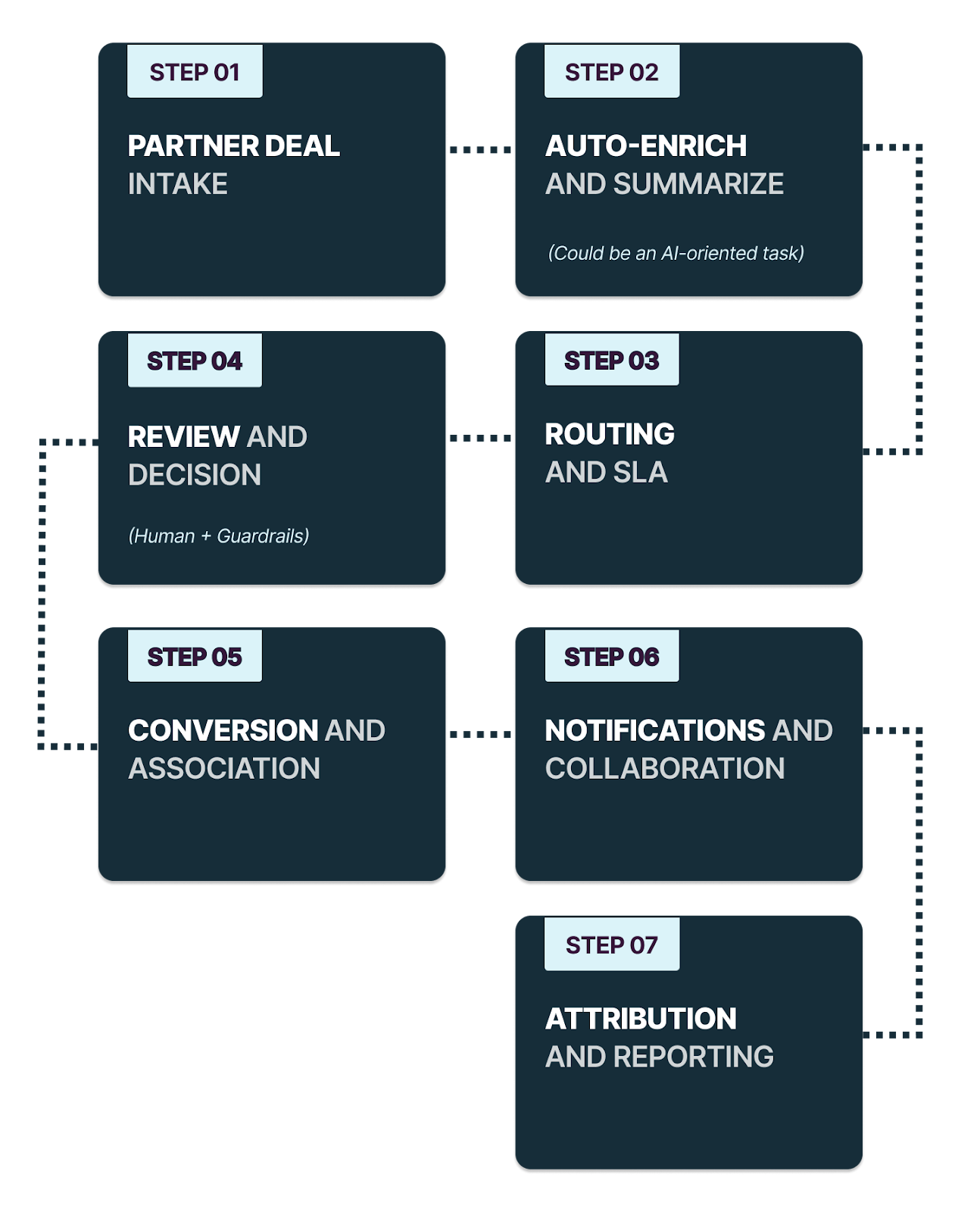
Here’s a bit more on each phase:
- Partner deal intake: The process begins when a partner submits a deal registration through a designated form, partner portal, or Slack Connect channel. Upon submission, a new Deal Registration record is automatically created, capturing all necessary standard identifiers and consent fields to ensure data integrity and compliance from the start.
- Auto-enrich and summarize (AI): Once the record is created, an asynchronous AI-driven job is triggered to enrich and validate the submission. The system checks for compliance completeness, searches the CRM for matching accounts and opportunities, and detects any conflicts or partner overlaps. It then generates an AI Summary, providing a concise overview of the findings along with confidence notes for the reviewer.
- Routing and SLA: After enrichment, the record is routed to the appropriate owner based on predefined rules such as territory, segment, or product line. At the same time, an SLA timer begins to track response time, and both the owner and the partner are notified through their connected Slack or Teams channels to ensure prompt follow-up.
- Review and decision (Human + Guardrails): The assigned owner reviews the AI Summary to confirm the system’s matches and identify any additional context or missing details. If more information is required, the owner can request it directly from the partner. Once complete, the owner either approves, denies, or escalates the deal registration, selecting from standardized decision reasons to maintain consistency and transparency.
- Conversion and association: When a deal registration is approved, the system automatically creates or associates the relevant Account and Opportunity records in the CRM. The partner and program are linked, and the attribution source is stamped, ensuring that all downstream reporting and credit are properly connected to the originating partner and deal.
- Notifications and collaboration: Upon decision, an automated message is posted in Slack Connect to update the partner on the outcome. This notification includes the decision details, next steps, and information on the internal owner or team member responsible for the deal, enabling seamless collaboration and clarity between both parties.
- Attribution and reporting: Finally, the system automatically tags the influenced pipeline and revenue data, feeding it into dashboards that measure key performance metrics. These include deal cycle times, approval rates, conflicts avoided, and overall partner contribution, providing clear visibility into program efficiency and impact.
“When you get into actual co-selling and working with partners, I think there are so many nuances there that really become challenging. And where I think AI will be in the future is, and Salesforce is moving in this direction,” said Aaron. “I’m tool agnostic, but right now, at Go Nimbly, we’re using Gong, Salesforce, Clay, HubSpot, and Crossbeam. However, I think the tools you use are typically less important than the outcomes you're trying to achieve.”
TL;DR
Aaron’s core advice for building a scalable co-selling motion is clear: start with alignment, not automation.
Before investing in tools or integrations, make sure Sales, CS, PS, Marketing, and Finance all understand why it helps them win faster, how attribution and commissions work, and what’s changing (and what’s not) in their workflows when partners are invited.
If that buy-in isn’t real, pause and fix it. The best tech stack won’t save a motion the field doesn’t believe in.
Next, establish Partner Ops ownership: someone accountable for cross-functional alignment, data hygiene, and process governance. Standardize wherever possible: use the simplest repeatable patterns that cover most cases, and resist one-off exceptions.
Measure what matters — cycle time, approval rate, partner-sourced pipeline, and conflict reduction — and use those insights to drive iteration, not just reporting.
Ultimately, co-selling scales through buy-in, data discipline, and Partner Ops leadership. Get those right first, and automation, efficiency, and results will follow naturally.
Curious how AI can make co-selling easier (and actually work)?
Book an ELG strategy call with our team to see how AI can streamline partner workflows, accelerate deals, and help your reps win bigger — together.
Want to hear more from Aaron? He creates content like this on LinkedIn, connect with him here.
FAQs
1. What is co-selling, and why does it matter for revenue growth?
Co-selling is when your sales team works together with partners — such as resellers, tech alliances, or service organizations — to pursue and close deals jointly. It matters because partner-sourced deals are statistically 53% more likely to close and close 46% faster than cold deals. When done well, co-selling also increases order value and reduces sales friction.
2. How can AI improve co-selling workflows?
AI helps by automating repetitive tasks—like deal registration validation, duplicate detection, or conflict checks—and surfacing insights that were previously buried. It acts as a sales assistant, preparing summaries, suggestions, and next steps so your team can move faster without losing rigor.
3. What are the biggest challenges when implementing AI in co-selling?
The toughest obstacle is buy-in. Co-selling involves multiple teams — Sales, CS, Marketing, Legal, Finance — each with different incentives. Without executive sponsorship, clear role definitions, and alignment on attribution, AI and automation can amplify the chaos rather than solve it.
4. What systems do you need to operationalize co-selling with AI?
You need a clean, well-structured CRM foundation. Then integrate an ELG (Ecosystem-Led Growth) platform like Crossbeam to power account mapping and partner data. On top of that, you build partner objects (programs, contacts, deal regs, attribution) before layering AI features that help with routing, enrichment, and decision support.
5. Does Crossbeam have any co-selling AI capabilities?
Yes — Crossbeam Copilot brings AI-powered “Ecosystem Intelligence” directly into the tools your reps already use, like Salesforce, HubSpot, and Gong. It surfaces recommended plays, partner insights, and enriched contacts right inside your workflow so sellers can act faster on partner data.