How to Build a Strong B2B Go-To-Market Strategy


B2B go-to-market strategy aligns sales, marketing, partnerships, and product around one plan for reaching and winning customers. Here's how to build one that holds up, including where AI now fits in.
A go-to-market strategy is the plan connecting everything a company does to reach, win, and keep customers: who you're selling to, how you'll reach them, and who owns which part of the process.
Done well, sales, marketing, partnerships, and customer success row in the same direction. Done poorly, or not at all, every team quietly builds its own version of "how we go to market," and none of them fully agree with each other. That misalignment shows up in the numbers too, according to the Future of Revenue Report 2025 from Pavilion and Crossbeam, misaligned GTM teams are 70% more likely to see extended sales cycles,
This is what a strong B2B GTM strategy actually includes, and how to build one that survives contact with a real quarter.
What a GTM strategy actually answers
Your GTM strategy needs to answer six questions:
- Who are we selling to? Your ICP and the personas inside it.
- What are we selling, and why now? Your positioning and the specific problem you solve.
- How will we reach them? The channels and motions you'll run: outbound, inbound, partnerships (Ecosystem-Led Growth).
- Who owns what? Which team is responsible for each stage, from awareness to renewal.
- What is the tracking process? How are you tracking your progress and results, which tools are you using?
- How are you leveraging AI to achieve your goal? Which MCPs, agents, workflows are you using to reach your goals faster.
A GTM strategy is the layer above marketing, sales, and partnerships, making sure they're solving for the same outcome instead of working in parallel, occasionally at cross purposes.
The core components
Ideal customer profile and personas. Go past firmographics to the specific triggers that signal a company is ready to buy, and the personas inside it who influence the decision. Build the profile off three signal layers, and prioritize accounts based on how many layers actually overlap:
- First-party signals (your own data): product usage patterns, free trial or PLG activity, support ticket volume, website engagement, existing champions inside the account. Look for accounts already showing usage-based intent. You can use tools like Gong, Salesforce, or HubSpot.
- Second-party signals (from your partner ecosystem): partner overlap, shared customers, integration usage, and technology adjacency. Look for accounts where a trusted partner already has a relationship, since that's a stronger buying signal than anything on a cold list. You can use tools like Crossbeam.
- Third-party signals (external market data): firmographics, funding events, hiring trends, technographic and intent data. Look for accounts in a relevant trigger moment, a new hire in the right role, a recent funding round, or active research on your category. You can leverage tools like Trace, Zoominfo, 6 sense, Bombora, or Demandbase.
Tip: Notion is where most teams document and operationalize the finished ICP so sales, marketing, and partnerships are working from the same definition instead of three different ones.
Positioning and messaging. How you describe your product needs to hold up across every channel and every team, and increasingly, across your partners too. A prospect who hears one story from a rep, a different one from a webinar, and a third from a partner can build confusion. If a partner pitches you as the add-on while you're positioning yourself as the platform, a shared prospect ends up with two conflicting stories from two vendors who are supposed to be on the same side.
Tools: PartnerStack, Euler, or Introw for a single, partner-visible source of truth on messaging. G2 for the proof points and review data that back positioning claims up.
Channel strategy. This can be outbound, inbound, ecosystem-led growth, paid. The right mix depends on your market and how much of your buyer's attention is already influenced by vendors and consultants they trust. For most B2B companies with any real partner ecosystem, Ecosystem-Led Growth is the most underused channel, because it requires overlapping data most teams don't have easy access to. Account mapping is usually the first step toward closing that gap.
Tools: Use Crossbeam for account mapping and Trace for account intelligence. Clay to blend first-, second-, and third-party signals into one outbound workflow instead of running each channel off separate data. Apollo.io for prospecting and sequencing. ZoomInfo for contact and intent data. Semrush for organic and paid channel research. HubSpot for content and lead nurture. Webflow for the landing pages and content that actually capture that organic traffic
Pricing and packaging. Your GTM motion needs pricing that matches it. Enterprise pricing bolted onto a self-serve product creates friction and no amount of good messaging fixes.
Tools: Stripe or Maxio to operationalize whatever packaging model you land on, and G2 to see how competitors in your category package and price before you finalize your own.
Team alignment and ownership. Every funnel stage needs a clear owner. Ambiguity here is one of the most common reasons GTM strategies fail in execution even when the plan itself was sound.
Tools: Notion or Asana for documenting who owns what at each stage, and Slack for the day-to-day handoffs between sales, marketing, and partnerships that a static doc can't capture on its own.
Precision over volume: what modern account-based GTM actually requires
The old ABM playbook was a big target account list and a lot of generic personalized-at-scale outreach. That's breaking down for a reason worth naming: AI has made generic outreach cheap and ubiquitous, which means everyone can now send a personalized-sounding email to a thousand accounts. The differentiation has moved from volume to precision, building deep context around a smaller set of high-value accounts instead of shallow context across a large one.
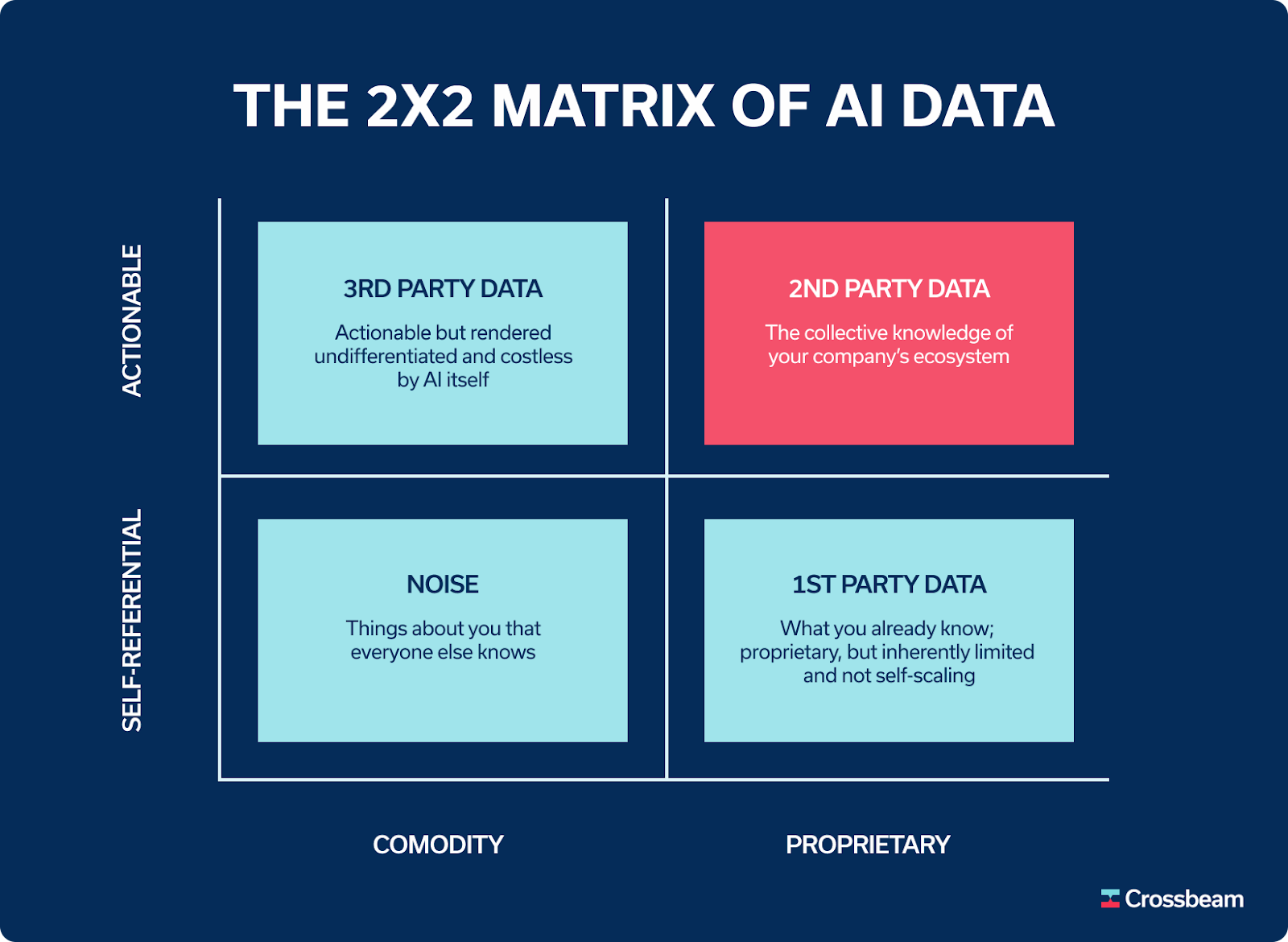
That shift makes second-party data more important to GTM strategy than it used to be. A target account list built purely from firmographic and intent data looks the same as every competitor's list. One informed by real partner overlap, knowing which accounts already trust someone you work with, is genuinely different, and it's the kind of context an AI-assisted outbound motion actually needs to be worth running. Bob Moore, Crossbeam's CEO, breaks this down further in his 2x2 matrix for AI data: third-party data is a commodity, first-party data only tells you what you already know, and second-party data is the one quadrant that's both proprietary and actionable.
How AI is changing go-to-market
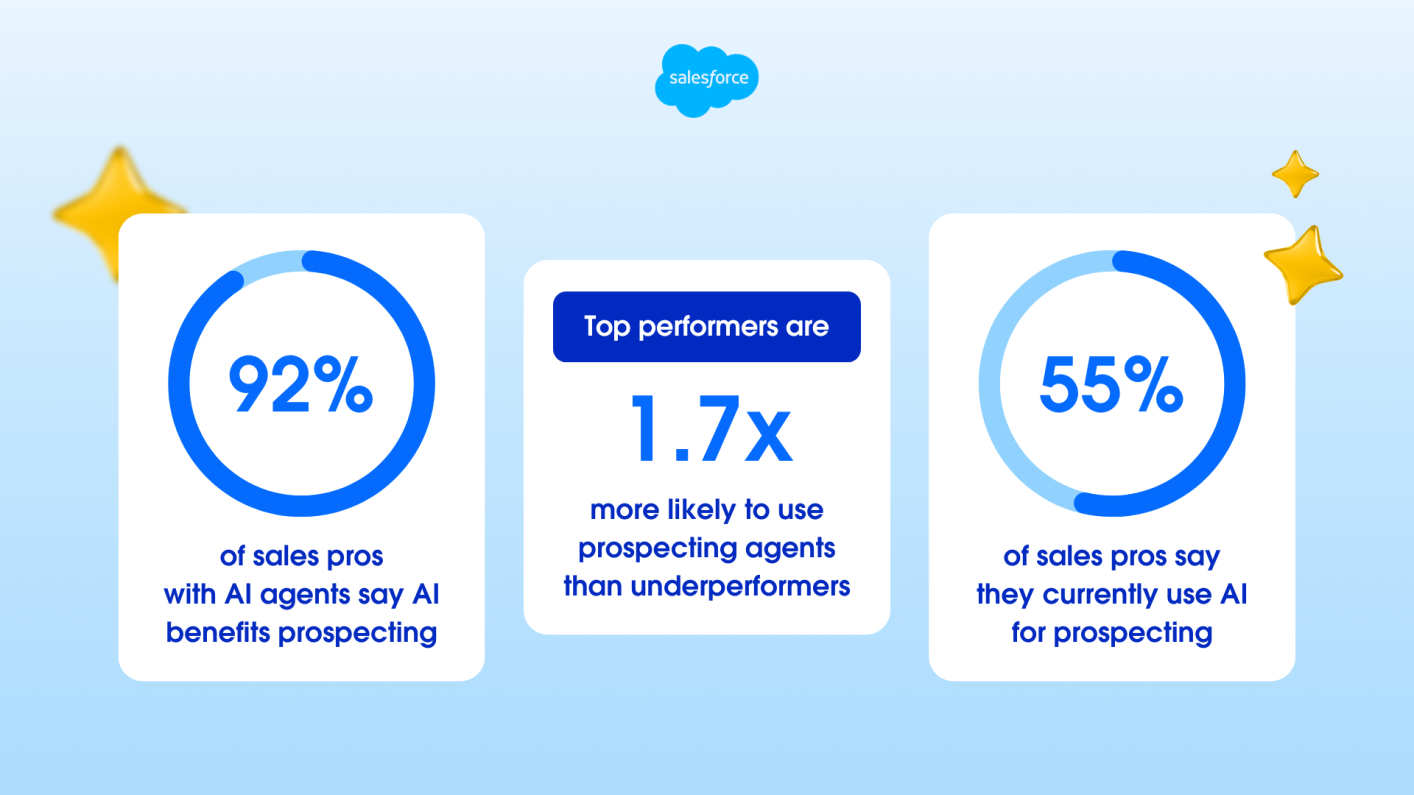
Sellers are adopting AI fast. Salesforce's Productivity Gap report found that 54% of sellers have already used an AI agent, with nearly 9 in 10 planning to by 2027, and Salesforce's own sales statistics found that sellers who partner with AI sales tools are 3.7 times more likely to meet quota. The tools are eating the tedious parts of the job first: account research, call prep, drafting the first pass of an outreach sequence.
The catch is that an AI agent only knows what it's fed. Rob Greenlee, who leads go-to-market partnerships at Anthropic, put it plainly during a session at the ELG Summit 2025: "the bottleneck for AI GTM was never the model." It's access, since the data a rep or an agent actually needs is scattered across a CRM, a Slack channel, a partner portal, and half a dozen other systems nobody wants to swivel-chair between.
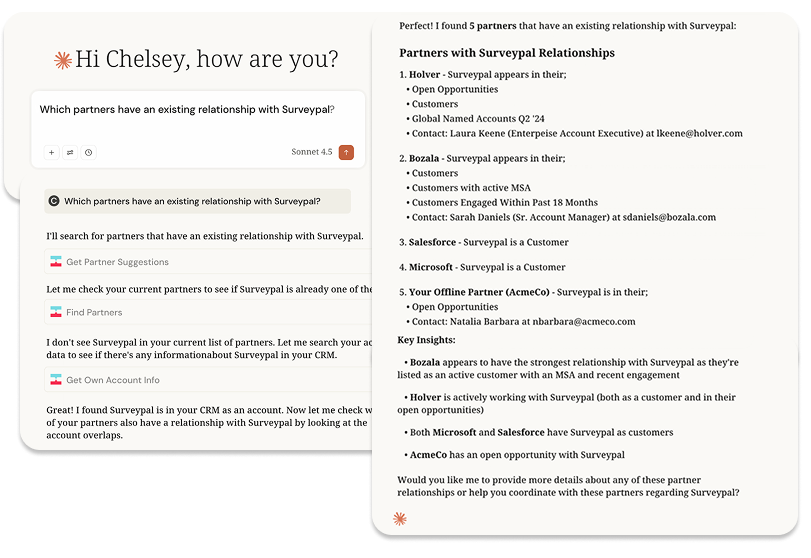
Anthropic built the Model Context Protocol to give Claude a direct line into that kind of data instead of a copy-paste job, which is part of why Crossbeam built its own MCP server: partner overlap an agent can query directly, in natural language, instead of a report someone has to remember to pull. You can read more about how that server works here.
Zoom out and the same pattern shows up at the macro level. The Anthropic Economic Index tracks AI use across the economy, and augmentation, AI working alongside a person's judgment, is currently outpacing pure automation. Applied to GTM, that means feeding a rep or an agent the same commodity data every competitor bought produces the same commodity decision every competitor's agent makes. Feed it second-party data instead, the kind that comes from a real partner relationship and isn't for sale to anyone else, and the output actually differs.
Here's what that looks like as an actual prompt, using an AI agent connected to Crossbeam through MCP: Prioritize and enrich a target account list with ecosystem signals
"I have a list of target accounts, and I want to know which ones to prioritize based on recent partner activity. Use the Crossbeam connector to check each account and rank them by where the most meaningful partner deal activity is happening right now, and enrich them with any partner-shared details and contacts."
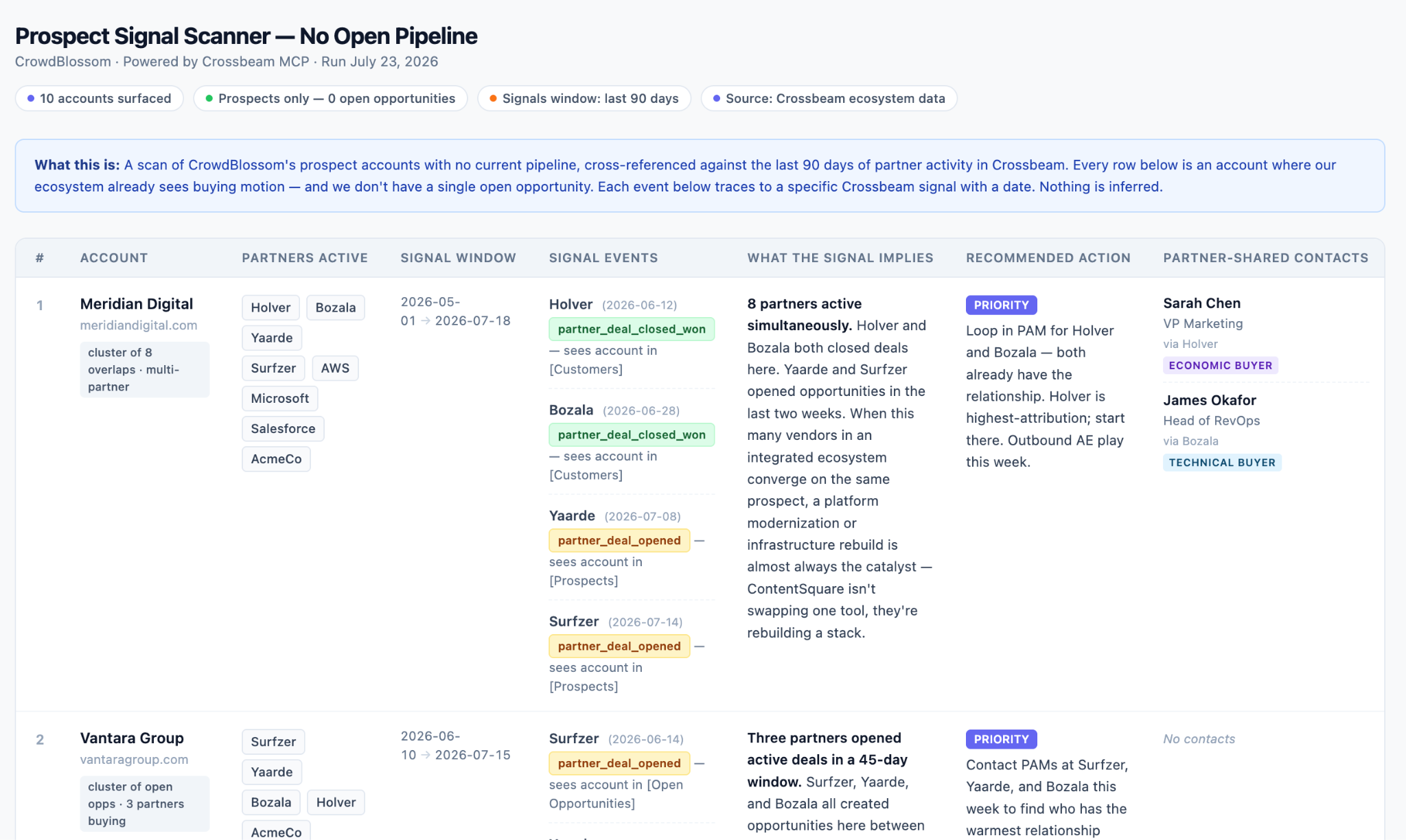
Before an account enters your pipeline, you have to decide if it's worth pursuing at all. Firmographic data and intent signals tell you who fits your ICP and who's in the market. None of that tells you whether a partner already has a relationship there, or what that partner already knows about the account.
This prompt takes any list of target accounts and scans Crossbeam's ecosystem data to surface additional account intelligence, highlighting where partner activity suggests a warm path in or a buying signal your team hasn't seen yet.
The other half of the same problem: AI visibility ownership
The data-access problem above isn't the only place AI is reshaping the funnel. Buyers used to reach a rep after forming an opinion from a Google search and a couple of reviews.
Now a lot of that research happens inside a chat window before anyone on your team even knows the account exists, which is why Answer Engine Optimization, or AEO, has become a GTM discipline in its own right. AEO is the practice of optimizing content so AI response engines like ChatGPT, Gemini, Perplexity, or Claude find it, cite it, and recommend it when someone asks a question related to your business or industry.
Forrester's 2026 Buyers' Journey Survey of nearly 18,000 global B2B buyers found that a majority now use AI tools to research products and compare vendors, with nearly half building their internal business case the same way, all before a salesperson gets involved. A GTM plan that still assumes the funnel starts with a website visit is aiming at a moment that's already passed for a growing share of buyers.
That shift is also about what an AI engine says about you when a buyer asks it a question directly. A 2026 Semrush survey of 481 marketers found 81% of teams with fully integrated SEO and AI search execution report more traffic or leads from AI platforms, compared to 36% among teams running the two as separate workflows. That's the single biggest organizational lever in the research, and it has nothing to do with better content and everything to do with who owns the problem.
Brand visibility in AI search builds across four layers, and each one maps to a team that's probably already in your GTM plan:
- Discoverability, can AI find and retrieve your content, owned by SEO and content.
- Clarity, does AI understand your brand correctly, owned by PMM and brand.
- Authority, does your brand look qualified to be included, owned by PR, partnerships, and affiliates.
- Trust, will AI confidently recommend you, owned by social, community, and CS.
If your GTM strategy assigns ownership across sales, marketing, and partnerships but never assigns ownership of how AI describes you, there's a gap in the plan, and it's the same kind of gap that leaves an AI agent working off partial data: nobody owns the full picture. Either way, it's a gap a competitor with a cleaner story, or a cleaner data feed, is quietly filling.
The teams pulling ahead right now are treating both sides of this, agent access and AI visibility, as one data and ownership problem.
Building your GTM strategy: a practical sequence
A full B2B GTM strategy involves a lot more than six steps. ICP workshops, positioning sprints, pricing committees, comp plan redesigns, tech stack audits, enablement rollouts, the full list easily runs into the dozens depending on the size of the company.
Trying to sequence all of it here would turn this into a project plan instead of something you can actually use. What follows instead is the shorter list: the tips that carry the most leverage, the few things that, done well, tend to keep everything else downstream from falling apart.
- Audit existing channels honestly, then chase the one you're underusing. Pull the last two to four quarters of data by channel, sourced pipeline, win rate, and average deal size, not just lead volume or MQLs. A channel generating a lot of activity but few closed deals is a candidate to fix. For most companies with an established partner network, the underused one is ecosystem-led growth: run an account mapping exercise with your top three to five partners before assuming the channel isn't viable, since most teams underestimate overlap until they actually check. ELG Insider's five ways to leverage ecosystem data is a good next read if this is new territory for your team.
- Assign clear ownership at each funnel stage, including AI visibility. Document it somewhere everyone can see it, a shared RACI in Notion or Asana works fine, rather than leaving it in one person's head or a Slack thread from six months ago. Name a specific owner for AI visibility too, since that's the stage most GTM plans still leave unassigned entirely.
- Put a system in place for prioritizing accounts, using second-party and third-party data together. Score accounts on where signals overlap instead of treating each data source as its own separate list. An account with strong intent data and a live partner relationship should outrank one with strong intent data alone, since the partner relationship is the harder signal for a competitor to replicate.
- Loop customer success from the start. Customer success usually sits closest to the signals that predict expansion and churn, but most GTM strategies only bring the team in once a deal is already closed. Give your team a seat while the ICP and channel strategy are still being built, since they'll spot mismatches between who you're selling to and who actually succeeds with the product.
- Build a shared glossary before you scale messaging. A one-page doc defining what your team means by ICP, qualified, and champion sounds trivial until two teams discover they've been counting different things as a "pipeline win" for two quarters. Cheap to build, expensive to skip.
- Set up a standing win/loss debrief. A short, recurring review of recently closed and recently lost deals, with sales, marketing, and partnerships in the room, is one of the fastest ways to catch a stale ICP or a positioning gap before it shows up in a missed quarter.
Treat these tips as a starting list rather than a finish line: pick the tip that exposes the biggest gap in how your team currently operates, fix that one first, and let the rest follow as the strategy matures.
What this looks like in practice: ServiceNow's ecosystem orchestration
ServiceNow ran a version of this sequence at enterprise scale after their partner marketing team, led by former Director Maisa Fernandez, found themselves buried in what she called "death by a thousand emails," partners lost in disconnected portals with no clear next step. That's the channel-audit and ownership steps above, learned the hard way first, then fixed deliberately.
Working with James Hodgkinson at 360insights and with Crossbeam, the team built a single "front door" for every partner type, from mature marketing teams down to individual developers, organized around three stages: Learn, Build, Activate. Each stage has a clear owner and a clear next action, closing the ownership gap that derails so many GTM plans. Crossbeam's Ecosystem Intelligence layer feeds account and partner-overlap signals directly into that workflow, so instead of a data dump, sellers see which partner has the right certification and the right relationship for a specific account before they ever reach out.
This gave ServiceNow the ability to trace every partner-driven lead back to a specific play, the kind of proof that gets marketing development funds renewed instead of questioned. As Fernandez put it, the framework let her team "prove where leads came from and where deals came from."
The lesson scales down as well as up: assign ownership at each stage, feed it real signal instead of guesswork, and build in a way to prove the motion worked. Read the full ServiceNow and 360insights story for the complete framework.
How Crossbeam supports B2B GTM strategy
A big piece of GTM strategy comes down to one question: what do your partners already know that you don't? Crossbeam connects your account data with your partners', and with the wider Crossbeam Network of 30,000-plus companies, turning that second-party data into signals that inform account prioritization, warm introductions, and co-sell motions, feeding directly into the strategy your teams execute against every day.
Customers running that motion see it show up in the numbers:
- Yotpo doubled their partner revenue using Crossbeam, Slack, and an ELG motion.
- Zeta Global drove a 30% increase in enterprise leads by combining ELG, Crossbeam, and LinkedIn connections.
- JustCall cut their average time to convert from 45 to 60 days down to 25 to 35 days on overlap-influenced deals, while holding 90% retention.
- Fundraise Up saw a 30% revenue outperformance after building ecosystem intelligence directly into how their sales team already worked.
This isn't only a RevOps or partnerships exercise, either. Crossbeam's RevOps use cases map the same overlap data to account scoring and territory planning, so the signal feeds pipeline decisions the moment it's captured, not weeks later in a QBR deck.
See what your ecosystem could add to your GTM strategy. Register free to find the overlap and signals hiding in your partner network.
Frequently asked questions
Who should own the GTM strategy inside a company?
Typically a GTM leader, CMO, or CRO with visibility across sales, marketing, partnerships, and customer success, since the strategy needs buy-in from all four.
How often should a GTM strategy be revisited?
At minimum quarterly. Buyer behavior and competitive dynamics shift fast enough that a strategy locked in a year ago is likely already out of date somewhere.
Is ecosystem-led growth part of GTM strategy, or separate from it?
It should be part of it. Treating partnerships as a separate initiative rather than a core GTM channel is one of the most common reasons companies underuse their partner data.
How is AI changing GTM strategy specifically?
It's compressing the buyer research phase, since more of that research now happens through AI tools before a rep is ever contacted, and it's raising the value of proprietary data like partner overlap, since generic data fed into an AI agent produces a generic result.