ELG Insider Daily #646: EQLs, the gifts that keep on giving
What Can B2B SaaS Companies Learn About Ecosystem-Led Growth from a Solo Entrepreneur?
ELG Insider Daily #645: Where is the AI in ELG?
ELG Insider Daily #644: Three easy ELG plays
ELG Insider Daily #642: Make the money follow you
When Sales and Partnerships Partner Up
ELG Insider Daily #640: Do not let anybody ghost you
ELG Insider Daily #639: Do not be an ordinary seller, instead do this!
ELG Insider Daily #638: The secret to customer retention
ELG Insider Daily #636: Speed up deals with this warm intro email template
ELG Insider Daily #635: How to Make the Right Noise at INBOUND
ELG Insider Daily #632: To win in sales, Always Be Collaborating
ELG Insider Daily #631: How to turn frenemies into power partners
Everything You Need to Know to Build a Reseller Program
ELG Insider Daily #630: Give your prospects the gift of time
ELG Insider Daily #628: Boost integration adoption by knowing your customers tech stack
ELG Insider Daily #627: 3 tips to master co-selling with partners
ELG Insider Daily #623: Cold email is not dead, it is just not partner-led
ELG Insider Daily #626: Shorten your enterprise sales cycles by 44%
ELG Insider Daily #625: The sales vet who turned an ecosystem into a revenue machine
The Crossbeam x Reveal merger: Watch Bob Moore and Simon Bouchez give the inside scoop
The story behind the merger: A recap from ELG Con London
ELG Insider Daily #622: To the infinity and beyond of channel partners
ELG Insider Daily #620: Focus on market trends, not just on product demand
ELG Insider Daily #620: How Cloud GTM is Transforming Legacy Partnerships
ELG Insider Daily #619: The GTM Attribution Conundrum
ELG Insider Daily #616: Rollworks' Crawl-Walk-Run Approach to Achieve Time To Value Faster
ELG Insider Daily #618: Get the Exclusive Story of the Crossbeam x Reveal Merger
ELG Idols: A Channel Sales Leader’s 10 Lessons for SaaS Orgs Transitioning to Partner Implementations
ELG Insider Daily #617: The Darling of 2010s Marketing Died. Who Did It?
Nearbound Weekend 06/22: Steal This Framework For Strategic Alliances
ELG Insider #679: Build a revenue-driven partner ecosystem
Nearbound Podcast #168: The BIG Announcement
Nearbound Daily #613: Reveal and Crossbeam Got Married—The Dawn of a New Era
Crossbeam Explains: Co-Selling
Nearbound Daily #614: BREAKING NEWS: Crossbeam and Reveal are Joining Forces
Is Your SaaS Org an Ecosystem Business?
Nearbound Daily #611: How To Best Use Account Mapping At The Expand/Engage Phase of the Bowtie
Nearbound Daily #610: Nelson Wang #1 Lesson Working With Resellers
Nearbound Daily #609: Five Ways To Create Nearbound Sales Champions
Nearbound Podcast #167: Building SaaS Credibility in a Skeptical World - Bobby Napiltonia
Nearbound Daily #608: Validate Your Partnerships Strategy with 'WOW' Moments
My #1 Lesson in Reseller Strategy that led to $250M+
Nearbound Daily #607: Find and Leverage Signals for Partnerships
Nearbound Weekend 06/15: The Soul of Nearbound
Howdy Partners #70: Generating $5 Million Through Partnerships with Pedro Mattos
Nearbound Daily #605: Are You Utilizing All Four Channels For Intros?
Nearbound Daily #604: The #1 Lesson Every Partner Leader Should Learn From Walmart's Sam Walton
Nearbound Podcast #166: Pete Caputa's Return: The Partner Led Startup Story
Nearbound Daily #603: Steal This Play to Engage Customers With Partners
Nearbound Daily #602: We Can Do Better With Partner Onboarding
Breaking News Roundup: Microsoft Exec Becomes CTO, HP's Business Model, and Cisco Investing $100 Million in Partners
Nearbound Daily #601: Doing Events The Nearbound Way
Nearbound Weekend 06/08: Use the ICE Framework to "Partner Pill" Every Department
Nearbound Daily #600: 5 Common Mistakes to Avoid When Starting Your Partner Program
The GTM Partners x Reveal partnership
Nearbound Daily #599: Steal This Partnership Value Model
A Deep Dive Into the Nearbound Book, With Mike Midgley
Nearbound Podcast #165: From Zero to $400M in Revenue - Finding Success in a Crowded SaaS Market with Jeff Cheal
Nearbound Daily #598: American Airlines' Recent Mistake Validates The Nearbound Era
Partnership Value Modeling
Nearbound Daily #597: Robert Cialdini On How To Influence Partners To Give You More
Nearbound Daily #596: How to Apply For a Job Like a Pro
How Bynder doubled the size of their tech ecosystem in just six months with ELG
Nearbound Weekend 06/01: How to Solve B2B Marketing with Nearbound
Your ELG buy-in playbook: How to bring your org’s key players on board
Nearbound Daily #593: Partners Are Not Your Glorified BDRs
Nearbound Daily #592: Tap Into Partners To Help Close a Deal In The Final Stages.
Nearbound Daily #591: Great Partners Are Like Diamonds
Top takeaways from the 2024 Ecosystem-Led Growth Conference
Nearbound Daily #590: How to Expand Into New Markets Through Partners
Nearbound Podcast #162: "I Built My Entire Business on Nearbound Principles" - with Tim Chermak
How Sales Teams Use Ecosystem-Led Sales to Hit Revenue Goals
Nearbound Daily #581: Partner Fleet Shares Their 9-Step Guide to Buy-In
Nearbound Daily #579: Metadata.io Kills Their CS Team (And Why It All Points To Nearbound)
The Era of Ecosystem Orchestration is Finally Here
Nearbound Daily #580: How Fullstory Increased Their Renewal Rate by 14%
How Fivetran Powers its Ecosystem-Led Sales with Data
Meet the RevOps-Turned-Partnerships Leader Who Transformed LeanData's Sales and Attribution Processes
Nearbound Weekend 04/27: My Key Takeaways from Goldenhour
Nearbound Daily #574: Steve Jobs On Buyer Preferences (And How It Relates to Nearbound)
Nearbound Daily #573: Meet NearBOT, Your Handy Nearbound Assistant
Nearbound Daily #571: Sapphire Ventures’ Guide to Building an Effective Partner Strategy Framework
Setting strategy and getting buy-in: Braze’s ELG Sales Tetrahedron
Nearbound Daily #570: Use Chris Lavoie's 2x2 Matrix To Prioritize Partners
Data Sharing Best Practices: How to Talk with your B2B Tech Partners
Chelsea Graham: The Unglamorous Art of Winning Your Sales Team’s Trust | Supernode 2022
Nearbound Daily #565: Here's How To Do Co-Marketed Events Better Using Nearbound Data (Step-By-Step)
Nearbound Daily #564: An Email Checklist to Make Better Impressions
Nearbound Podcast #161: 3 Things You Need to Know: Attribution Crisis, Early Majority, and the Consolidation of Tech with AI
Nearbound Daily #563: Every Stat to Help You Prove the Value of Partnerships
Nearbound Daily #562: How Oneflow Saw a 190% Surge in HubSpot-related Opportunities
Nearbound Daily #561: Get The Respect of Your Sales Team in 60 Days (Resources)
Nearbound Weekend 04/13: The Only Way To Create A Nearbound Culture
What’s an IPP—and (when) do you need one?
Nearbound Daily #560: How Pigment Increased Win Rates 5-10% with a Nearbound Overlay & Reveal
Nearbound Daily #559: Clari's CEO Complete Guide To Run The Best Meetings
Nearbound Podcast #160: How Open Source Unlocked Our Ecosystem - with Clint Oram
Unleashing the power of ELG The stats you need to know
Howdy Partners #68: Automating Revenue Generating Partnerships with Rob Rebholz
Ecosystem-Led Marketing: Awareness and Demand

‍

How to build a demand generation framework (6-step guide)

by
Crossbeam
SHARE THIS
Build a demand generation framework in six steps using partner ecosystem overlap. Includes scoring rubrics, tiered campaigns, and routing rules.
by
Crossbeam
SHARE THIS

In this article

Join the movement

Subscribe to ELG Insider to get the latest content delivered to your inbox weekly.

A demand generation framework is a repeatable operating model that tells your B2B team which accounts to target, which signals to act on, how to hand accounts to sales, and which metrics prove each stage works. It replaces a pile of tactics with defined stages, owners, and measurements. This guide walks you through building one in six steps, using partner ecosystem data as your targeting signal.

Before you start:

  • Who it's for: RevOps managers, GTM systems analysts, and partner operations specialists who configure the CRM and reporting.
  • What you need: admin access to your CRM (Salesforce or HubSpot), a documented ideal customer profile (ICP), a Crossbeam account with a few connected partners, and optionally an intent provider such as Demandbase or Bombora.
  • What you'll produce: a target account segment, enrichment fields, a scoring rubric, campaign briefs, routing rules, a dashboard spec, and a review cadence.
  • Difficulty and time: intermediate, roughly two to four weeks of part-time work.

What is a demand generation framework?

Ivris Tech defines it as "the system a B2B team uses to create demand, capture it, and convert it into revenue on purpose instead of by accident." The "on purpose" part matters because of buyer timing. The Ehrenberg-Bass Institute's 95:5 rule holds that only around 5% of business buyers are in-market in any given quarter. The other 95% won't buy for months or years.

Buyers also decide early. 6sense's 2025 B2B Buyer Experience Report found that buyers fill roughly four slots on a Day One shortlist and buy from one of those vendors about 95% of the time. Buyers now reach out at about 61% of their journey, up from the 69% mark a year earlier.

So your framework needs two tracks. Demand creation earns a place on the shortlist before anyone is shopping. Demand capture converts the buyers who show intent. A tactic list blends them, but a framework gives each its own goal, channels, and metrics.

How does demand generation differ from lead generation and ABM?

Demand generation is the umbrella system. Lead generation and account-based marketing (ABM) are motions that run inside it. Treat them as interchangeable, and your dashboards will measure the wrong things.

Criteria Demand generation Lead generation ABM
Goal Build and capture market demand Collect contact info from interested people Win named, high-value accounts
Audience Whole market, including the 95% not buying yet Individuals who respond to an offer Pre-selected accounts and buying groups
Typical output Shortlist presence, pipeline Form fills, MQLs, EQLs Account engagement, meetings, opportunities
Typical metric Creation and capture metrics, pipeline influenced Cost per lead, lead-to-SQL rate Account engagement, opportunity creation by account

Swipe to see the full table →

Your framework uses all three. Demand generation sets the stages and metrics. Lead generation feeds the capture stage. ABM focuses spend on the accounts your scoring model puts at the top.

What are the components of a demand generation framework?

Every working framework has stages, and each stage has a goal, inputs, and a metric. This build uses six, and Crossbeam supplies the account-level signal that most frameworks lack. Ecosystem-Led Growth (ELG) is the go-to-market strategy that treats your partner ecosystem as a primary source of pipeline and revenue. Here, it supplies the targeting layer.

Step Stage Goal Crossbeam role Primary metric
1 Identify Build a target set Overlap detection, partner connections Overlap accounts matching ICP
2 Enrich Add timing and roles Overlap fields alongside intent data Accounts with active intent
3 Score Prioritize Overlap strength as a score input Tier distribution
4 Activate Run ABM and co-marketing Partner relationship context Account engagement rate
5 Route Hand off to sales Signals pushed into CRM workflows Time-to-meet
6 Measure Learn and reallocate Performance dashboards Creation vs. capture trends

Swipe to see the full table →

Step 1: How do you identify audiences with ecosystem overlap?

Your first artifact is a target account segment built from ecosystem overlap: accounts that appear in both your CRM and a partner's CRM as customers, prospects, or open opportunities. The partner side of that match is second-party data, meaning data a partner shares with you directly, under controls you both set.

  1. Connect with partners in the Crossbeam Network, starting with those who serve your ICP.
  2. Run overlap detection to surface shared accounts.
  3. Sync results to your CRM and set matching logic: domain first, then company name plus country.
  4. Filter by ICP fit, overlap strength (number of partners, customers, or prospects), and relationship context, meaning which partner knows the account and how close they are.

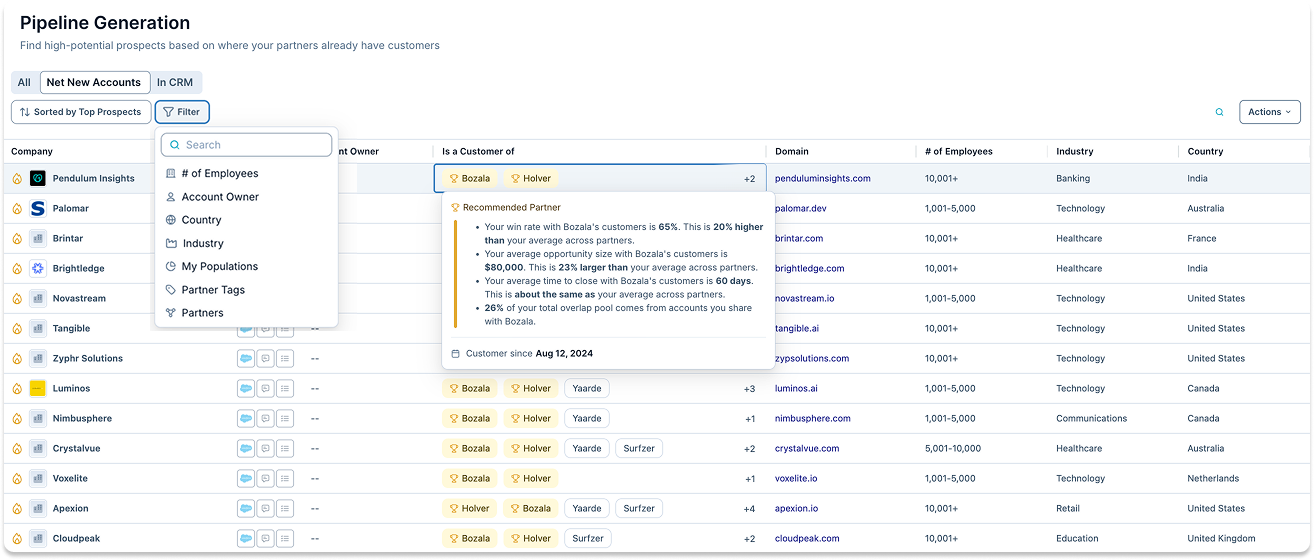
To extend the list past your CRM, Crossbeam's Pipeline Generation surfaces net new accounts, partner-sourced prospects that sit outside your CRM. Pushing overlap fields onto account records is covered under Crossbeam's account enrichment.
Checkpoint: spot-check 20 overlap accounts. Each should exist in your CRM and match your ICP on industry, size, geography, and tech stack.

Warning: overlap alone isn't a target list. Add an ICP filter and a trigger event, such as a funding round, a new executive hire, or someone who recently became a customer of your partner.

Step 2: How do you enrich overlap accounts with intent and buying group data?

Overlap tells you who is adjacent to your ecosystem. Intent data tells you when to move. Bombora's Company Surge signals track when a company's employees consume an abnormal volume of content around specific B2B research topics across a cooperative publisher network. Demandbase Intent monitors online browsing patterns of prospective and current customers.

Pick five to eight topics tied to the problem you solve, then add these fields to the account object:

  • intent_topic
  • intent_last_seen (date)
  • intent_window_days
  • buying_role (economic buyer, champion, technical evaluator)
  • priority_score

Map each intent account to a buying group by listing the two or three roles you must reach. Buyers contact vendors early, so identifying roles before the surge fades matters.

Checkpoint: build a CRM filter for "overlap = true AND intent_last_seen within 30 days AND buying_role is not empty." If you can't express it as a segment, you can't route on it.

Warning: topic mismatch inflates your list. Treat any intent window older than 30 days as stale and drop its points.

Step 3: How do you score, segment, and prioritize accounts?

Your artifact here is a scoring rubric that combines three inputs. These weights are a starting point, so tune them against your own conversion data after 60 days.

Input Max points Scoring rule
Ecosystem overlap 35 15 for one partner, 25 for two or more, +10 if a partner has a warm path or open opportunity
Intent 35 35 if a matching topic surged in the last 14 days, 20 for 15 to 30 days, 0 after 30
ICP fit 30 30 full match, 15 partial, 0 outside ICP

Swipe to see the full table →

Map bands to actions: 80 to 100 is Tier 1 (co-sell outreach), 60 to 79 is Tier 2 (ABM), 40 to 59 is nurture, and below 40 is monitor only.

CRM deliverables: three score fields, one tier field, a "score reason" text field, and segment rules for each tier. Define MQL status here so marketing and sales share vocabulary.

Checkpoint: open a Tier 1 account as a rep would. The overlap partner, intent topic, and score reason should all be visible before any outreach.

Warning: lead-only scoring misses the buying group. Roll contact activity up to the account.

Step 4: How do you run ABM and co-marketing campaigns on your top accounts?

Turn each tier into a play. Co-marketing campaigns work best when the partner already has a relationship with the account, because the invitation carries relationship context instead of a cold pitch.

Tier Audience Channels CTA
Tier 1 Overlap plus fresh intent Partner-sourced intro, personal email, LinkedIn matched ads Meeting with account owner and partner
Tier 2 Overlap or intent, fit confirmed LinkedIn ads, webinar invites, email sequence Joint webinar or workshop
Nurture Fit only Newsletter, ungated guides Subscribe

Swipe to see the full table →

Give every campaign a brief: goal metric, tier, partner, asset, landing page, and UTM set. Add a required "How did you hear about us?" field on forms to capture self-reported attribution that UTMs miss.

Checkpoint: each live campaign has one goal metric and consistent tags in your CRM.

Warning: gate intent assets (ROI calculators, pricing guides, demo requests), and keep early education ungated so it can build shortlist presence.

Step 5: How do you route leads and enable sales co-sell?

An EQL, or Ecosystem-Qualified Lead, enters your funnel through partner overlap rather than a cold form fill. Crossbeam defines it as a partner-vetted contact: ecosystem data and the partner relationship confirm fit before the lead ever reaches your queue. Add a lead source value for EQLs so routing treats them distinctly from other leads.

Write routing as explicit logic. Sample rule: IF tier = 1 AND intent_last_seen is within 14 days, THEN assign to the account owner (or the segment SDR if none) and create a task. Sample SLAs (service level agreements, the maximum time a rep has to act on a routed account): Tier 1 within four business hours, Tier 2 within one business day.

Signal-aware outreach means timing and wording a message from the signals on the account: the partner connection, the intent topic, the role. Push those fields into your sequencing tool, so reps see them.

Playbook A, webinar follow-up: attendee scored, Tier 2 and up routed within one day, email references the session topic and partner.

Playbook B, co-marketing event: partner introduces the account, EQL created within 24 hours, joint follow-up.

Checkpoint: report meeting rate by tier, and confirm every handoff carries the same fields.

Step 6: How do you measure demand creation and demand capture?

Track creation and capture separately. Capture metrics lag, so judging creation by them punishes the work that builds your shortlist position.

Type Metric Formula
Creation (leading) Overlap account engagement rate Engaged overlap accounts / total overlap accounts
Creation (leading) Self-reported share Responses naming partner, community, or content / total responses
Capture (lagging) EQL conversion rate EQLs becoming SQLs / total EQLs
Capture (lagging) Time-to-meet Median hours from routing timestamp to meeting booked
Capture (lagging) Pipeline influenced Opportunity amount where the account had a campaign touch in the prior 90 days

Swipe to see the full table →

Build two dashboard views: creation progress and capture conversion (EQL to SQL, SQL to opportunity, pipeline created). Review stage performance monthly. Each quarter, shift budget toward the tactics that moved creation metrics.

Warning: pipeline-influenced counts touch, so report it next to attributed pipeline, never in place of it.

Which prompts and templates speed up the build?

Paste these into your AI tool of choice and adjust the brackets. If you work in Clay, the Clay MCP brings Crossbeam partner context into the same workflow.
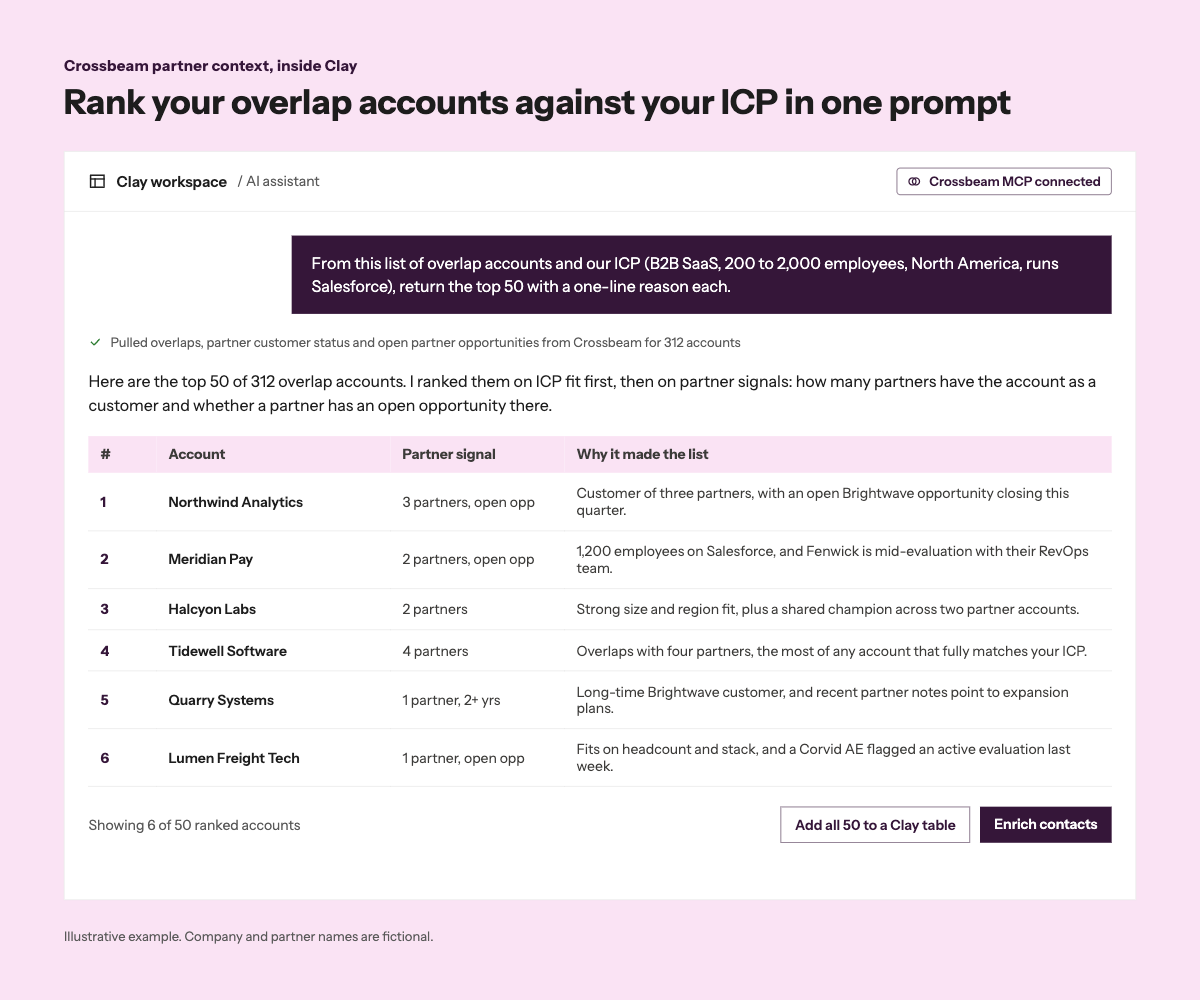
  1. "From this list of overlap accounts and our ICP ([criteria]), return the top 50 with a one-line reason each."
  2. "Write messaging for a [role] at an account with intent on [topic] and a connection through [partner]."
  3. "Draft a co-marketing invite from [partner] to [account type] about [topic], under 120 words."
  4. "Write landing page copy for [webinar], with one headline, three benefits, and one CTA."
  5. "Turn this scorecard into routing rules with owner, SLA, and fallback."

Campaign brief skeleton:

Campaign name:
Tier / segment rule:
Partner:
Goal metric and target:
Asset and landing page:
UTM set (source / medium / campaign / content):
Owner and SLA:
Review date:

What does a completed scorecard look like?

Use one row per account, so reps see the "why" next to the action.

Account

Example Co A

Tier 1
Overlap score35 / 35
Intent score35 / 35
Motion
Partner-sourced co-sell outreach
Owner
Account owner
SLA
4 business hours
Account

Example Co B

Tier 2
Overlap score25 / 35
Intent score20 / 35
Motion
ABM plus webinar invite
Owner
Segment SDR
SLA
1 business day
Account

Example Co C

Nurture
Overlap score15 / 35
Intent score0 / 35
Motion
Ungated content
Owner
Marketing
SLA
Weekly review

What should you do when your framework stalls?

  1. SymptomOverlap accounts don't appear in CRM
    Likely causeDomain mismatch or duplicates
    FixStandardize domains, dedupe, rerun matching
  2. SymptomTier 1 list is too long
    Likely causeWeights too generous
    FixRaise the Tier 1 cutoff or shorten the intent window
  3. SymptomReps ignore routed accounts
    Likely causeMissing context
    FixShow the score reason and partner on the record
  4. SymptomMeetings aren't converting
    Likely causeOutreach ignores the signal
    FixAdd partner and topic to the first line
  5. SymptomCreation looks flat
    Likely causeJudging with capture metrics
    FixReview leading indicators separately

What have you built, and what comes next?

You now have a six-stage framework: an overlap-based target segment, intent and buying-role fields, a weighted scoring rubric, tiered campaigns, routing rules with SLAs, and a dashboard that separates creation from capture.

Next, run the model on one tier for 60 days, compare scores against actual meeting and opportunity rates, and adjust weights. Then add partners to the Crossbeam Network to widen your overlap set.

Ready to wire ecosystem signals into your CRM? Register on Crossbeam for free.

Frequently asked questions about demand generation frameworks

What is the definition of a demand generation framework in B2B marketing?

It's the system a B2B team uses to create demand, capture it, and convert it into revenue on purpose. It defines stages, channels, owners, and metrics so results are repeatable.

What are the main demand generation framework components?

Audience identification, enrichment, scoring and segmentation, ABM and co-marketing activation, routing to sales, and measurement. Each has a goal and metric.

What is the difference between demand creation and demand capture?

Creation builds awareness and shortlist presence among buyers who aren't shopping yet. Capture converts buyers already showing intent. Measure them with separate leading and lagging metrics.

How long does it take to build a demand generation framework?

A first version usually takes two to four weeks of part-time work. Expect to adjust scoring weights after 60 days of real conversion data.

You’ll also be interested in these

From Overlaps to Outcomes: Turning Ecosystem Data into Pipeline, Faster
Generating Net-New Pipeline with Ecosystem Intelligence
15 Crossbeam MCP Use Cases for Partnerships and GTM Teams