{  "@context": "https://schema.org",  "@graph": [    {      "@type": "Article",      "headline": "First-Party vs. Second-Party vs. Third-Party Data: What's the Difference?",      "description": "First-party, second-party, and third-party data each solve a different RevOps problem. Here's what to build with each one, the tools that connect them, and how to turn all three into signals your revenue team can act on.",      "keywords": "1st party vs 3rd party data, first party vs second party vs third party data, types of data in marketing, revops data stack",      "author": { "@type": "Organization", "name": "Crossbeam" },      "publisher": {        "@type": "Organization",        "name": "Crossbeam",        "logo": { "@type": "ImageObject", "url": "https://www.crossbeam.com/logo.png" }      },      "mainEntityOfPage": { "@type": "WebPage", "@id": "https://www.crossbeam.com/blog/first-vs-second-vs-third-party-data" }    },    {      "@type": "FAQPage",      "mainEntity": [        {          "@type": "Question",          "name": "Which type of data is most reliable?",          "acceptedAnswer": {            "@type": "Answer",            "text": "First-party and second-party data are both generally more reliable than third-party data, since both come from a direct, verified source instead of an inference."          }        },        {          "@type": "Question",          "name": "Can second-party data replace third-party data entirely?",          "acceptedAnswer": {            "@type": "Answer",            "text": "Not entirely. Third-party data still covers accounts where you have no first-party or second-party signal at all, but it shouldn't be the primary layer your strategy depends on."          }        },        {          "@type": "Question",          "name": "Where does intent data fit into this framework?",          "acceptedAnswer": {            "@type": "Answer",            "text": "Intent data is usually a form of third-party data, since it's typically inferred from aggregated behavioral signals across many sources rather than shared directly by a partner."          }        },        {          "@type": "Question",          "name": "What should a RevOps team build first if they have none of this connected yet?",          "acceptedAnswer": {            "@type": "Answer",            "text": "Start with first-party data hygiene, since second- and third-party signals are only useful once your own CRM data is clean enough to match against."          }        }      ]    }  ]}

An Outside-In GoToMarket = GoToEco
Nearbound Daily #495: How To Take Ecosystem Partners Out of A Channel Hole
Howdy Partners #64 - Unlocking Success in Channel Partnerships - Rob Sale
Friends with Benefits #28 - Creating the Life You Want: Morgan J. Ingram's Guide to Breaking Through the Noise
Nearbound Daily #494: How to Bridge the Gap With Your Sellers
Nearbound Daily #493: Step-By-Step Guide to Winning Budget for Partner Tech
Barbara Treviño: Empower Your Go-To-Market Teams With Partner Data | Supernode 2022
Nearbound Weekend 01/06: 3 Trends I'm Watching in 2024
Nearbound Daily #488: Your 2024 Guide to Nearbound Marketing
Nearbound Podcast #146 - From the Vault: Navigating the Partner Ecosystem - Norma Watenpaugh
Nearbound Daily #487: Complete Guide to Nearbound Product in 2024
Nearbound Daily #486: Nearbound GTM — Everything You Need To Know For 2024
Nearbound Weekend 12/30: Partner Pros are Sculpting History
Nearbound Daily #485: How Zapier Scales Partner Success
Howdy Partners #63 - Unveiling the playbook for GTM success - Matt Dornfeld
Nearbound Daily #484: Enhance Your 2024 Events Strategy
5 Ways to Align Customer Success Teams with Your ELG Strategy
Nearbound Podcast #145 - From the Vault:The Art of Channel Partnerships with Bobby Napiltonia
Building in an Ecosystem: Why Hapily is Shipping Products Entirely on HubSpot by Scott Brinker and Connor Jeffers
Nearbound Daily #481: 'Twas the Night Before a Partner Deal
Nearbound Weekend 12/23: It's a wonderful partner pro life
Howdy Partners #62 - The Nearbound Playbook: Proven Strategies for Success - Will Taylor & Isaac Morehouse
Friends with Benefits #27 - Building Trust and Adding Value in Partnership Programs - Bryan Williams
The nearbound email template hub
Nearbound Podcast #144 - The rise of the chief partner officer - Asher Mathew
Nearbound #477: Don't Get Blinded By The Shine 😵
Nearbound Daily #476: How to Find the Right Rumble 👂
Nearbound Weekend 12/16: Do We Have A New Funnel? 🎀
Nearbound Daily #475: Co-sell, Co-keep, Co-grow
Howdy Partners #61: How Partnerships Can Drive Customer Advocacy - Will Taylor
How to Measure Partnerships ROI
Nearbound Daily #474: Nearbound, Allbound, Glory-bound 🙌
Friends with Benefits #25 - Building Exceptional Relationships - Matt Quirie
Brandon Balan and McKenzie Jerman: We replaced our mid-market sales with Ecosystem-Led Growth. This is what happened. | Supernode 2023
Nearbound Podcast #143 - Cracking the Nearbound Code: Secrets to Successful Nearbound Plays - Isaac Morehouse and Will Taylor
Nearbound Daily #471: Uncover Your Shadow Partner Program
Nearbound Weekend 12/09: Fruit Ninja Influencer Drives 600k in Revenue
The Future of Revenue: What You Need to Know
Nearbound Daily #470: Yes, It Really Is That Easy
Nearbound Daily #469: No BS Guide to Revenue 💰
Nearbound Daily #468: Some triggering advice from Jason Lemkin 🤐
Key takeaways: The 2023 state of partner-led growth report
Nearbound Podcast #142 - The Kobe Bryant Approach to Partnerships: A Conversation with Rohan Batra
Nearbound Daily #467: Overcome partnerships negativity
Nearbound Daily #466: Ecosystem revenue times infinite 💰
Nearbound Weekend 12/02: Nearbound synergy 👩‍🔬
Howdy Partners #59: The Secret to Building a Successful Partnership Strategy - Katie Landaal
Friends with Benefits #23: The Power of Storytelling - Priya Sam
Nearbound Podcast #141 - Unleashing the Nearbound Mindset - Jared Fuller
Getting to "All In": Achieving Cross-Functional Buy-In for Your Ecosystem Strategy and Plan
Nearbound Podcast #140- - Revenue Over Relationships: How to Make Money in Every Partnership - Rasheité Calhoun
With ELG, Your Sales Team Needs Fewer Opportunities to Hit Quota
The Future of Revenue 2023
Nearbound Daily #454: Why your GTM determines co-sell strategy 💪
Nearbound Daily #453: TrustRadius on how buyers think and purchase 💰
Cold Outbound Isn’t Dead. Here’s What Sales Leaders Say are the Most Cost-Effective Sales Strategies in 2023
Nearbound Weekend 11/11: Good language produces results
Friends with Benefits #21: A Masterclass in Purposeful Networking - Scott Leese
Session two. Why Sales Teams Need Nearbound by Bobby Napiltonia and Jared Fuller
Session twelve. Phone a Friend: How Nearbound Social Warms Up Cold Calls by Daisy Chung, Avi Mesh, and Adam Sockel
Session three. When the Buzzword Meets the Road: Does Co-Selling Have to be So Hard? by Sam Yarborough, Stephanie Pennell, Xiaofei Zhang, and Rasheité Calhoun
Session thirteen. Beyond the Data: Henry Schuck’s Journey from Bootstrapped to Billions by Henry Schuck and Simon Bouchez
Session ten. Public Ecosystems and Private Ecosystems by Harbinder Khera, Theresa Caragol, and Kevin Linehan
Session six. Level Up Your 2024 Results: The Big Partner Bet by Judd Borakove
Session seven. Go To Network & The 3 Nearbound Sales Plays by Scott Leese
Session one. The Challenge for CROs Thinking Nearbound by Mark Roberge and Jill Rowley
Session nine. The Antidote to More: How Nearbound Rewrites the Better Together Story by Latané Conant
Session fourteen. 30 Minutes to President's Club LIVE at the Nearbound Summit by Nick Cegelski and Armand Farrokh
Session four. Operational Rigor in the Nearbound Era by Cindy Zu and Graham Younger
Session five. When Partner Attach Goes Wrong and How to Coach Your Way Out of It by Aaron McGarry and Cory Bray
Session eleven. Turning Your Company’s Network Into Pipeline by Joshua Perk
Session eight. Real Templates You Can Use to Run Nearbound Sales Today by Will Allred and Jared Fuller
Nearbound Daily #448: 👊 A never-before-seen lineup of top marketers
Session two. Nearbound Surround: How to Reach Buyers in the 'Who' Economy by Isaac Morehouse
Session twelve. The 3 Best Event Types for Driving Revenue by Kate Hammitt and Emily Wilkes
Session thirteen. The Future of ABM: How to Elevate Your GTM Strategy with Intent Data & AI by Deeksha Taneja and Yiz Segall
Session ten. How People-First GTM and Nearbound Will Forever Change How You Grow Pipeline and Revenue by Mark Kilens and Nick Bennett
Session seven. Event Led Growth: Partner Events at Scale by Justin Zimmerman
Session one. The End of the Demand Waterfall bySidney Waterfall
Session nine. The Data is In: It's About 'Who' not 'How' by Vinay Bhagat
Session fourteen. LIVE Freestyle Performance by Harry Mack
Session four. People Trust People: How to Drive Pipeline with Personalities by Adam Ryan and Daniel Murray
Session five. How To Scale Revenue Through Pay-For-Performance Partnerships by Michael Cole and Adam Glazer
Session eleven. What is Nearbound Social? by Logan Lyles
Session fifteen. Marketing Against the Grain LIVE at the Nearbound Summit by Kipp Bodnar and Kieran Flanagan
Session eight. Revenue Renaissance: Why Marketing & Partnerships Will Lead Revenue in 2024 by Tyler Calder
Session two. How Our Product Team Is Thinking About Partnerships in 2024 by Simon Bouchez
Session two. Bringing Champions Into Your Nearbound GTM by Jeff Reekers
Session three. Empty Platform Promises: Delivering on 1+1 = 3 by Chris Trudeau and Russell Dwyer
Session seven. An Ecosystem Strategy to Evolve from a Product to a Platform by Kenny Browne and Cody Sunkel
Session one. Unleashing the Power of Partnerships: Driving Product Innovation and Performance by Katie Landaal and Sophie Cheng
Session one. You Work for the Customer: Remembering the 'Why' of Partnerships by Jill Rowley and Jared Fuller
Session four. Partner Led Product Strategy by Bryan Williams and Ben Wright
Session four. How to Attach Partners to Customers so Everyone Wins by Jen Spencer and Rich Gardner
Session eight. Platform Vs. Product: How Product and Partner Teams Can Shape the Future of an Ecosystem by Karen Ng and Kelly Sarabyn
Building Successful Partnerships with Phil McKennan from Qualtrics
Chapter 2: Nearbound Defined
Session two. GTM Unplugged: 5 Easy-to-Use Frameworks That Make GTM Simple by Sangram Vajre and Lindsay Cordell
Session twelve. The Top 10 Biggest Mistakes I See Revenue Leaders Making in 2023/2024 by Jason Lemkin
Session three. Alliances: Becoming a Number 1 App Partner as a Startup by Mike Stocker, Marc Ginsberg, and Madelyn Wing
Ecosystem Operations and Alignment

First-Party vs. Second-Party vs. Third-Party Data: What's the Difference?

by
Andrea Vallejo
SHARE THIS

First-party, second-party, and third-party data each solve a different RevOps problem. Here's what to build with each one, the tools that connect them, and how to turn all three into signals your revenue team can act on. 

by
Andrea Vallejo
SHARE THIS

In this article

Join the movement

Subscribe to ELG Insider to get the latest content delivered to your inbox weekly.

For most RevOps teams, the difference between first-party, second-party, and third-party data comes down to what you can actually build with each one.

Every scoring model, routing rule, and alert you build runs on one of these three data types, and most RevOps stacks are quietly overweighted toward the two that don't actually differentiate you. 

The gap is worth closing: RevOps teams have shortened sales cycles by 46% and doubled average contract values, and neither number came from only first-party or third-party data. 

Here's what each type is good for, what to actually build with it, and how they connect.

First-party data: what you build with it

First-party data is what you collect directly: CRM records, website behavior, product usage, support tickets. It's yours because you own the relationship.

What you can build with it: lifecycle stage definitions, lead and account scoring baselines, territory and ownership assignment, attribution models, and churn-risk models based on product usage. This is the data behind almost every dashboard RevOps ships, because it's the ground truth for what's actually happening with an account you already have.

The limit: it only covers accounts you've already touched. A perfect first-party model tells you everything about your current book and nothing about the much larger pool of prospects in your TAM who haven't shown up yet. If you stop here, you might end up with excellent reporting on existing pipeline, but no real signal for where new pipeline should come from.

Second-party data: what you build with it

Second-party data is another company's first-party data, shared directly with you, with their consent. In B2B, this comes from a partner: they share which of their customers overlap with your target accounts, or flag that a shared account just expanded.

What RevOps builds with it: account routing rules that prioritize partner-warm accounts over cold ones, lead scoring models that add points for verified partner overlap instead of inferred intent, renewal and expansion alerts triggered by a partner's Customer Success data, and territory assignment that accounts for existing partner relationships instead of ignoring them.
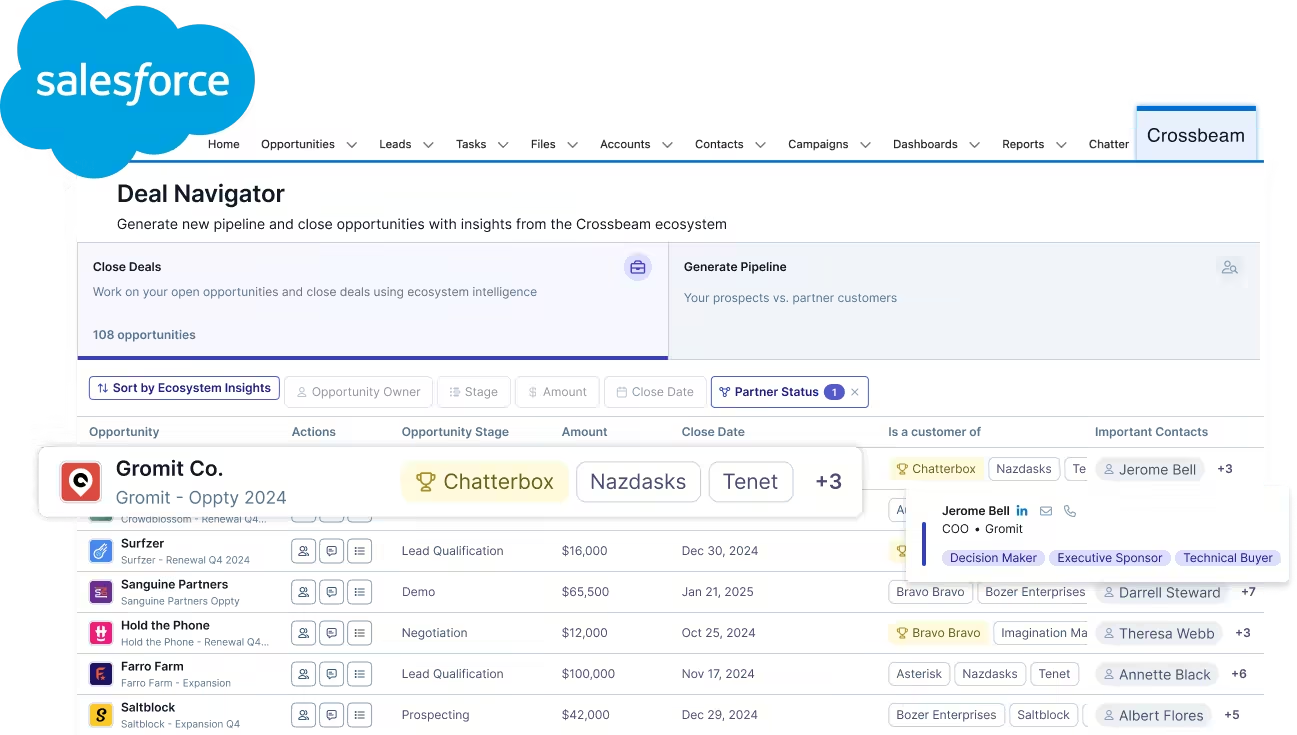
Crossbeam’s Deal Navigator in Salesforce. 

In practice, this starts with building targeted account segments: pipeline stage, ICP fit, or churn risk, overlaid with partner data to find opportunities already sitting in your CRM that you didn't know were partner-influenced. From there, it extends into automated co-selling and expansion workflows that trigger the moment a high-value overlap appears, and into forecasting and territory planning that factor in partner influence instead of treating every account as equally cold.

Why it's worth the setup cost: it's proprietary (your competitors don't have your specific partner relationships) and verified (it came from a real relationship, not an inference). This is also the layer most RevOps stacks skip entirely, not because it isn't valuable, but because it requires a live connection to a partner's data instead of a subscription you can just buy.

The limit: it depends on having the right partnerships in place, a system to share the data securely, and good CRM hygiene. You can't buy your way into it the way you can with third-party data.

Third-party data: what you build with it

Third-party data is aggregated by a provider with no direct relationship to the people or companies it describes, then sold to whoever pays.

What RevOps builds with it: firmographic enrichment for records you're missing (industry, size, revenue), technographic scoring for integration or displacement plays, and intent-based segmentation for top-of-funnel targeting when you have zero first-party or second-party signal to go on.

The limit: inferred rather than confirmed, so accuracy varies by provider and drifts over time. Available to every competitor buying the same dataset, which means it stops being a differentiator the moment you turn it on. Increasingly caught by privacy regulation that limits what providers can legally collect and how.

Side by side

First-Party vs. Second-Party vs. Third-Party Data
First-party Second-party Third-party
Source Your own customers and product A partner's first-party data, shared directly Aggregated from many unrelated sources
Ownership You collect and own it Shared with consent from another company Purchased or licensed from a broker
Accuracy High, directly observed High, comes from a real relationship Variable, often inferred
Exclusivity Fully proprietary Proprietary to you and your partner Sold to anyone who pays
What RevOps builds Scoring baselines, lifecycle stages, attribution Warm-account routing, partner-aware scoring, renewal alerts Enrichment, TAM segmentation, top-of-funnel targeting

Combining all three: what a real signal stack looks like

None of these three data types is meant to run alone, and treating any one of them as the whole strategy is where most RevOps stacks fall short.

A combined model looks something like this: 
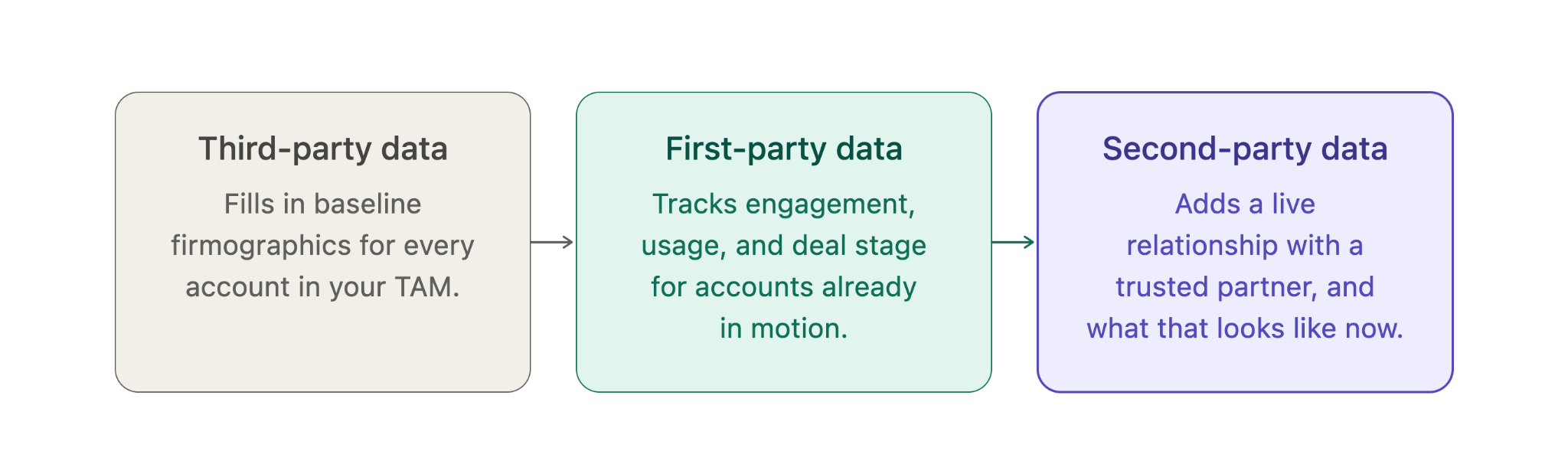
Stacked together, that's an account-scoring model that can tell the difference between "large company, no signal" (third-party only), "existing customer showing usage decline" (first-party only), and "cold account that happens to be a partner's best customer, worth a warm intro before an SDR ever calls" (second-party in play). 

The tools that connect them

This is usually where RevOps teams get stuck, not because the concept is unclear, but because each data type tends to live in a different tool with no native connection between them.

  • System of record: Salesforce or HubSpot. This is where all three data types need to land eventually, since it's where reps and automation actually act.
  • First-party data: already flowing into the CRM from forms, product analytics (Amplitude, Mixpanel, or your own event pipeline), and support tools. The gap here is usually making sure product usage reaches the CRM instead of sitting in a separate analytics tool nobody in sales opens.
  • Third-party enrichment: tools like ZoomInfo, Clearbit, or similar providers, typically synced into the CRM through a native integration or a reverse-ETL tool like Census or Hightouch.
  • Second-party data: Crossbeam connects directly to your CRM and your partners' CRMs, matches the overlap, and pushes it back as fields, alerts, or a routing trigger, without anyone exporting a spreadsheet. 
  • Orchestration: something has to decide what happens when a signal fires, an alert in Slack, a field update in Salesforce, or a task assigned to a rep. Tools like Workato, Zapier, Clay, or native CRM automation typically handle this layer, and it only works if the data feeding it (first-, second-, and third-party) is already landing in one place.

How revenue teams turn this into action

Once the data is connected, the actual RevOps output looks like a handful of concrete workflows:

  • Lead and account scoring that weighs verified partner overlap alongside firmographic fit, so a smaller account with a live partner relationship can outrank a larger account with none.
  • Routing rules that flag partner-warm accounts for a specific rep or motion instead of dropping them into the general queue.
  • Renewal and expansion alerts triggered the moment a partner's data shows risk or opportunity on a shared account, and shared with your team in Slack or by email.
  • Territory and account assignment that factors in existing partner relationships, so a rep isn't cold-calling into an account your partner already has a foothold in.
  • Deal acceleration, unsticking stalled deals with partner intel, warm introductions, and influence from the right ecosystem connections. Crossbeam's own BD team used this exact motion to close deals 350% bigger than their average.
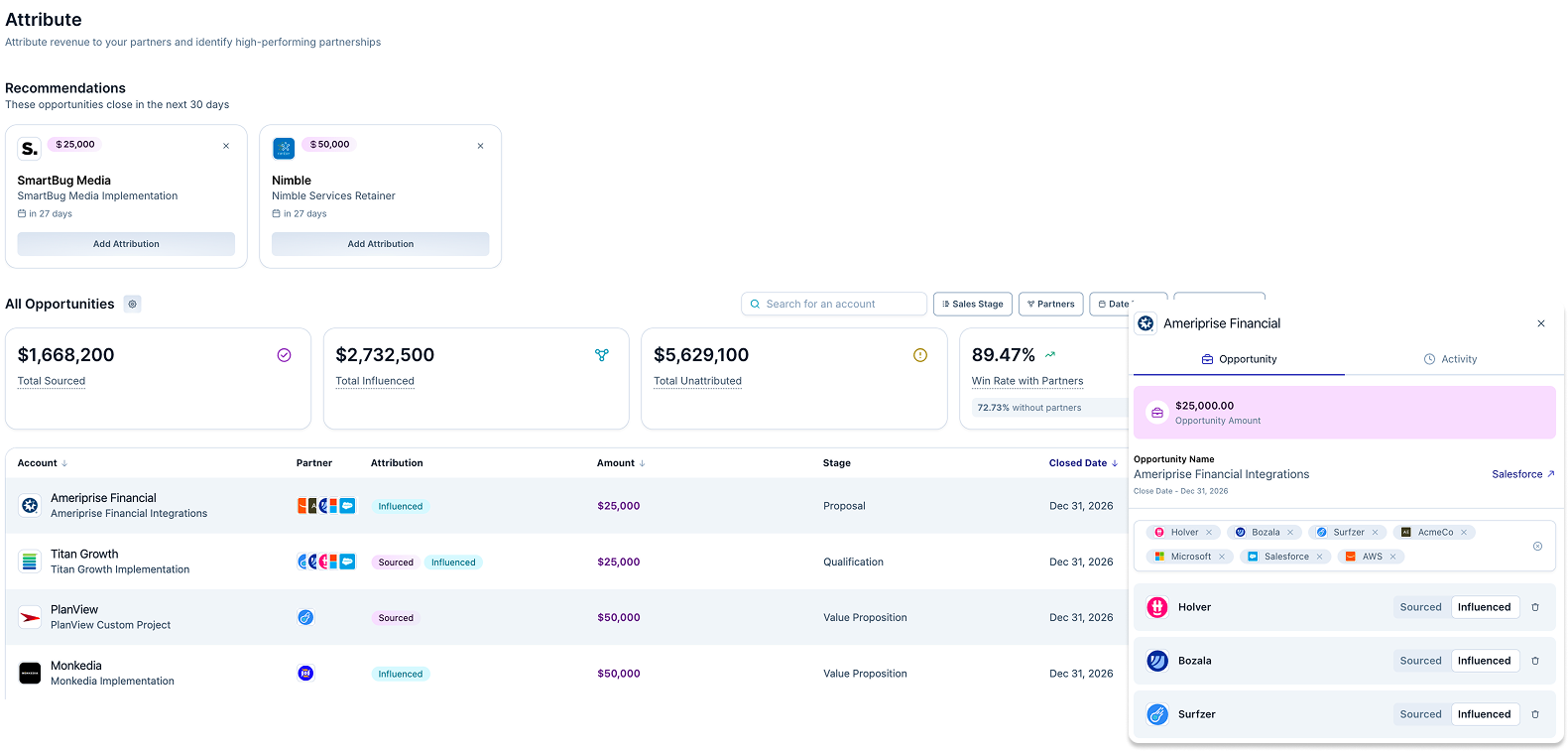
  • Attribution, tracking partner-sourced versus partner-influenced pipeline, attach rates, and win rates automatically through a Performance Dashboard instead of trying to reconstruct partner impact after the fact.
  • AI-ready scoring and planning, since a model is only as good as what it can see. Feeding real-time, proprietary partner signals into pipeline health scoring gives an AI system, or a planning process, a genuine read on deal potential instead of a firmographic guess.

How Crossbeam fits in

Crossbeam is your single source of truth that unifies fragmented partner data with your CRM and sales tools, so overlap doesn't depend on someone remembering to run a manual export.

Once that connection exists, Crossbeam Copilot pushes Ecosystem Intelligence directly into the tools your teams already use, merging partner data with your CRM and tools like Clay and Gong for clear visibility into account overlap, influence, and impact opportunities. 
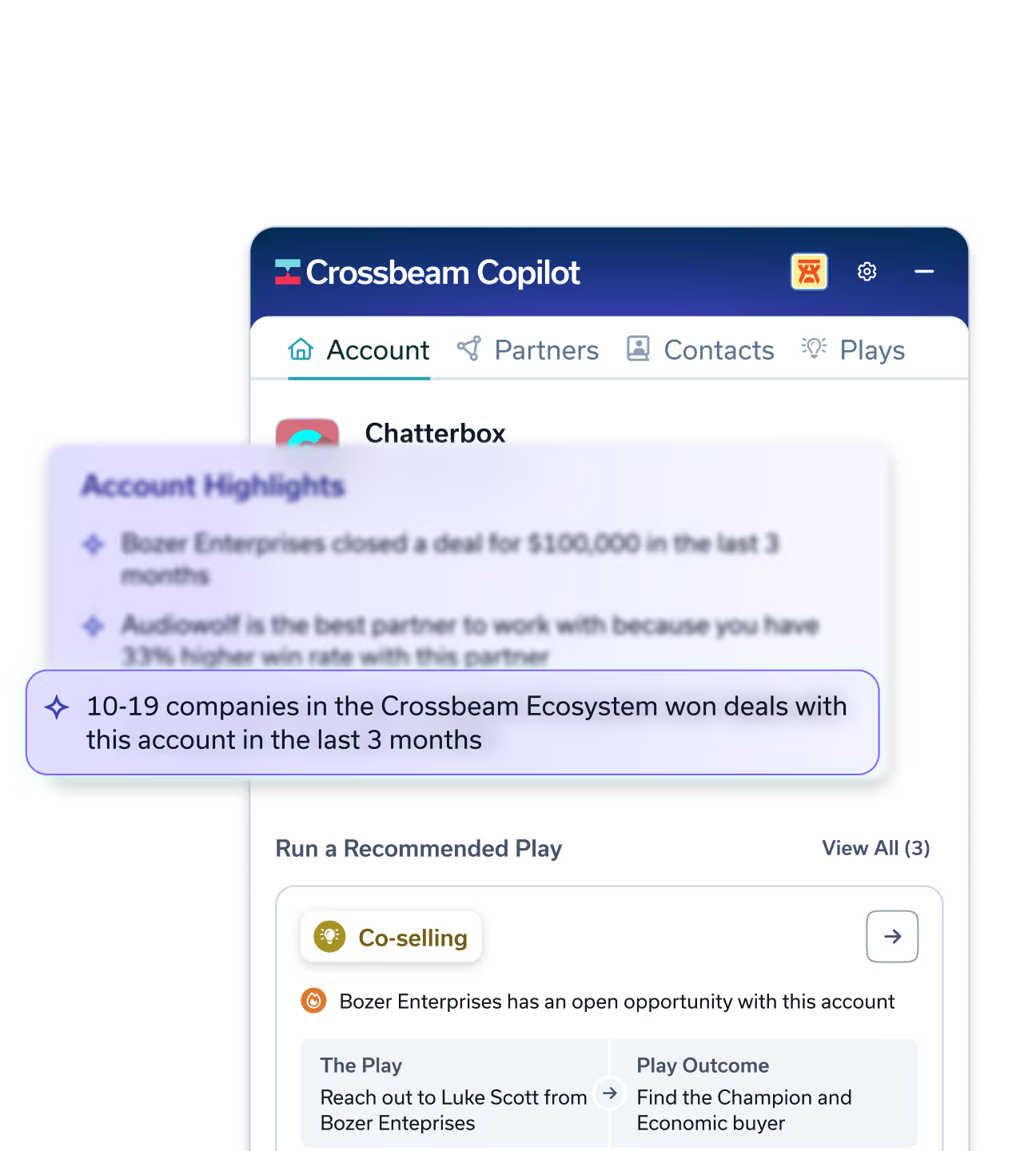
Crossbeam Copilot.

On the segmentation side, Deal Navigator lets you build ultra-specific target account lists by pipeline stage, ICP fit, or churn risk, then overlay partner data to trigger automated co-selling and expansion workflows the moment a high-value overlap shows up.
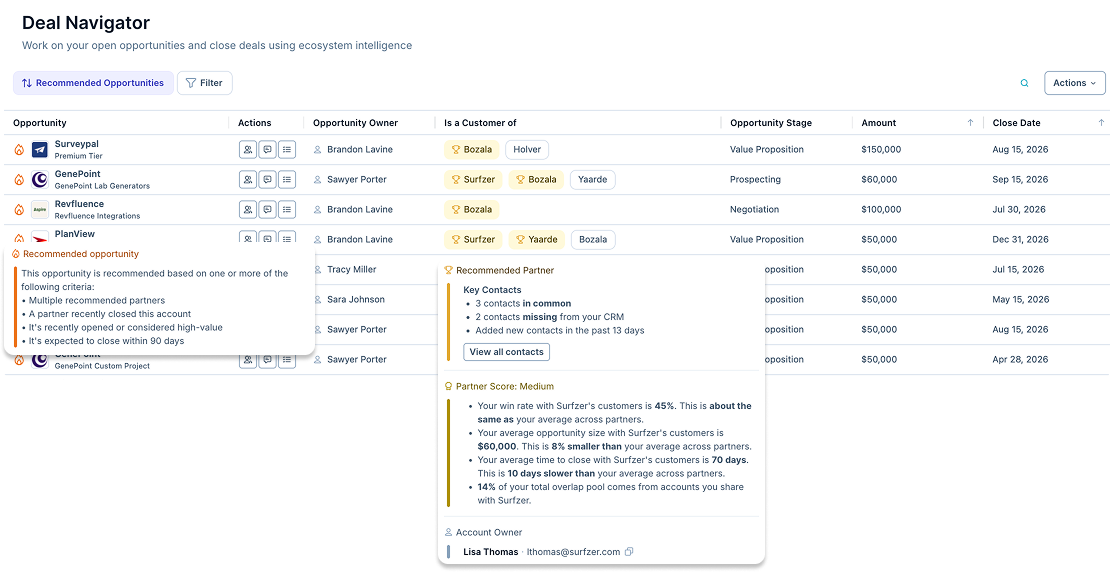
For proving it out, Crossbeam's Attribution engine tracks partner-sourced versus partner-influenced pipeline, attach rates, and win rates automatically, so the ROI conversation doesn't depend on someone manually reconstructing which deals a partner actually touched.
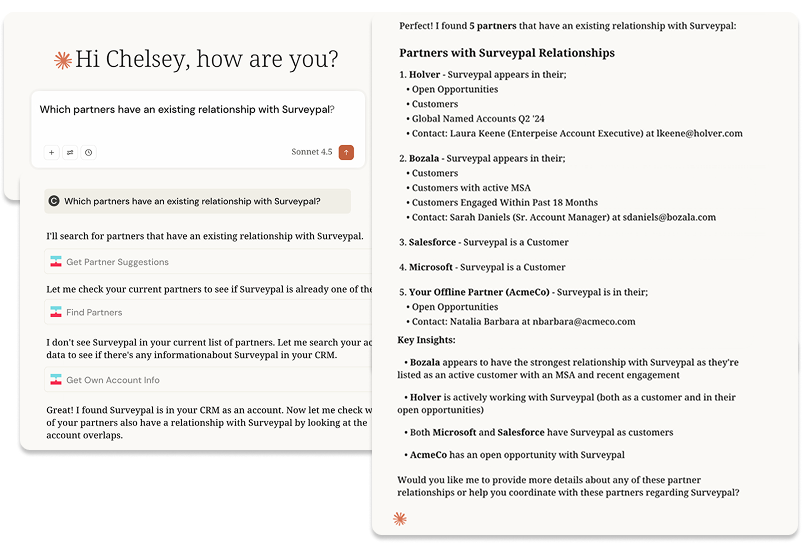
And for teams building their own scoring models or agent workflows, the Crossbeam MCP server exposes the same overlap data directly to Claude, ChatGPT, Glean, or a custom-built agent, so a model can query live partner context as part of a decision instead of a person checking a dashboard first, which is the same AI-readiness principle behind feeding real-time partner signals into pipeline health scoring more broadly.
None of this replaces your enrichment or analytics stack. It's the connective layer underneath it, since no third-party provider can sell you data about your own specific partnerships, and it's the layer RevOps teams point to when they explain how they shortened sales cycles by 46% and doubled ACVs: not a better firmographic model, but a data source competitors simply don't have.

Curious what second-party data could reveal about your accounts? Register free to see what your partner ecosystem already knows, or book a demo if you'd rather talk it through first.

Frequently asked questions

Which type of data is most reliable?

First-party and second-party data are both generally more reliable than third-party, since both come from a direct, verified source instead of an inference.

Can second-party data replace third-party data entirely?

Not entirely. Third-party still covers accounts where you have no first-party or second-party signal at all. It just shouldn't be the layer your strategy depends on.

Where does intent data fit into this framework?

Usually as third-party data, since it's typically inferred from aggregated behavioral signals across many sources rather than shared directly by a partner.

What should a RevOps team build first if they have none of this connected yet?

Start with first-party data hygiene, since second- and third-party signals are only useful once your own CRM data is clean enough to match against. From there, third-party enrichment is the fastest to stand up, and second-party data, starting with account mapping, delivers the most differentiated signal once a partnership or two is connected.


You’ll also be interested in these

What Is Second-Party Data (and Why It Matters for GTM)?
10 Signals an AI SDR Needs to Personalize Outreach
The 10 AI Podcasts Every B2B SaaS and GTM Leader Should Have Queued Up