The 2026 Sales Leader Playbook for Ecosystem-Led Growth


Learn how sales leaders can turn their ecosystem into a growth engine. Insights from Erin Bates, Crossbeam’s CRO, on operationalizing Ecosystem-Led Growth through daily sales actions, Ecosystem Intelligence, and coaching.
How to turn your ecosystem into a daily revenue engine
For many sales leaders, partnerships still feel like a supporting character — helpful, but not central to how revenue is actually won. They live in quarterly planning decks or partner reviews, not inside forecast calls, deal reviews, or pipeline meetings.
But during Crossbeam’s ELG Summit session, Alina Loux, Sr. Manager of Customer Education, and Erin Bates, Chief Revenue Officer, made one thing clear: Ecosystem-Led Growth (ELG) only works when it shows up in the day-to-day actions of sales leaders and reps.
This session wasn’t about theory. It was about execution, what sales leaders can do today to turn their ecosystem into a measurable growth lever.
Why ELG matters for sales leaders right now
Sales leaders are under more pressure than ever to do more with less: fewer reps, tighter budgets, longer buying cycles, and higher expectations for efficiency.
The data shows that teams who operationalize their ecosystem outperform those who don’t:
- ELG-influenced deals are 53% more likely to close
- Deals close 46% faster when ecosystem signals are involved
- Ecosystem-sourced customers are 58% less likely to churn
As Erin put it during the session:
“The challenge isn’t whether partnerships work, it’s whether we’ve built them into how sales actually operates. Hitting revenue targets is always the holy grail. But the two biggest challenges I see right now are pipeline generation and figuring out how to actually act on all the data teams have. There’s so much data out there — the question is, what do I look at, and how do I turn it into something meaningful?”
If your ecosystem isn’t embedded into sales workflows, you’re leaving revenue on the table.
Below is a practical playbook distilled from that conversation.
Stop treating the ecosystem as a side channel
One of the biggest blockers to ELG adoption isn’t tooling — it’s mindset.
The problem isn’t that sales teams don’t value partners; it’s that they often reduce them to a single step in the process: a warm intro at the top, a handoff at the end, or a last-mile assist when a deal stalls, rather than integrating partners across the full GTM motion.
According to Erin, this framing limits impact. “ELG doesn’t work when partners are an optional overlay. They have to be treated as core GTM infrastructure.”
Action for sales leaders:
- Position partners as part of how deals are won, not how deals are “helped”
- Instead of viewing partners as a late-stage assist, use Crossbeam ecosystem data to unlock “meaningful movement” in every deal, such as who can help, where they can add credibility, and how they can accelerate momentum.
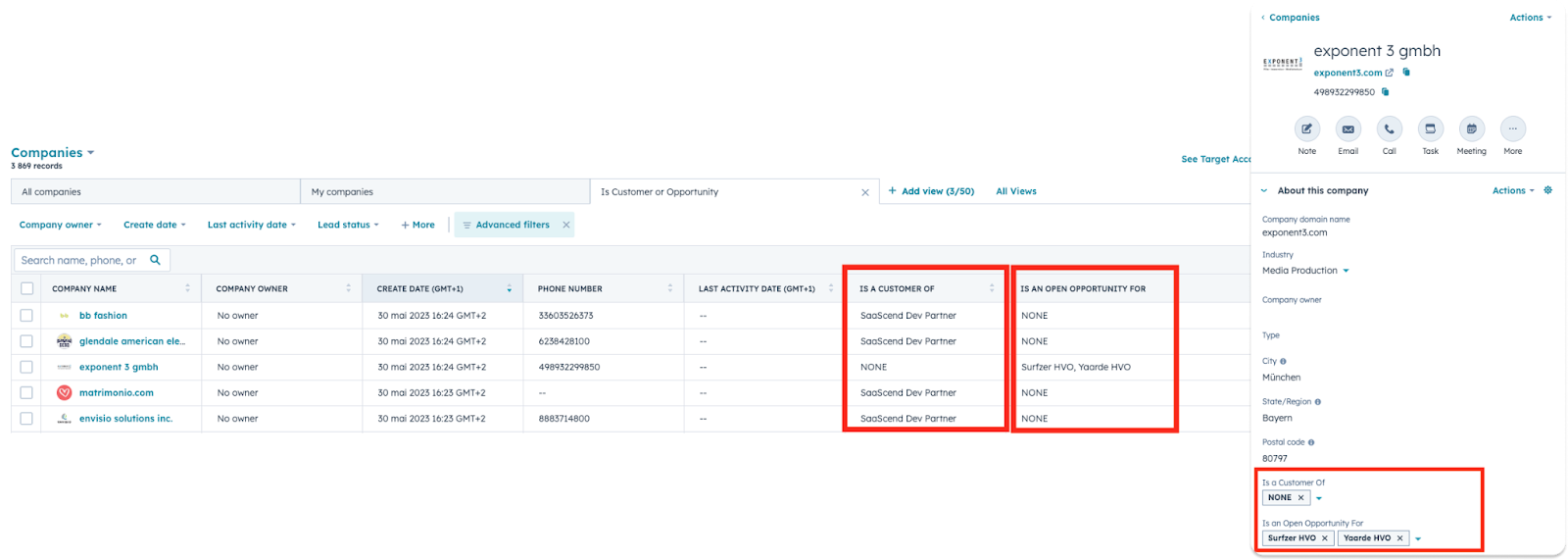
- Leverage Gong Forecast or Clari to pull Crossbeam ecosystem signals (like “is a customer of” and “is an opportunity for”) into custom fields that surface directly in forecast calls and deal reviews.
- Align sales leadership language so reps understand that partner signals are revenue signals
Erin states: “When your leader brings up in a forecast call, ‘What partner have you engaged with on this deal?’ you should know how to answer.”
Make partner data visible where sellers already work
Even motivated reps won’t use partner data if accessing it feels like extra work.
Alina emphasized that enablement fails when ecosystem insights live outside of sellers’ existing tools and rhythms. As Erin said bluntly:
“If a rep can’t figure out what to do in two minutes, you’ve lost them, they’re moving on to something else.”
The goal isn’t more dashboards. It’s fewer steps between insight and action.
Action for sales leaders:
- Surface ecosystem data directly inside Salesforce
- Use fields like “is a customer of” during deal reviews
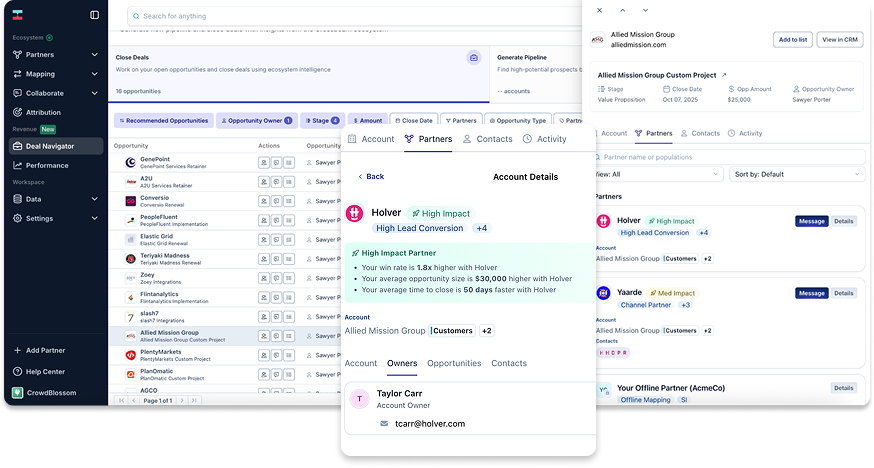
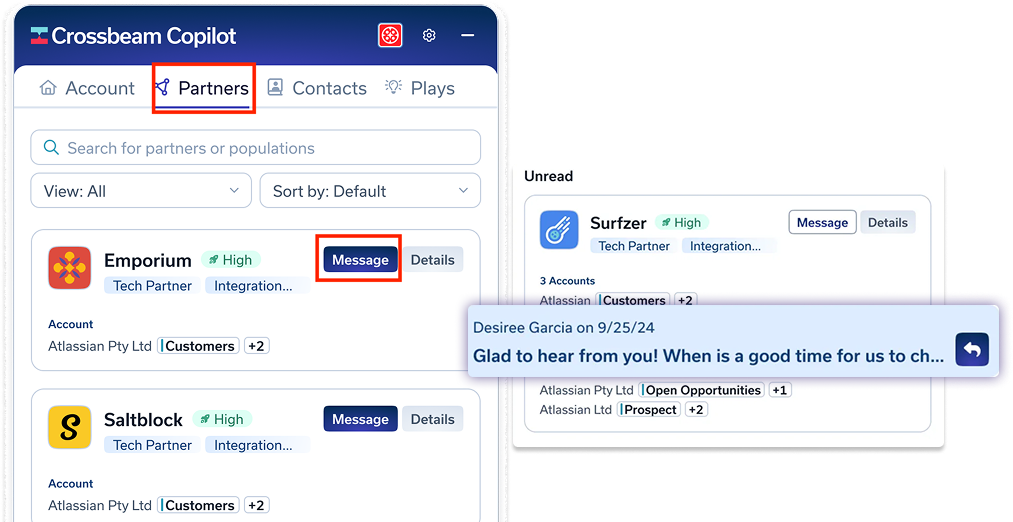
- Leverage Crossbeam's Deal Navigator intent signals to identify which accounts are currently active and focus rep effort where timing is most likely to generate pipeline.
- Turn signals into action by auto-launching tasks, sequences, or emails through tools like Gong Engage or Outreach — without manual handoffs.
- Set up real-time alerts in Slack when partner deals close or new opportunities open, so reps engage with relevance instead of guesswork.
This is where sales leaders can set the tone: if ecosystem data appears in the same places as pipeline and forecast data, it gets utilized.
Coach to ecosystem moments, not just pipeline stages
Traditional sales coaching focuses on deal stages, objections, and next steps. ELG-driven teams coach to ecosystem moments. ELG sales also focus on capturing the value of ecosystem moments.
This includes:
- When a partner enters or exits an account
- When overlap changes from prospect to customer
- When multiple vendors appear in the same deal
- When intent signals spike across the ecosystem
“Those moments are where acceleration happens,” Erin explained. “If leaders coach them early, deals move faster.”
Action for sales leaders:
- Add ecosystem checkpoints to pipeline reviews
- Ask reps why a partner is involved, not just if
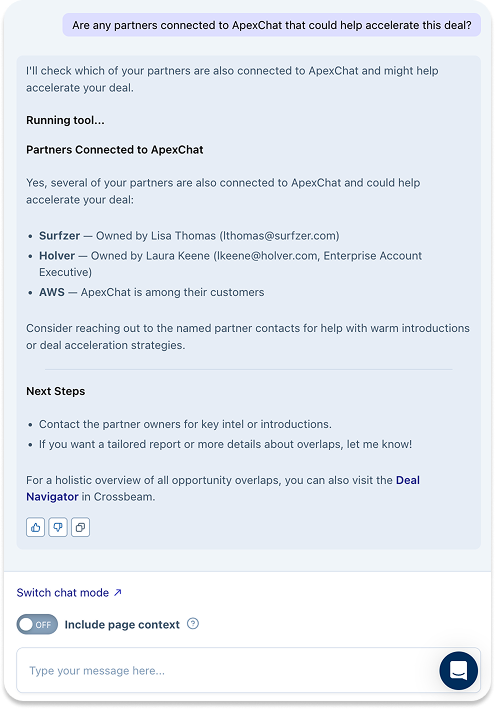
- Use AI Chat to ask "Are any partners connected to [account name] that could help accelerate this deal?”
- Reinforce partner engagement as a strategic decision, not a reflex
Erin reminds us that “The impact of turning a one-year sales cycle into a nine-month sales cycle can be really meaningful — not just for the quarter, but for the year.”
Enable sellers to act, not just observe
Insight without action creates frustration. Sales leaders need to move beyond “interesting data” and give reps clear plays they can run immediately.
Erin highlighted several ways sales teams are doing this today:
- Use Generate Pipeline to surface accounts showing real intent signals
- Rely on Crossbeam Copilot to act as the filter and highlight which accounts and contacts matter most based on real ecosystem signals, so you can stop researching everything and start working only on the accounts that are already qualified and warm.
- Use AI Chat to:
- Ask which partners can help move a deal forward
- Draft outreach emails based on ecosystem context
- Sync Ecosystem-Qualified Leads (EQLs) into HubSpot or Salesforce to trigger targeted campaigns and create higher-quality MQLs for your sales team.
- Build target account lists and trigger alerts in Slack, Outreach, or Gong
- Use webhooks to notify reps when:
- A partner closes a deal
- A new overlapping opportunity appears
The goal: remove guesswork and let reps focus on timing and relevance.
For sales leaders looking to go deeper, Crossbeam offers hands-on learning through Crossbeam Academy certifications, the ELG Bootcamp, Demo Office Hours, Special Topic sessions, and an extensive Help Center to support teams at every stage of adoption.
Proof in practice: How BEMO boosted meetings by 900%
One standout example from the session was Enrique Gutierrez, a GTM Engineer at BEMO, who rebuilt outbound around ecosystem signals.
By combining Clay, HubSpot, and Crossbeam, BEMO:
- Stopped researching every account
- Focused only on accounts with real ecosystem relevance
- Automated enrichment and prioritization
The result? A 900% increase in meetings booked.
“Before we had Crossbeam, I took it as a personal goal to learn how to use Clay, set it up, and see what we could do with it,” said Enrique. “With Clay in the picture, we were already automating 60% to 70% of all our account research. We just weren't researching the right accounts, Crossbeam acted as a data layer to reveal the right accounts to focus on.”
Alina describes it as Clay does the research, but Crossbeam is the flashlight, pointing reps to the accounts that actually matter.
Measure what you expect sellers to use
Sales teams adopt what leaders inspect. If ecosystem selling matters, it has to be measured. Erin recommends starting with the Performance Dashboard.
“It shows you where partners could have helped — but didn’t. That's an immediate coaching opportunity and immediate revenue upside.”
Action for sales leaders:
- Celebrate wins where partnerships clearly helped move the deal
- Regularly review the Performance Dashboard in Crossbeam to see where partners could have been engaged and how that might have impacted revenue last quarter and pipeline this quarter.
- Use CRM historical and current data to pinpoint open opportunities where partner involvement hasn’t happened yet, and take action to bring partners into deals that can still move pipeline this quarter.
- Analyze which reps are effectively leveraging partners and which aren’t. Use top performers as examples to coach peers and scale strong ecosystem behaviors across the team.
“You can also see which reps are using their ecosystem and which aren’t,” Erin explains. “That gives you a chance to learn from the people doing it well and help that behavior spread across the team.”
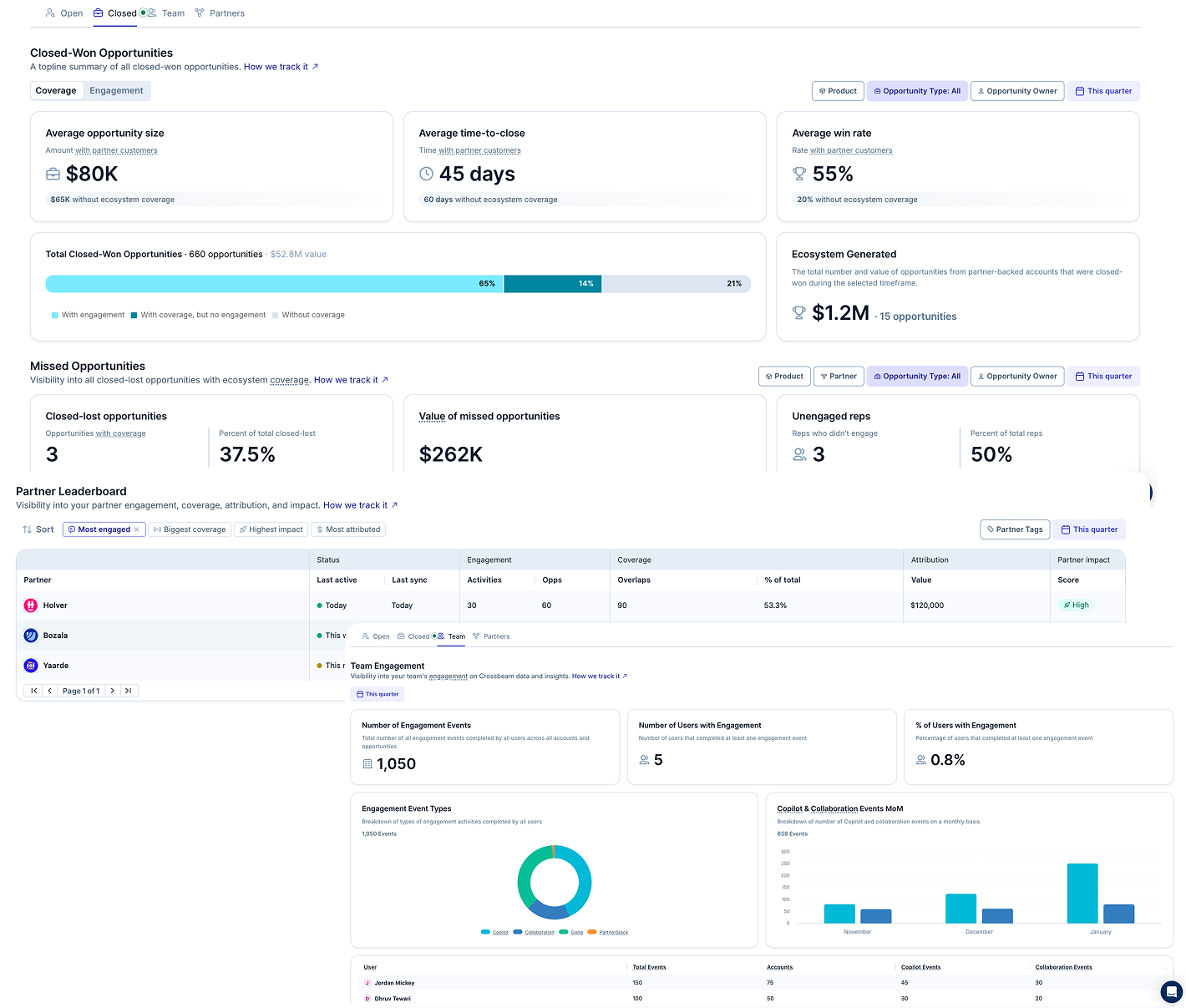
This closes the loop between strategy, execution, and results, and reinforces ELG as a first-class sales motion.
Turning ELG from strategy into a habit
The biggest takeaway from this session wasn’t a new framework, but rather a reminder that ELG is built through daily reinforcement.
When sales leaders:
- Normalize Ecosystem Intelligence
- Coach to ecosystem moments
- Enable clear, repeatable actions
- And measure what matters
…the ecosystem stops being abstract and starts becoming a reliable growth lever.
Another helpful tip from Erin, “If you just go to the Performance Dashboard and regularly check it, you can see where you could have engaged partners but didn’t — and how that could have impacted your revenue last quarter and this quarter. This gives you very clear, actionable ways to make an impact, not just long term, but on pipeline right now, for this quarter.”
Ready to operationalize ELG for your sales team?
If you want to see how sales leaders are using Ecosystem Intelligence to generate pipeline, accelerate deals, and coach more effectively, book a demo with Crossbeam.
FAQs
- Is Ecosystem-Led Growth only relevant for large sales teams? No. ELG applies to teams of all sizes. Smaller teams often benefit faster because they can operationalize partner insights without heavy process overhead.
- How do I get sellers to actually use partner data? Make it visible in their existing workflow, tie it to concrete actions, and reinforce its value during pipeline reviews, not just in enablement sessions.
- What’s the first step to operationalizing ELG for sales? Start by identifying one ecosystem signal that matters most to your business and building a simple, repeatable play around it.