


.jpg)


.png)




.jpg)


.jpg)

.webp)


.webp)


How Netskope Operationalizes Ecosystem Data in their Sales Motion


Explore how Netskope built an ecosystem-led growth strategy that aligns sales reps and partners through actionable data. Using Crossbeam, Netskope automated account mapping, improved partner collaboration, and turned visibility into a repeatable revenue engine.

Note: The data and images shared throughout this article are from sources such as Crossbeam, ELG Insider, and Forrester. They do not, in any way, reflect Netskope’s performance.
If you sell into mid-market or enterprise today, you can’t walk in alone — you need to leverage your ecosystem. Your champions already run half a dozen critical tools, and they lean on peers and existing vendors to de-risk every bet.
According to benchmark research, ecosystem-led motions consistently outperform solo selling:
- Partner-involved deals are 53% more likely to close and close 46% faster, often with ~40% higher order value.
- Two-thirds of B2B firms expect indirect (partner-driven) revenue to outgrow last year by more than 30%, and ecosystems are becoming core to growth planning, not side channels.
Yet the “last mile” is still a challenge for many sales teams. It’s not that they lack partner data, it’s that they can’t turn it into timely, rep-ready actions. Signals live in exports, emails, and Slack threads; manually swapping spreadsheets with partners, reconciling mismatched account names, and chasing stale lists kill momentum, so it’s logical that your reps skip it.
Enter Matthew Schaner, VP of Sales, East at Netskope, who will show you how to operationalize partner data so your reps actually use it (every day, in every deal).
“The manual way is a massive effort… reps just don’t do it. With Crossbeam, we improved dramatically and now we run sales plays on top of the data,” said Matthew.
Want to learn how to build and drive adoption for your ELG sales motion? Keep reading.
Netskope’s operating system for channel sales
Matthew has long pushed a 360° account surround, aligning channel and tech alliances around every target.
“For most of my career, I’ve been a huge fan and proponent of working with both our channel partners and what I consider technology alliance partners,” Matthew said. “It’s about creating a 360° sales motion around our accounts, making sure we understand not just the products the customer is consuming from us, but what they are consuming from others, and what their broader technology strategy is.”
But belief only matters if the data is accurate and it shows up in rep behavior. His solution is deceptively simple: a lightweight PG and territory plan, a spreadsheet-driven workspace that pipes in Salesforce ownership and Crossbeam overlap for a rep’s top accounts and tells them exactly who to call and why.
“In our strategy, the rep picks top accounts. The planning document auto-pulls data, normalizes names, and surfaces the alliance counterpart and reseller contact,” said Matthew. “When we meet, we can immediately say: talk to this person at that partner.”
Netskope’s step-by-step ELG sales process
A key element of Matthew’s ELG sales motion is account mapping with Crossbeam.
Crossbeam compresses the heavy lifting and turns overlap into action. “One of the huge benefits with Crossbeam is the ability to automate what would otherwise be manual processes,” said Matthew. “We run sales plays against the data we pull from Crossbeam.”
One challenge that Matthew and his team faced was identifying and developing a strategy to target prospects who already use a strategic integration partner.
To overcome that challenge in the first stage of their sales cycle, Matthew came up with an automated method to leverage Ecosystem Intelligence that follows these seven steps:
1. Pick and tier the right accounts: New reps pick around 10 priority accounts and tier them (enterprise/strategic). This focuses the system on high-leverage work.
2. Pull the signals, not just the lists: Matthew exports Crossbeam data such as:
- Contact data (who’s the person his sales teams need to reach out to)
- Overlapping data (partner name, partner populations)
- Any indicator of a previous relationship between partner and Netskope’s prospect
- Technographic data
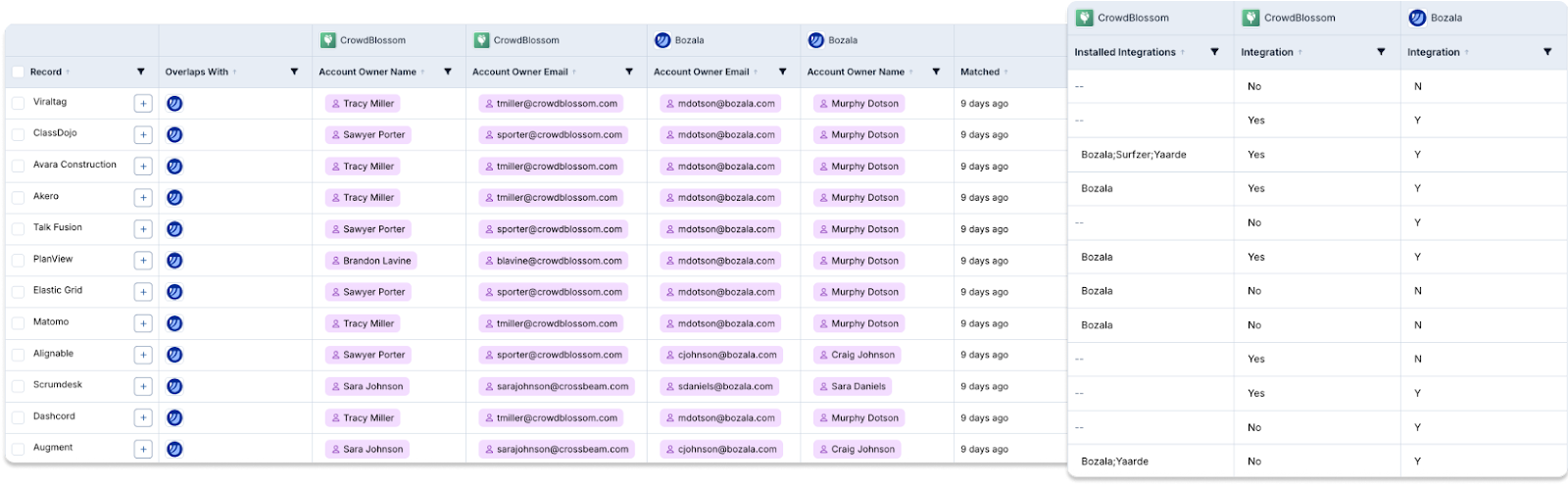
He combines that data with Salesforce data (such as customer status, country/region, account name) the plan ingests automatically. “It’s not enough to know they bought the tech, it’s knowing who to call on the partner side,” said Matthew.
3. Attach a human: For each overlapping channel and tech partners, this method surfaces the exact partner rep. The output isn’t a dashboard, it’s a to-do list with names.
4. Run an integration-first play: They cohort accounts by a specific integration and run a tight campaign including integration case studies, relevant collateral, and co-events/webinars. All anchored to the technology their prospect already uses.“The message is, ‘You saw value in what you bought; here’s how customers get more value with our integration together,’” explains Matthew.
5. Harvest real deal intel from partners: Before negotiations, Netskope’s reps connect with their alliance counterparts to gather information about procurement, future projects, use cases, etc.
6. Reference by stack similarity: When their buyers ask for proof, Matthew matches them with customers running the same vendor mix, increasing confidence that the proposal will work end-to-end. “We’re using Crossbeam not only to find the tech stack our buyers are using but to find another success story (with our integrations) that has the profile of the customer we’re talking to,” said Matthew. “Our story is going to be a lot stickier if we can find someone who uses the same group of technology vendors that our buyer is using.”
7. Inspect it in every review: In deal and territory reviews (quarterly for tenured reps, more frequent for new hires), partner alignment is a standing line item. Matthew often asks his team which reseller and alliances are engaged, who you spoke to, what intel you got, and what marketplace angles exist.
This is the behavior change: partner data and automation aren’t “sometimes tools”, they should be baked into planning, outreach, negotiation, and inspection.
Driving (and keeping) adoption with ELG
Matthew’s secret isn’t a dashboard, it’s a ritual and a culture.
He frames the transition as an “eat your vegetables” moment (it’s something you enforce because it’s going to help in the long run): reps don’t always see the value on day one, until they get their first win or get challenged.
For example, when someone says procurement is pushing for concessions, Matthew’s first question to his rep is, “Did you talk to your tech alliance partner and ask how their deal went with procurement?”
Another thing that Matthew does is that, during 1:1 or deal reviews, reps are expected to arrive with answers to the following questions per account:
- Which alliances are currently overlapping and what impact are they having on our strategy?
- Who are your counterparts at each partner organization?
- What intel or insights have those counterparts shared recently?
- Which marketplaces have you looked at?
- Who our reseller / tech alliance partner alignment is?
- Who have you spoken to before?
“If we didn’t have Crossbeam, reps wouldn’t have the necessary data to build their sales motion,” said Matthew. “Our sales process includes multiple individual touch points, but there are opportunities that we wouldn’t know about unless we’ve spoken to a tech alliance partner.”
The benefits of an ELG sales motion
The payoff of this strategy compounds quickly:
- There’s less thrash and more precision, fewer cold starts and more partner-aware outreach.
- Negotiations move faster with realistic ranges borrowed from recent partner deals at the same account.
- References land harder because they mirror the buyer’s ecosystem.
- Inspection becomes repeatable because the data exists and is expected.
As Matthew puts it, after that first win, the motion becomes self-propelling: “Once they see the result, I never have to ask them again. The really good reps understand the community and ecosystem aspect and, very often, they are excited when they see they can use Crossbeam because they see the value of how much time they save with it.”
Advice to sales leaders rolling out an ELG sales motion
If you’re a sales leader just spinning up a partner-led motion (and maybe just getting started with Crossbeam), Matthew’s advice compresses the learning curve into three moves:
- Start where overlap is real, not loud: Don’t chase the most enthusiastic partner; chase the most relevant one. Map your Ideal Customer Profile (ICP), then use Crossbeam to surface the top vendors in that space with the heaviest customer overlap.
- Treat partnerships like an investment account: At the beginning of your ELG sales motion, your reps might feel that they do all the work. That’s normal. “They’re going to have to give more than they get,” said Matthew. You have to keep making deposits: introductions, joint planning, co-selling reps through early cycles. As trust and reciprocity build, the relationship flips and pays dividends.
- Make partner prompts part of your operating system: Bake partner questions into territory plans and deal reviews: Which alliances overlap? Who’s your counterpart and have you spoken? What intel did you get: procurement, timing, what’s next? Encourage reps to use alliance teams as sounding boards:
Anchor on these three points and the motion becomes self-reinforcing. You’ll stop treating partner data as a “nice to have” and start running your business on it, where overlap guides focus, deposits compound into pipeline, and inspection turns collaboration into habit.
If you want to learn more about how to build an ELG sales motion, book an ELG Strategy call with our team.
__________________________________________________
FAQs
1. What are the benefits of running a partner-led sales motion?
According to Crossbeam data, partner-led deals are 53% more likely to close and close 46% faster, with around 40% higher order value. ELG motions also improve pipeline visibility, make negotiation smoother, and strengthen customer confidence through validated partner references and integration success stories.
2. How does Netskope use Crossbeam to enable ELG?
Netskope uses Crossbeam to map overlapping customers and prospects with partners like resellers and technology alliances. This helps sales reps instantly see which partners share target accounts, who to contact, and what integrations matter most — cutting down manual work and turning partner data into actionable plays.
3. How did Netskope operationalize partner data for their sales team?
Matthew Schaner, VP of Sales, East at Netskope, built a lightweight Partner and Territory Plan that syncs Salesforce ownership data with Crossbeam overlaps. Each rep gets a list of high-priority accounts, partner contacts, and integration insights — so they know exactly who to call and what message to lead with.
4. What advice does Netskope have for sales leaders building a partner-led motion?
Matthew Schaner recommends:
- Start where overlap is real, not just loud.
- Treat partnerships like an investment — make consistent deposits of time and trust.
- Make partner prompts part of every operating rhythm (territory plans, deal reviews, and pipeline inspection).
5. How can I build my own ELG motion?
Start by mapping account overlaps in Crossbeam, identifying your most relevant partners, and embedding partner touchpoints into your sales reviews and planning. Want to see how Netskope did it? Book an ELG Strategy Call with Crossbeam to learn how to operationalize your ecosystem data.


