
















Article
|
7
 minutes
How ServiceNow and 360insights Are Rewiring Partner GTM for the Agentic Era: Insights From the ELG Summit
Article
|
7
 minutes
Why AI + Partnerships Is the New GTM Power Combo: Insights From the ELG Summit
Video
|
50
 minutes
Building AI-driven GTM on second-party, partner data
Video
|
5
 minutes
Welcome session
Video
|
45
 minutes
The Future of Ecosystem AI
Video
|
48
 minutes
Ecosystem-Led Channel Panel discussion
Video
|
21
 minutes
Crossbeam AI in Action: From Signal to Close
Video
|
47
 minutes
Crossbeam Hot Ones with Jay McBain
Video
|
46
 minutes
How to Win in 2026 with Multi-Partner Sales
Video
|
35
 minutes
From Overlap to Revenue: Turning Solution + Tech Partnerships into Sales Wins
Video
|
18
 minutes
The Sales Leader’s Playbook for Ecosystem-Led Growth
Video
|
16
 minutes
The grand finale: ELG Story Awards
Article
|
7
 minutes
How Netskope Operationalizes Ecosystem Data in their Sales Motion
Article
|
 minutes
The Ecosystem Era: Why the ELG Summit 2025 Will Define the Future of GTM
Video
|
46
 minutes
Turning Channel Potential Into Revenue Reality
Article
|
7
 minutes
From Noise to Numbers: Turning Partnerships into Real Revenue
Article
|
5
 minutes
AI at Crossbeam: Building a Data Team for your AI Agents
Article
|
7
 minutes
AI Go-To-Market: An Ecosystem-Fueled Playbook
Article
|
 minutes
Accelerating Deals at Stripe with Crossbeam Deal Navigator
Article
|
6
 minutes
Ideal Reseller Profile (IRP): A Step-by-Step Guide to Choosing the Right Channel Partners
Video
|
 minutes
Accelerating Deals at Stripe with Crossbeam Deal Navigator
Article
|
7
 minutes
How to Use Crossbeam, Gong, Chili Piper, and LeadiQ to Close Deals Faster
Video
|
 minutes
Ring the Gong - Episode 2: Closing the Gap from Lead to Close With LeadIQ and Chili Piper
Article
|
5
 minutes
Mastering Channel Partner Management
Article
|
7
 minutes
AI and Automation for Partnership Success
Article
|
6
 minutes
How Aircall Turned a Stagnant Partnership with HubSpot into a High-Performance Co-Selling Motion
Video
|
52
 minutes
How Crossbeam Is Building for the Future of AI-driven GTM: A Roadmap Sneak Peek
Article
|
6
 minutes
How to Use AI in the Sales Cycle: Automate Outreach, Predict Revenue, and Leverage Your Ecosystem
Article
|
7
 minutes
From Pitch to Program: Winning Internal Buy-In for Channel Success
Article
|
10
 minutes
The Anatomy of a Channel Reseller Program
Article
|
5
 minutes
What Is a Reseller Program? A Modern Guide for GTM Leaders
Article
|
6
 minutes
Build a Modern AI Sales Tech Stack
Article
|
4
 minutes
The 2x2 Matrix of AI Data
Article
|
6
 minutes
AI at Crossbeam
Video
|
45
 minutes
Build a Smarter Sales Playbook: Powered by Ecosystem Data
Article
|
6
 minutes
How to Power Scalable Channel Demand with an Ecosystem-Led Strategy
Article
|
7
 minutes
Your Next Big Deal Is Already in Your Ecosystem — Here’s How to Find It Fast
Article
|
7
 minutes
How to Use Crossbeam, Gong, and Clay to Drive More Revenue
Video
|
29
 minutes
Ring the Gong: Optimize Your Sales Stack for Revenue Impact
Video
|
28
 minutes
Introducing Deal Navigator and the Performance Dashboard
Video
|
30
 minutes
What's new in Crossbeam: elevate your GTM strategy
Article
|
6
 minutes
Ecosystem Intelligence: The Shortcut to Sales That Actually Close
Article
|
7
 minutes
How to Equip Your Sales Team with the Right Signals and Partners to Close Deals Faster with ELG‍
Article
|
6
 minutes
How to Use Gong for Partnerships
Article
|
5
 minutes
The Art of Partner Vetting: Finding the Right Fit for Long-Term Success
Video
|
18
 minutes
ELG Attribution in Crossbeam: Measuring What Matters
Video
|
20
 minutes
What's New in Crossbeam: Streamlined Ecosystem Insights
Article
|
6
 minutes
How Suppeco Built their Reseller Program with WeTransact, Crossbeam, and ELG
Article
|
5
 minutes
The Two-Way Data Sharing Play: How CallRail Increased Integration Adoption by 167% Through a Strategic Partnership with HubSpot
Article
|
5
 minutes
Co-Selling for Success: How Chili Piper and Gong are Generating Millions in Revenue by Partnering Up
Article
|
5
 minutes
ELG DNA: How G2 Drives a 3x Better Win Rate with HubSpot-sourced Deals
Article
|
6
 minutes
Key Takeaways from the 2025 Future of Revenue Report and How to Action Them
Article
|
7
 minutes
How CoPort Launched Their PLM Platform with the Help of ELG
Article
|
6
 minutes
Accelerate innovation and market reach: Why data sharing is a game-changer for ISVs
eBook
The 2025 Future of Revenue Report
Article
|
4
 minutes
Your GTM Motion Isn’t Dead — It’s Just Not Partner-Led
Article
|
6
 minutes
Let's save your deal, one intro at a time
Article
|
6
 minutes
How Document Crunch Used ELG and Crossbeam to Achieve 85% of Their Pipeline Goal — And Stay on Track for 100%
Video
|
28
 minutes
Maximizing Crossbeam: Master Salesforce Reports & Dashboards
Article
|
5
 minutes
How BEMO Boosted Meetings by 900% Using Clay, Crossbeam, HubSpot, and Ecosystem-Led Growth
Video
|
20
 minutes
The Inside Track: Get to Know Crossbeam's Salesforce App
Article
|
7
 minutes
Turning Clojure Code into Temporal Gold: Crossbeam’s Data Pipeline Transformation
Article
|
4
 minutes
5 Ways to Leverage Your Partner’s Influence and Trust
Article
|
3
 minutes
ELG Insider Daily #694: Ditch drag for drive
Article
|
3
 minutes
ELG Insider Daily #693: Turn data into dollars
Article
|
3
 minutes
ELG Insider Daily #692: ELG isn’t just B2B
Article
|
3
 minutes
ELG Insider Daily #691: Stop chasing revenue alone
Article
|
4
 minutes
New Data: Involving Partners in Deals Increases Win Rate for Nearly Every Ecosystem Size and Type
Article
|
3
 minutes
ELG Insider Daily #689: Lean into your winning niche
Article
|
3
 minutes
ELG Insider Daily #687: The email inbox that ate my productivity 🎃
eBook
Template: Impact of integration tracker
eBook
Template: Tracking your tech ecosystem's impact on churn
eBook
Template: Warm intro emails
eBook
Template: Tech integrations by partner
eBook
Template: Partner tiering checklist
eBook
Template: Partner onboarding workbook template
eBook
Template: Integration questionnaire
eBook
Template: Integration announcement
eBook
Template: Co-marketing checklist
Article
|
3
 minutes
ELG Insider Daily #686: AI is a partner’s partner
Video
|
50
 minutes
Uncovering the Crossbeam Ecosystem Revenue Platform
Article
|
3
 minutes
ELG Insider Daily #685: 43% of buyers don’t want a rep…
Article
|
3
 minutes
ELG Insider Daily #683: How to put your buyer in the driver’s seat
Article
|
4
 minutes
Follow the network: Your path to market expansion
Article
|
4
 minutes
Following to Lead: How to Win Buyer-Driven Deals
Video
|
 minutes
ARReasons to pay for Crossbeam
Article
|
3
 minutes
ELG Insider Daily #681: The 5S framework is not just for marketing
Article
|
3
 minutes
Incentives: The Key to Activating Your Partner Ecosystem
Article
|
3
 minutes
ELG Insider Daily #680: A lush forest of opportunity
Article
|
4
 minutes
ELG Insider Daily #676: What it really means to scale
Article
|
4
 minutes
ELG Insider #678: The 4 +1 pillars that hold up your partner ecosystem
Article
|
6
 minutes
5 Ways to Leverage Ecosystem Data
Article
|
3
 minutes
ELG Insider #677: In business, context is everything
Article
|
1
 minutes
What's Better Than an Open Opportunity? 1.6 Million of Them
Article
|
5
 minutes
ELG Insider #661: Step aside, spreadsheets
Article
|
3
 minutes
ELG Insider Daily #674: Help write the new GTM playbook
Article
|
3
 minutes
ELG Insider Daily #673: I just want to sell, sell, sell
Article
|
3
 minutes
ELG Insider Daily #671: 7 tactics to turn partnerships into pipeline
Article
|
4
 minutes
How to Scale Your Reselling Program
Article
|
4
 minutes
ELG Insider Daily #670: Trust the process

Subscribe for Access

ELG Success Stories

How Fullstory Builds Their Tech Partnerships Program with Reveal’s Help to Increase Their Renewal Rate by 14%
by
Multiple Contributors
SHARE THIS

Discover Fullstory's winning strategy to boost customer success through seamless integrations, Reveal data, and a customer-first mindset.

by
Multiple Contributors
SHARE THIS

In this article

Join the movement

Subscribe to ELG Insider to get the latest content delivered to your inbox weekly.

Nigel Liaw joined Fullstory in September 2023 as their Director of Technology Partnerships to craft seamless integrations and innovative solutions that directly address and alleviate Fullstory’s customer pain points. 

Nigel’s mindset of putting the customer first has helped him build a tech partnership program that helped increase Fullstory’s customers’ renewal rate by 14%.

This is the story of how he and his team succeeded by having a customer-first mentality, leveraging Reveal, and making the most out of nearbound data.

Rapid read: Fullstory’s 5 steps to build a successful integration program

**Note: This rapid read is a quick snapshot of the tactical takeaways from Fullstory’s success. If you want to get the most out of this story and understand the context behind these tactics, keep scrolling to read the full story.

The result

The step-by-step guide

Your product may not be perfect, and that’s okay. You can rely on partners to fill those gaps, improve your customer experience, and increase the value proposition of your joint solution.

To enhance Fullstory’s customer experience, Nigel Liaw, followed a 5-step process to deliver more value to them:

  1. Identify potential tech partners
  2. Connect with partners
  3. Build a pitch
  4. Enable teams
  5. Track 

Here’s Fullstory’s playbook that you can use today to increase the impact of your integration program:

Identifying potential tech partners

  • Actively listening to customers’ needs and leveraging insights from customer interactions as the primary entry point for identifying potential partners.
  • Select your tech partners according to data like market presence, account overlap, contact overlap, your company’s Ideal Customer Profile (ICP), customer feedback, and your company’s strategic goals.
  • Align with your internal Product team to get buy-in and support, ensuring that the integration aligns with the overall strategic roadmap. This will help your integration strategy receive the necessary resources and backing for success. 

Connecting with partners

  • Expand your ecosystem and connect with partners, by leveraging customers, team members, and partner introductions to facilitate collaboration and drive revenue. 
  • Evaluate key elements to ensure the partnership’s worthiness. This includes identifying common customers and prospects, understanding the partner’s ICP, assessing similarities in use cases, defining the joint value proposition, and determining the added value to the customer journey.

Build your pitch

  • Leverage Reveal as a valuable data source to construct the narrative and business case for your integrations, ensuring buy-in from the Product team.
  • Communicate key insights such as customer pain points, customer insights, the number of mutual customers, the Total Addressable Market (TAM) of the integration, specific joint use cases with tech partners, and potential candidates for beta-testing. 

Team enablement 

  • Align integration initiatives with your team’s internal goals and objectives.
  • Share data points such as the partner’s relevance to customer goals, common customers, active and inactive integrations, and potential use cases with your CSMs so they can establish stronger connections with partner counterparts, understand customer needs better, and deliver enhanced value.

Track 

  • Build dashboards for measuring integration adoption, retention, and expansion. By consolidating data related to integration usage, you can monitor customer engagement and identify opportunities for improvement. 
  • Leverage Reveal data to assist your Customer Success teams in setting up plans and conducting informed conversations during Quarterly Business Reviews (QBRs). 

How Fullstory builds their integrations

If you want to make sure your partner program is successful, you have to go back to the basics. 

This means that you have to identify how you can better work with partners and how your customers can better benefit from them. 

To get this right, Kevin Crow, Global Head of Partner Management at Fullstory helped build a partner program by classifying their partners and focusing on their customers’ needs. 

“When I first started at Fullstory two years ago, I helped build our partner programs, and part of the partner operational components. It was all about systematically identifying how we better work with partners, how we aligned in accounts to work together, and how we tracked our success in Salesforce.”

Their partners are allocated in three buckets: 

1. Solution partners: Agencies and consultancies that help implement and enable customers on Fullstory by building service models.

”We have around 130 solution partners around the globe. When I started we only had 20 solution partners."

2. Technology partners: All of the companies that form part of their growing ecosystem of out-of-the-box integrations (and an open AP). 

“We are close to 100 technology partners.”

3. Google: Partners are listed in the Google marketplace, they have multiple integrations with them, and they do several GTM strategies together. 

To learn how Fullstory is building a successful tech partner program that helped them achieved an increase in renewal rates by 14% in five steps, I spoke with Fullstory’s Nigel Liaw, Global Director of Technology, and Kevin Crow, Global Head of Solution Partners.

Let’s dive in!

Identifying potential partners

There are many ways to identify partners. Still, Nigel’s favorite one is combining qualitative and quantitative data. The first step involves actively listening to Fullstory’s customers’ needs.

“Our first point of entry is our customers. We are listening to our customers first, and leveraging signals and intel that we’re getting from our customers, Product team, and customer-facing teams 
We also pay attention to where are heading in an industry and market perspective.”

Once he gets the intel from his customers, it’s time to action step two: leveraging data to support those customer insights.  

“When we want to engage with a potential tech partner, we always look at where the overlap is in mutual customers to then evaluate whether or not we have the interest to go further down with the integration.”

Nigel leverages the data he can find in Reveal’s directory like market presence, account, and contact overlap, and then matches it with his ICP and its needs to better identify potential partners. Kevin Crow shares, “Reveal is a tool that helps us evaluate the partnership, but also helps us identify where should we focus on when it comes to mutual customers with our partners.”
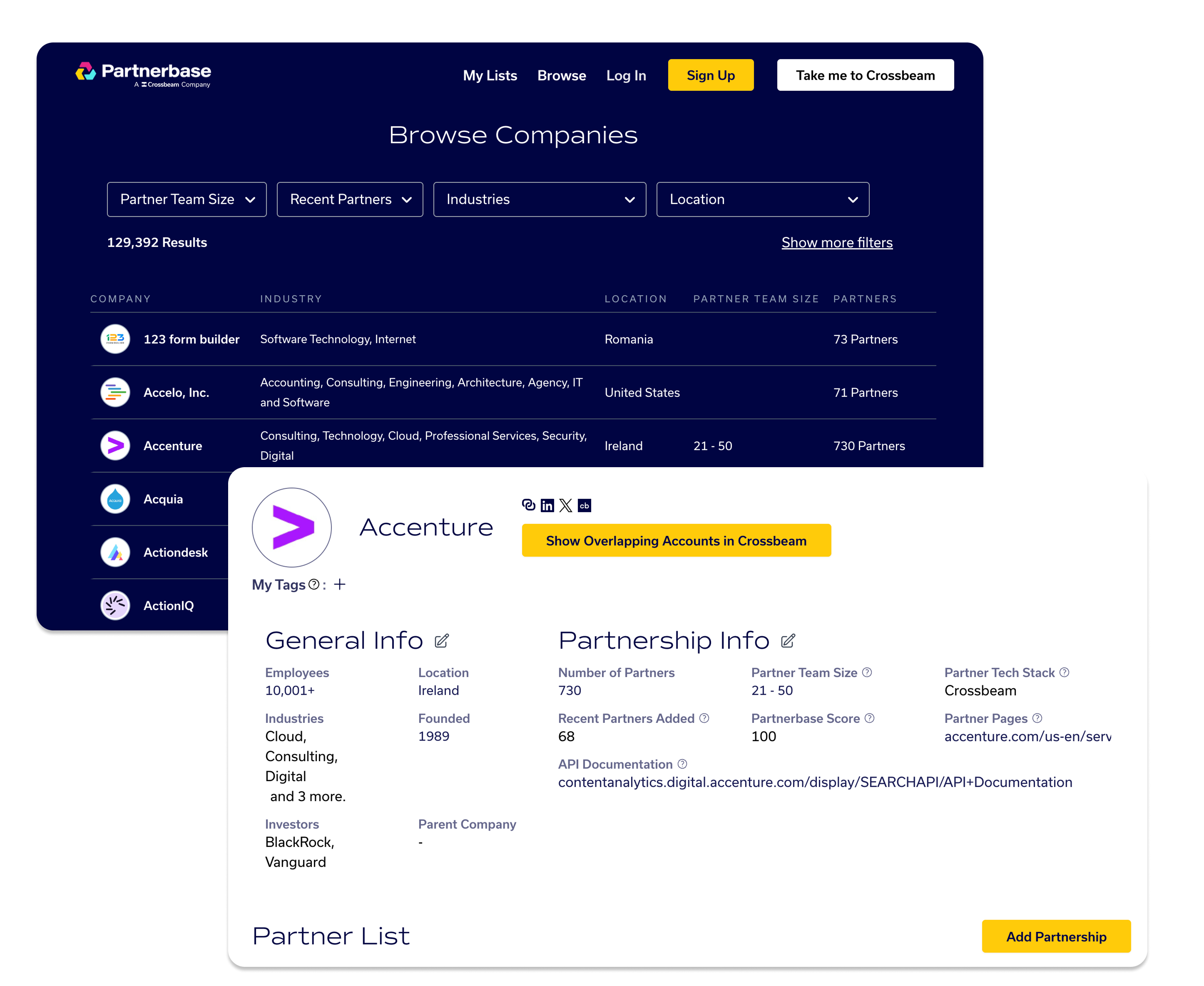
Reveal’s Directory

Connect with partners 

There’s no better way to connect with partners than by running a nearbound play. In this case, Nigel and his team tapped into the existing trust and relationships their customers, team members, and partners have with their potential partners.

This not only helps them expand their ecosystem but tap into their customers’ resources and audiences to build better and more purposeful integrations. 

“Our customers can help us with an integration to the contacts he has at the partner organization.”

Once Nigel reaches out to their potential partner, he starts thinking about how to better share data.  

“Depending on the partner and their comfort around sharing data with us, we signed an NDA, a partnership agreement, and then we start to explore how the customer overlap will look like.”

To make sure a tech partnership is worth pursuing, here are some elements Nigel always looks for before even trying to pitch it to their Product team:

  • Who are our common customers and prospects? 
  • Who is their ICP?
  • What are the similarities in use cases?
  • What will the joint value proposition look like? 
  • What is the extra value added to the customer journey?
“It’s all about evaluating how our existing product and solution that our customers are buying can be enhanced with a partner.”

And as always, you need to back up your integration with data. Now is the time to leverage Reveal. 

“We use Reveal to set up the program and the partnerships once we identify those partners that bring more value to our customers.
We’re primarily looking at account overlap filtering that down to our ICP and identifying mutual customers and joint opportunities.” 
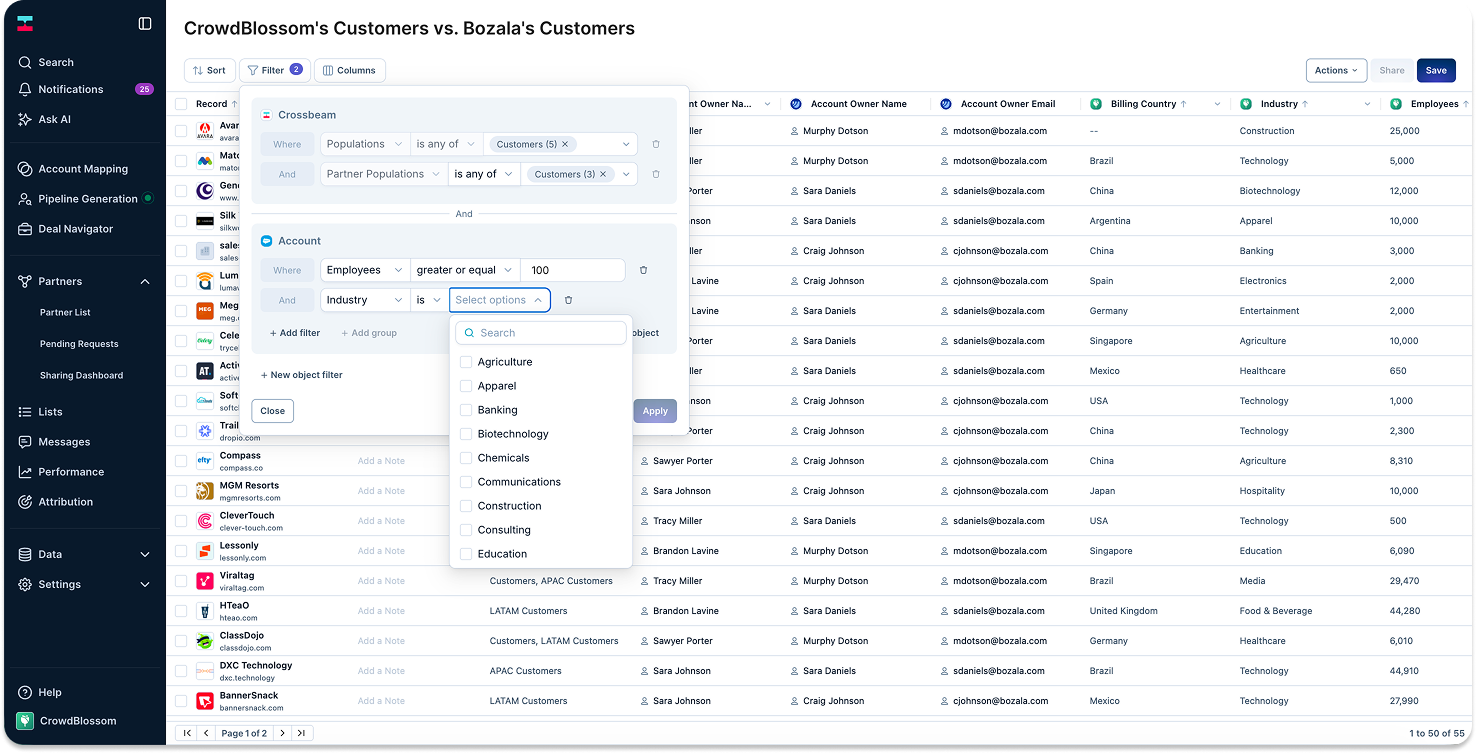
Reveal’s 1:1 account mapping with the “Common customers” view and ICP filter.

Build your pitch

Now that Nigel has the data and the joint value proposition, it’s time to build the business case to ensure their Product team doesn’t say, ’Thank you, next’. 

“When it comes to using Reveal, it’s a great data source to help build the story and the business case around building the integration.” 

Whenever Nigel has to pitch an integration to his Product team he focuses on sharing customer and Reveal data like:

  • Customer’s pain points
  • Customers insights
  • The number of mutual customers and a couple of examples
  • The TAM of the integration 
  • The tech partner that closes their product gap and the specific joint use cases
  • Identify candidates for beta-testing and new product integrations 
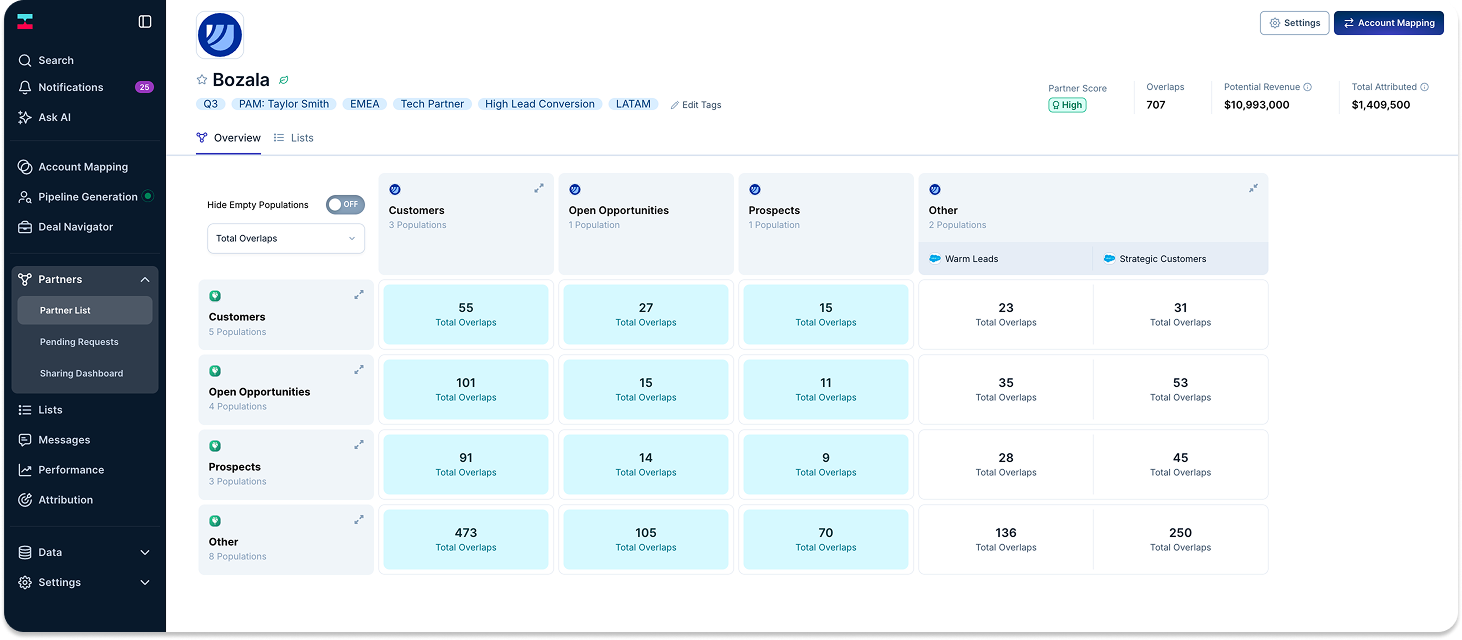
An overview of your Total Addressable Market in Reveal and a HubSpot report. 
“There are two parts you need to consider when building your pitch. The first part consists of identifying what is the data telling you and the second part is how can you action the data or even leverage it to help you inform part of that integration process. The data around the mutual customers help us inform and prioritize our partners.”

Team enablement

When Nigel is rolling out an integration and wants to enable his internal teams, he emphasizes how the integration will help them reach their goals—speaking the language of each team.

“We use Reveal to go and look at how many integrations are currently active on our side versus the total number of customers we have overlap with. We enable our Customer Success team on the value of the integration so they can later reach out to their customers and share the JVP of the better together story.”

In addition to telling the Customer Service team how the new integration is going to help them reduce churn, increase retention, or expand their account list, you have to show them how. 

“A lot of CSMs focus a lot on their customers and how are they using their product. But a paradigm shift that Reveal is activating, is that this is not only about your product, but your product plus the product stack your customers are using," says Kevin Crow.

Nigel and his team build a series of workshops and enablement sessions that help them understand how to leverage partners for each use case or goal their CSMs have. 

“Consider the role of your CSMs. Are they thinking about retention or expansion? Then consider their goal and their type of customer or account list. Based on that, create specific programs or playbooks for them focused on how they can leverage the new integration based on their goals.”

What Nigel, Kevin, and the Partnership team do is share the following data points in Reveal with his Customer Success team to help them better leverage the tech partner: 

  • The partner that can help them reach their goal
  • The common customers with the partner 
  • The number of common customers with an active integration 
  • The number of common customers with no active integration
  • Which of their customers’ tech stacks do they have a great use case with
  • Which of their customers’ tech stacks do they have an actual integration with
“This data can help your CSMs connect with your partner’s CSMs. In this way they will leverage your partner relationship to understand better the customer and deliver more value.”
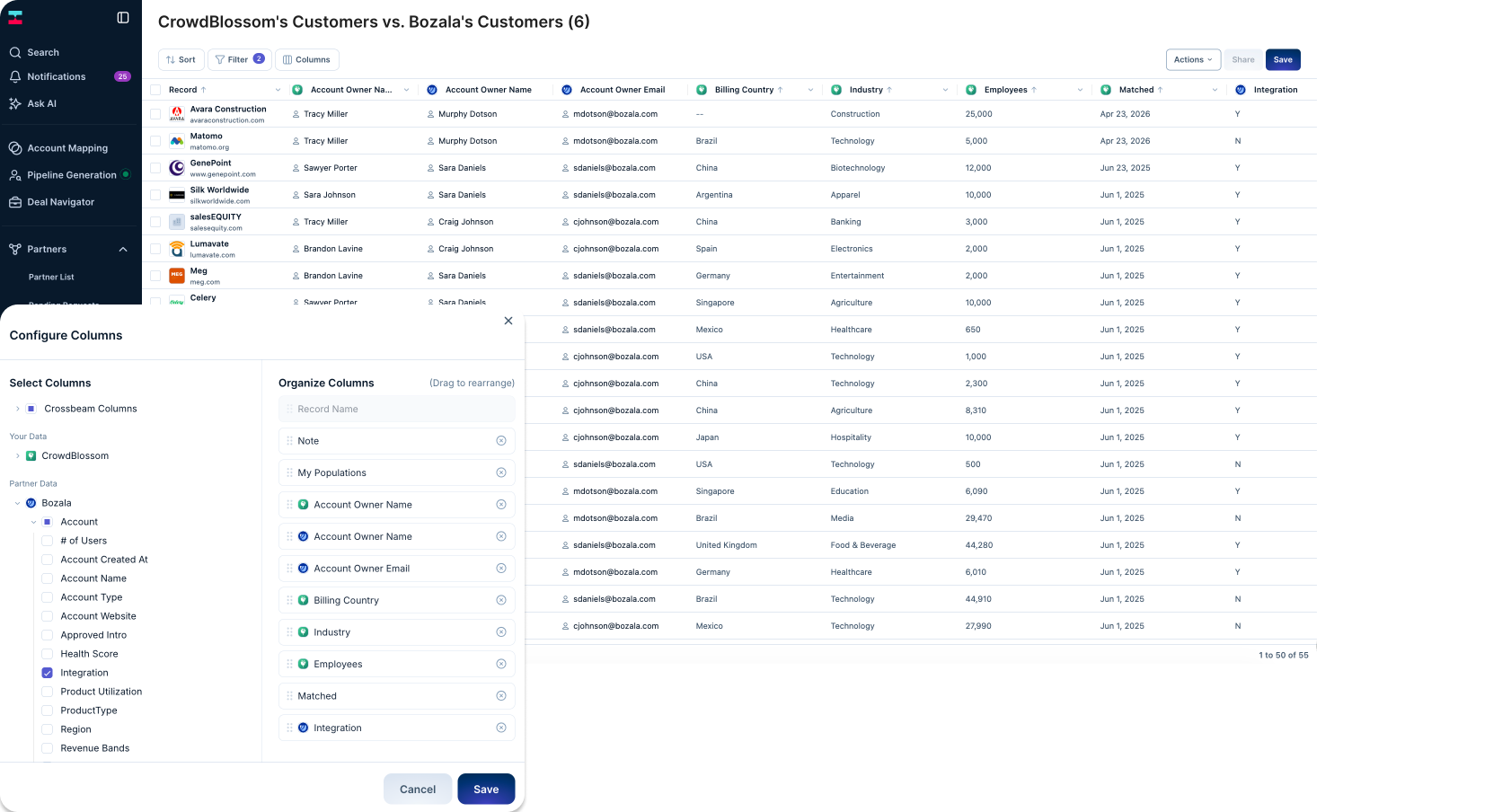
How to add the column of active/inactive integrations in Reveal’s 1:1 account mapping
Reveal’s 1:1 account mapping with the imported field “integration”c
“We take all the Reveal data, and push it into Salesforce, so CSMs should look in Salesforce before they have a quarterly review with their customers. They should be able to look at and identify the integration opportunities. CSMs are a critical component in closing the integration loop.”—Kevin Crow
Integration dashboard in Salesforce based on the “(Reveal) Is a customer of” field 

Track

To measure the integration adoption, retention, and expansion, Nigel and his team, built some dashboards in Looker Studio and all the data related to how many customers are using their integration goes to that dashboard. 

“We validate and verify the data in Looker Studio based on the number of customers we see in the overlap in Reveal. This data helps us identify those customers that aren’t using the integration. With this, we can meet with our partner and discuss some strategies to push the integration to all of our common customers.”
Integration performance report in Salesforce based on Reveal data on inactive integrations
“Reveal has helped us a lot in terms of preparation, from partner reviewing to helping Customer Success teams. If we’re looking at a QBR for a specific customer, we can help the Customer Success team set up their plan and the conversation with the customer.
Reveal has helped us quickly identify those low-hanging fruits regarding integrations. So every time we talk to the customer, we’re more informed and have more knowledge regarding their current tech stack.”

The power of integrations

Buyers want to be surrounded with value at every step of their journey. But single companies can’t do this alone. 

Fullstory leaned on the trust and expertise of their partners to build a better customer experience leading to: 

  • An increase of 14% in renewal rate for customers with 2 active integrations or more. 

A final word: Nigel’s and Kevin’s advice to those starting on Reveal 

There are so many use cases for Reveal, but if you’re focusing on driving customer success, Nigel and Kevin have some tips for you:

  •  Leverage data to facilitate discussions not only with your customers or partners but with your internal teams too. 
“Reveal data can help you recruit partners and build internal business cases on why building a strategic partnership or an integration is important.”—Nigel Liaw
  • Use overlap data to identify which integrations are worth pursuing. 
“There’s an infinite list of other SaaS technology companies that want to integrate with you. Reveal helps you be smart and thoughtful around that. As soon as you pass the use cases of the integration, the real key to understanding what the potential of the integration is through the overlap data. Reveal helps you build the integration and do something commercially thanks to the data around your total addressable market and your overlap opportunity.”—Kevin Crow

Want to learn more about how to drive nearbound customer success by leveraging integrations in Reveal? Book a call with our team. 

Let’s talk about strategy!

You’ll also be interested in these

Article
|
7
 minutes
How Pigment Increased Win Rates 5-10% with a Nearbound Overlay & Reveal
Article
|
7
 minutes
Oneflow Sees a 190% Surge in Created Opportunities After Beginning Two-Way Data Sharing with HubSpot
Article
|
7
 minutes
How Box Uses Reveal Everyday to Power Their Nearbound GTM