


Subscribe for Access


What should be included in a partnership agreement + so much more.

Note: this is the latest in our Partnerships 101 series. You can read the others below:
- Partnerships 101: ISVs, VARs, SIs, MSPs, and the Glue that Holds them Together
- Partnerships 101: What’s a PRM and should I use one?
- Partnerships 101: How to Execute a Co-Marketing Motion to the Right People, Every Time
- Partnerships 101: Account Mapping. How to (Finally) Do It Without Giant, Cumbersome Spreadsheets
- Partnerships 101: How to Organize and Execute an Online Event With Your Partners
Tech partner programs can show a strong ROI by bringing in new leads, closing more deals, and reducing customer churn. For many SaaS companies, a good tech partner program can be the difference between failure and success. Getting it right matters. But, where do you start?
I work at Pandium, where we sell an integration platform specifically for building SaaS marketplaces. We’ve helped dozens of clients, partners, and prospects through the process of launching and growing their tech partnership programs. I’ve seen many tech partnership programs taken on by partner managers who are doing it for the first time (we even wrote a book about it).
In this article, we’ll take a whirlwind tour of the major pillars of rolling out a technology/integration partnership. We’ll cover:
- What is a Tech Partner Program?
- Attracting Tech Partners
- Finding Partners: Direct Outreach
- Finding Partners: Inbound Leads
- Persuading Partners to Join
- Writing a Partner Agreement
- Launching and Maintaining the Integration
Let’s go!
What is a tech partner program?
First, let’s get on the same page. A technology partner is a fellow product company that offers an integration to your product (or vice versa). Thus, “technology” partners are often referred to as “integration” partners. Think of how Freshbooks allows you to submit expenses from Dropbox. Or InVision prototypes can populate a JIRA ticket. Or any Slack plugin.
A good technology partnership makes each product more “sticky”—when your favorite tools all work together, you’re less likely to have a reason to switch to competitive products. As a partner professional, you may be measured on the number of technology integrations you secure or leads generated from technology partners.
Attracting tech partners
Identifying your first partners should start with a thorough mapping of your customers’ journey and understanding of what other software they are using. It helps to know your average customers’ tech stack, which you can find through customer interviews, sites like stackshare.io, builtwith.com, or through products like G2 Stack for Enterprise.
(Note: You can use Crossbeam to connect with possible partners, find your overlapping customers, and know exactly where to build your next integration. Sign up for free here.)
Once you get a good sense of your average customers’ tech stack, you can brainstorm which integrations they would find most valuable to improving their workflow.
Customer feedback is also key. Find out if there are integrations prospects and customers are constantly requesting. Check your customer forums, talk to your customer success managers, and see if there’s been any requests via social media.
Once you’ve developed a shortlist of integrations your customers would most value, further evaluate the potential partners for brand alignment, technical suitability, and their available support and resources.
For example, if you’re going to integrate with a larger software company, you’ll likely have to build the integration, while a smaller company might be willing to build into your product. However, smaller companies might have less robust APIs or less support for their API.
Finding partners: Direct outreach
In the beginning, you’ll have to rely more heavily on direct outreach to develop new tech partnerships. As you grow, you can attract more inbound leads and add scalable processes to facilitate these relationships.
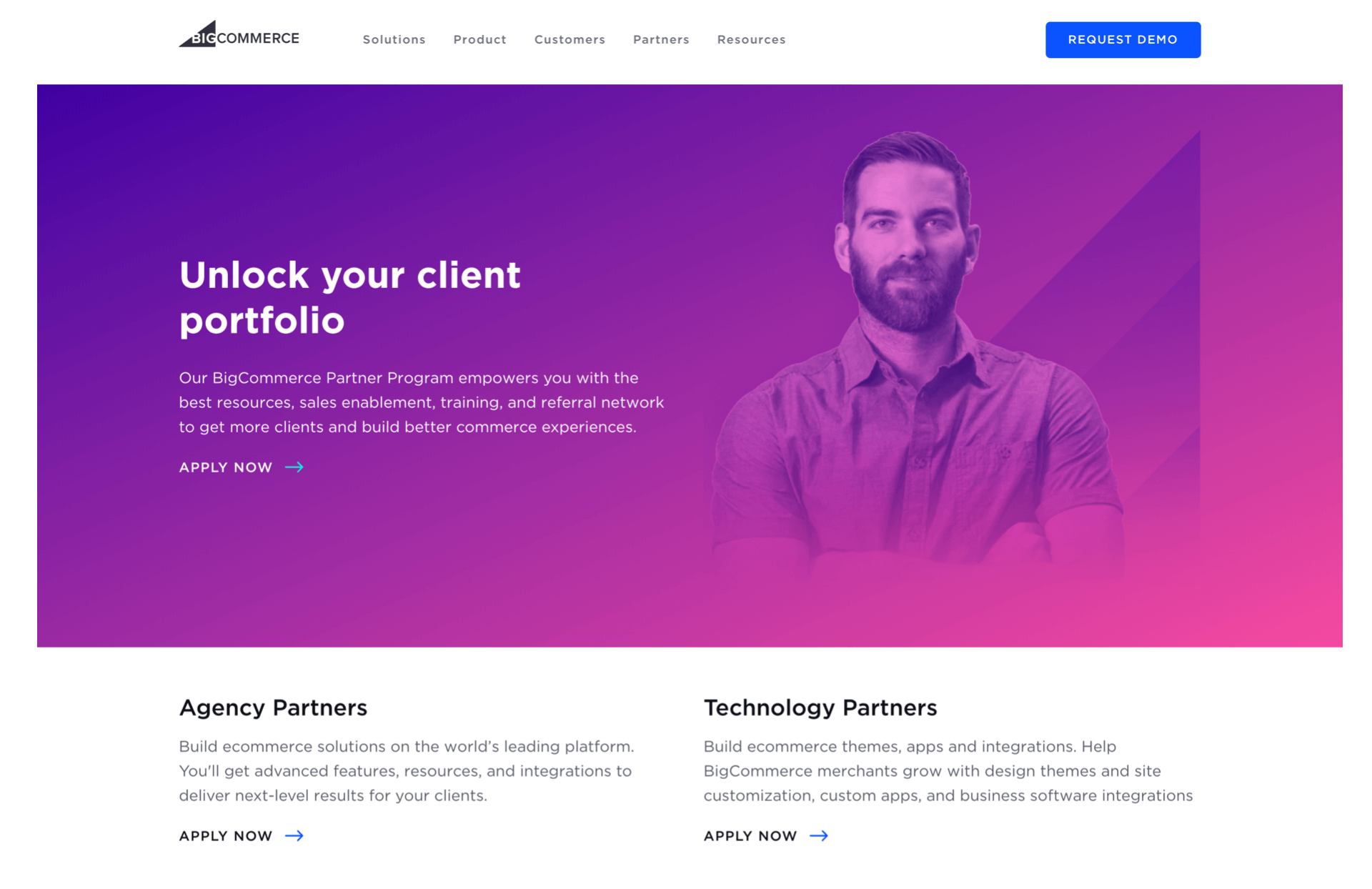
Larger companies, like Box and BigCommerce, often have a form on their website where you can apply to become a tech partner. Other companies, like Klaviyo, list an email to reach out to. These forms and dedicated emails work well for starting conversations.
If there is no public form or email for a potential tech partner, and you don’t have a personal connection, look for the relevant partnership person on LinkedIn. Limit your search by the company you’re targeting and then do a search first with “partnerships” and then with “alliances” in the job title.
Once you’ve narrowed the results down to the partnerships team, identify if anyone has “tech partnerships,” “strategic partnerships,” “tech alliances,” or “strategic alliances” in their title. (And if you find this hard to wrangle, don’t worry you’re not alone. Partnership job titles are all over the place.)
These are the people you’d want to reach out to first. If no one has those terms in their title, reach out to the highest-ranking (usually a VP of Partnerships or Head of Partnerships) person listed, as they will likely oversee both channel and tech partnerships.
If you’re targeting a smaller company and no one has “partnerships” or “alliances” in their title, you can pick the highest-ranking person with “business development” or “revenue” in their title and they can often point you in the right direction.
Once you’ve identified the target person on LinkedIn, find their email (if you don’t already have a method to do this, you can use a free extension like Hunter or Clearbit Connect.)
A simple email like the following should do the trick:
Subject: My Company – Your Company tech integration?
Hi,
My research shows we share a number of the same customers, and we market to a similar audience. Our customers are frequently asking for an integration with Your Company’s Product.
Can we schedule a call to discuss a potential tech partnership?
If you’re planning to build the integration yourself, you can mention that as well.
Finding partners: Inbound leads
An important part of a scalable tech partnership program is having tech partners come to you. This means marketing your program to both partnership teams and developers.
As soon as you’ve got a half-dozen integrations, create a webpage dedicated to your integrations. These pages have a grid of tiles showcasing all your integrations, and are, at a minimum, searchable by product category. Check out BigCommerce, Klaviyo, and Aircall for examples.

This page not only tells your potential partners you’re serious about your tech partnerships, it helps you to collect analytics on leads that can prove ROI.
If you have a public API, market it to developers as reliable, easy to work with, well-supported and robust in its functionality. Get developers excited to work with your API through developer-dedicated web pages, developer forums, and developer events. For example, BigCommerce’s developer pages are well-written and easy to navigate. They also have active forums where they and their partners answer questions.
Other companies that have good developer pages are Google’s GKE, Mailchimp, LeagueApps, and ShipBob.
Marketing to partnership teams can include web pages that make the business case for your product as well as any data you have on how integrations with your product attract leads, reduce customer churn, or increase upsells.
Aircall’s and Box’s tech partnership page, for example, explains how a business will grow by partnering with them. Salesforce also makes the case that a business can gain leads and new customers by joining their tech partnership program.
Eventually, marketing to partnership leaders can include ads, account-based marketing, and event marketing.
Persuading partners to join
Once you’ve made contact with a potential tech partner, the next step is to get potential partners excited about becoming part of your program.
In addition to your website, create a one-sheet PDF and a deck designed for the partnership team, as well as a one sheet for developers. The partnership one sheet should include:
- Elevator pitch for your product
- Number of users you have, and anything that makes them high value (for example, enterprise size accounts)
- The value of integration and integrating with your product
- Why developers would want to work with you, including any support or resources you offer
- Co-marketing and co-selling resources you offer for those in your tech partnership program
- Quote from a current integration partner showing ROI, if possible
- Any significant logos of customers or partners
Schedule a call where you can run through your sales deck. If possible, include a short demo at the end. Otherwise, schedule a follow up call to share your product in more detail.
The more data in your sales deck, the better. If you use Crossbeam, you can cite the number of shared customers to demonstrate the need for the integration. A case study with a current tech partner showing clear ROI can also help.
Share the size and nature of your own user base, its growth, and its budget. However, if these numbers are not impressive, lean into your vision and brand. HubSpot, for example, articulates their commitment to growing alongside their partners in a way that might compel partners beyond the numbers. DrChrono also leans into their brand, encouraging partners “make a dent in the universe” by joining them in “chang[ing] healthcare.”
Sharing the user story of how customers would use the integration, and a quote from one of your customers requesting the integration can also show a potential partner there would be real value in an integration with your product.
Writing a partner agreement
Once a potential tech partner is excited about the idea of building an integration to your product, share your program’s terms and conditions either via email or follow up call.
Most fully scaled tech partnership programs, like Shopify, Box or Pivotal, have tiers of partners with different obligations, requirements, and terms, with the information available on their website.
If you’re trying to build an integration with a larger partner, you will have to work off their terms and conditions. The smaller you are (unless you fill a significant unmet need of their users), the less likely they will be to modify their terms.
Initially, you will not want to list the terms and conditions of your program publicly so you can be more flexible in your arrangements depending on a potential partner’s value to your business.
Draft a standard contract that you modify according to each partner. Obviously, you’ll need your lawyers to approve the language, but HubSpot’s terms are available here and databrick’s are here for reference on what types of issues should be addressed.
Items you should establish in your tech partnership agreement include: approval process, monetization, co-marketing obligations, co-selling obligations, support, data exchange and tracking, and failure to comply.
Whew. Let’s look at each one quickly:
Approval process
Specify what the technical requirements are to enter your marketplace or, if you don’t have a full-fledged marketplace yet, to create an integration with your product.
Initially, you might want to ensure your terms of service require high technical standards for every integration to your product. This establishes a positive brand for your integration marketplace.
As you grow your program, you can offer different tiers of partners with varying degrees of tech oversight by your developers, making it clear to customers what the technical standards are for each tier. Shopify, for example, requires Shopify Plus Certified apps to meet higher standards of security and performance than the regular apps in their marketplace.
Monetization
Larger SaaS companies often charge an annual fee and/or take a percentage of their tech partners’ revenues that are driven from their marketplace. Salesforce charges an initial security review fee of $2,700 as well.
These annual fees can be in the tens of thousands for elite tiers of partnership. Box’s range from $10-25k and Magento’s are $10-20k, for example.
Depending on the size of your user base and how many leads you’re likely to drive for a partner, upfront costs should be negligible. Revenue cuts of larger marketplaces are often 15 percent (though they can be up to 30 percent) so adjust down according to the benefit your partners will see, and how quickly you want to grow your app marketplace.
Co-marketing obligations
At a minimum, you’ll want to identify how your partner can use your logo and vice versa. Beyond that, you’ll want to specify if the co-marketing opportunities are optional or required. At the beginning of your program, unless you have many companies jumping to build integrations into your product, you will want to ensure your partner’s obligations are not that arduous.
You might consider requiring or encouraging a dedicated webpage on the integration, issuing a press release about the integration, webinars, case studies, ebooks, blogs, and participation in events.

Initially, these terms should be negotiated with each partner by referencing who is bringing more to the partnership in terms of users and meeting a critical need of current customers. If you both benefit roughly equally, consider requiring both parties to contribute a press release, a blog, and sharing on social as marketing obligations.
If the other party has less to gain, consider offering more marketing requirements on your end to make the deal more compelling.
Co-selling obligations
Like with co-marketing, specify what co-selling obligations are required and what are merely encouraged.
You might consider training their sales team in the integration, creating sales collateral to give to prospects and customers, and sending over referrals.
If you’re roughly equal partners, consider requiring each sales team take a demo on the integration and have a one-sheet PDF on the integration that they can share with prospects.
Support
If there is an issue with the integration (whether due to a malfunction or user-error), who will provide support for it and how will this be communicated to the customer? It is important that this is clear to the customer as well as to your team and your partner’s team.
Data exchange and tracking
There are many different ways to track the success of an integration partnership, from Google Analytics tracking visits to the integration tile page to products like Gainsight PX or Amplitude that show usage and its effect on retention. You can also use a PRM to track referrals.
Specify the data you will be providing to your partner and vice versa. The more data you can provide your partner, the better. These numbers are not provided to require a certain amount of leads by either party, but they will help both parties to assess whether the relationship is bringing meaningful ROI.
Failure to comply
Like with any contract, you should specify what happens if one party isn’t meeting their obligations. What are the consequences if someone does not complete their sales and marketing obligations, for example? What if they fail to provide technical support?
Courses of action can include anything from removing the integration from your marketplace, suspending them from your program, or paying damages.
Launching and maintaining the integration
After you come to an agreement on the terms and conditions with your partner, communicate the timeline and planned launch for your integration. Whether these activities are required by the official agreement or not, have a standard process in place for launching new integrations.
At a minimum, you will want to email customers who have requested the integration, notifying them of its release. Depending on your integration schedule and the significance of any particular integration, you can choose to bundle a number of integrations together in notifying customers and prospects via email, social media, and a press release.
For example, Google and Box effectively co-marketed their new integration. Box announced it at the Google Next conference, both companies issued press releases, Google wrote a blog post, and Google recorded Box’s VP of Business Development talking about the integration.
In order to maintain and foster your tech partner relationships, establish regularly scheduled touch-ins to discuss any tech issues, traction, and co-marketing and co-selling opportunities.
Depending on the significance of the partner, these meetings could be anywhere from weekly to bi-annually. By regularly checking in with your partner, you increase the chances the integration is benefiting both parties as well as the needs of your shared customers.
By following these best practices to kick off your tech partnership program, you can build a tech partnership program that is scalable and demonstrates a clear ROI to your C-suite and to your partners. A tech partnership program, when properly run, will create a thriving tech ecosystem around product, making for happier partners and happier customers.
And if you’d like to learn more, book a free ELG strategy call with our team.


