<script type="application/ld+json">
{
 "@context": "https://schema.org",
 "@graph": [
   {
     "@type": "BlogPosting",
     "@id": "https://insider.crossbeam.com/entry/how-triumph-runs-an-elg-motion-that-actually-moves-pipeline#article",
     "headline": "How Triumph Runs an ELG Motion That Actually Moves Pipeline",
     "description": "How Triumph's Partnerships Manager Kelly Gindlesperger operationalizes ecosystem overlap data into sales workflows using account-level intelligence, Slack alerts, structured AE meetings, and templated warm intros to move pipeline.",
     "url": "https://insider.crossbeam.com/entry/how-triumph-runs-an-elg-motion-that-actually-moves-pipeline",
     "mainEntityOfPage": {
       "@type": "WebPage",
       "@id": "https://insider.crossbeam.com/entry/how-triumph-runs-an-elg-motion-that-actually-moves-pipeline"
     },
     "datePublished": "2026-06-10",
     "dateModified": "2026-06-10",
     "author": {
       "@type": "Organization",
       "name": "Crossbeam",
       "url": "https://www.crossbeam.com"
     },
     "publisher": {
       "@type": "Organization",
       "name": "Crossbeam",
       "url": "https://www.crossbeam.com",
       "logo": {
         "@type": "ImageObject",
         "url": "REPLACE_LOGO_URL"
       }
     },
     "image": {
       "@type": "ImageObject",
       "url": "REPLACE_FEATURED_IMAGE_URL"
     },
     "articleSection": "Ecosystem-Led Growth",
     "keywords": "Ecosystem-Led Growth, ELG, partnership pipeline, account mapping, warm introductions, relationship-context data, co-selling"
   },
   {
     "@type": "FAQPage",
     "@id": "https://insider.crossbeam.com/entry/how-triumph-runs-an-elg-motion-that-actually-moves-pipeline#faq",
     "mainEntity": [
       {
         "@type": "Question",
         "name": "Why do most partnership programs struggle to influence pipeline?",
         "acceptedAnswer": {
           "@type": "Answer",
           "text": "Most partnership programs fail because ecosystem data never reaches sellers inside their daily workflow. Static overlap reports and spreadsheet exports create visibility, but not execution. High-performing ELG teams operationalize overlap signals inside Slack, Salesforce, and active pipeline reviews."
         }
       },
       {
         "@type": "Question",
         "name": "What is signal-aware outreach?",
         "acceptedAnswer": {
           "@type": "Answer",
           "text": "Signal-aware outreach is outreach personalized using ecosystem overlap and relationship-context data instead of generic firmographic or intent signals. It identifies prospects already connected to your partner network, creating warmer and more relevant entry points into accounts."
         }
       },
       {
         "@type": "Question",
         "name": "Why do Slack alerts work better than static overlap reports?",
         "acceptedAnswer": {
           "@type": "Answer",
           "text": "Slack alerts create immediate visibility for sellers inside the tools they already monitor all day. Static reports require manual review and platform switching. Real-time ecosystem alerts increase the likelihood that AEs actually act on overlap signals."
         }
       },
       {
         "@type": "Question",
         "name": "What should partnership teams include in a warm intro request?",
         "acceptedAnswer": {
           "@type": "Answer",
           "text": "Strong partner intro requests should include the specific target account, why the account matters, the AE working the opportunity, a fully written intro template, and a clear business value for the prospect. Reducing effort for the partner dramatically increases intro success rates."
         }
       },
       {
         "@type": "Question",
         "name": "How should companies measure ELG performance?",
         "acceptedAnswer": {
           "@type": "Answer",
           "text": "Companies should track partner-sourced pipeline, warm intro conversion rates, opportunity influence, pipeline acceleration, lost-won revenue, and partner engagement activity."
         }
       },
       {
         "@type": "Question",
         "name": "Why does relationship context outperform intent data alone?",
         "acceptedAnswer": {
           "@type": "Answer",
           "text": "Intent data tells you who might be researching a solution. Relationship-context data tells you who already trusts someone in your network. That trust layer creates structurally different outbound conversations and improves pipeline conversion potential."
         }
       }
     ]
   }
 ]
}
</script>

Nearbound Daily #075: Trust is the only way
Best Practices for Sourcing Ecosystem Qualified Leads | Connector Summit 2022
The Partner Experience Weekly: Finding Balance as a Creator (Pivot!)
Co-Sell Orchestration: The Ultimate RevOps Solution
Nearbound Sales #17: Beat Your Company's Drum
Nearbound Podcast #113: The Four Lenses of Measuring Partner Impact
Nearbound Daily #072: It's all about trust
Nearbound Weekend 05/27: Make better decisions
Howdy Partners #34: Realistic Priority Setting
Nearbound Daily #069: Partnerships ecosystem > your GTM strategy
The Partner Experience Weekly: How to Select an Account Mapping Solution
Nearbound Daily #068: Don't wait for permission
Nearbound Podcast #112: Unveiling the Secrets to Unbeatable Customer Retention and Win-Back Strategies
Nearbound Daily #066: Put your money on partnerships
How Fullstory Builds Their Tech Partnerships Program with Crossbeam’s Help to Increase Their Renewal Rate by 14%
Nearbound Marketing #15: New LinkedIn Ad Feature That Changes the Game (for Marketing with Employees)
The what, why, and how of B2B SaaS tech partnerships: Part 1
Nearbound Daily #064: Retention is the new acquisition
Nearbound Sales #15: Get Warm Intros Every Time
The Partner Experience Weekly: Drop the CRM
Nearbound Podcast #111: The Chaos Quotient
Nearbound Marketing #14: The Total Account Checklist (& Why You Need One)
Nearbound Daily #060: Get tribal
How to make agencies and tech partnerships work
Nearbound Sales #14: How To Earn the Right To Their Attention
The Partner Experience Weekly: Getting Started with Partner Experience
Transforming Informal Channel Relationships Into Strategic Alliances
Promises Made, Promises Kept: How One VP Enhanced Sendoso's Partner Program
Nearbound Marketing #13: 5 Steps to Webinars that Don't Suck
Partner Teams Need Better Positioning - Introducing Co-Selling Teams
Looking for GoToEco Hidden Gems
Howdy Partners #32: Measure What Matters: How To Create Alignment Internally
Alessandra Andrenacci: Programmatic Partner Distribution - Leveraging Verticalized Partner Programs | Supernode 2023
Nearbound Sales #13: 10 Years of Driving Growth Through Partnerships
Nearbound Marketing #12: The YouTube Strategy that Actually Works in B2B
Partnerships are Transforming the Auto Industry
Leveraging Ecosystem Clusters to Drive Many:Many Reciprocal Co-Sell
Nearbound Podcast #108: How To Get Fired as a Partner Manager with Jared & Isaac
Getting Dedicated Dev Resources for Integrations is Possible. Here’s How.
Nearbound Daily #046: The partner moment has arrived
Nearbound Marketing #11: How Strategic Advisors Help You Live In Market
Howdy Partners #30: Can ChatGPT Replace Us Partnership Folks?
Nearbound Daily #044: Keep your head up
Harness Your Sales Reps as Channel Managers
Nearbound Sales #11: Want To Stand Out From The Crowd Of Sellers?
How to use Reveal for Co-marketing Events
Nearbound Daily #041: Don't Be Normal
Nearbound Marketing #10: 6 Do's & Don'ts of Partner Marketing You Can't Ignore
Did AI Just Kill SEO?
Brian Jambor: Building a Partner Program From Zero | Supernode 2022
Prove the Value of Your Channel Program Using 7 Critical Metrics
Nearbound Sales #10: Close More Deals With The Secret Partner Sauce
Nearbound Daily #038: Measure What Matters
"The End is Near" For 3rd-Party Data Says Scott Brinker
Weak Economy Equals Nearbound Opportunity says Bain Executive
Nearbound Daily #037: Better Than a Cold Email
Nearbound Daily #036: What Stops Referrals from Scaling?
Nearbound Marketing #9: How to Leverage the Weirdos on Your Partnerships Team
Nearbound Podcast #105: Mastering Partnerships Skills Through AI
The Partnering Reference Architecture: Managing Your CRM
Nearbound Daily #034: Give Value First
Howdy Partners #3: Ideal partner profile (IPP)
Building a Partner-First Mindset in Your Organization
Nearbound Sales #9: How to De-Risk Your Investment In Partnerships
The Big Bet: Why 23% of Companies are All In on Co-Selling
Nearbound Daily #033: 12 Rules for Partner Pros
Nearbound Daily #032: Use Partnerships to Turn On Easy Mode
Nearbound Weekend 04/01: AI Changes Things (or does it?)
Nearbound Marketing #8: The 7-State Jeep Tour That was Partner-Powered
Nearbound Daily #030: The keys to unlock your partner program
Nearbound Daily #029: Build a nearbound motion
Nearbound Sales #8: The Best Analogy In Partnerships
Nearbound Podcast #104: When Sales and Partnerships Partner Up
Nearbound Daily #025: The partner motion never stops
Howdy Partners #27: Engaging Internally with Marketing - How to Help Them Do More With Less and Win Together
A Lack of GTM Support for ELG Could Cost You Millions in Revenue
A Partnership Made in Heaven (well, space anyway)
Nearbound Sales #7: They Win, You Win
Nearbound Daily #024: Partnerships are your greatest resource
Nearbound Podcast #103: Think Customer Outcomes or Die - Raja Nucho on Surrounding the Sale with Partners
You Only Get One Shot At A First Impression: How To Ace Partner Onboarding
Nearbound Daily #023: Don't swim against the current
Howdy Partners #25: What is the 'SaaS Buying River'
What are ecosystem leads and how to find them
Nearbound Sales#6: Sell Together, Sell More
The partner experience weekly: Should partnerops role up to revops?
Nearbound Daily #020: GTM is about to get wild
Nearbound Podcast #102: War Stories with Legends
Nearbound Marketing #20: Creators Are Your Cheat Code
Women in SaaS Partnerships Are (Probably) Underpaid
Nearbound Sales #5: Unlock Unstoppable Momentum and Build a Flywheel
The Partner Experience Weekly: Account Mapping - 9-Box Strategic Plan
Nearbound Podcast #101: From Seller to VP Sales to CEO — How to Partner Pill Your Sales Org
How to earn the respect of your sales team in 60 Days
Building an Ecosystem Cluster Strategic Co-Sell Program
Nearbound Weekend 03/04: How can we save B2B?
Nearbound Marketing #4: Evangelism Leads Where?
The Ecosystem-Led Growth Race Between the US and Europe: Who’s Winning?
Howdy Partners #24: How to Make Partner Enablement Actually Engaging
Nearbound Sales #4: The Dark Side of Working with Partners
ELG Success Stories

How Triumph Runs an ELG Motion That Actually Moves Pipeline

by
Kelly Gindlesperger
SHARE THIS

Learn how Triumph operationalizes Ecosystem-Led Growth using Crossbeam, Slack, and Salesforce to generate warm intros, activate partner overlap data, and drive measurable pipeline impact. Partnerships Manager Kelly Gindlesperger shares the workflows, templates, and sales activation strategies behind Triumph’s ELG motion.

by
Kelly Gindlesperger
SHARE THIS

In this article

Join the movement

Subscribe to ELG Insider to get the latest content delivered to your inbox weekly.

How Triumph Runs an ELG Motion That Actually Moves Pipeline

Last updated: June 2026

Most partnership teams say they support pipeline. Very few can point to the exact workflow that makes pipeline move.

That’s the difference between a partnership program and an Ecosystem-Led Growth (ELG) motion.

At Triumph, Partnerships Manager Kelly Gindlesperger has built a system that operationalizes ecosystem overlap data directly into sales workflows. Instead of vague “let’s co-sell” conversations, her team uses account-level overlap intelligence, Slack alerts, structured AE meetings, and templated warm intros to create measurable pipeline outcomes.

The result is a partnership motion designed around one thing: helping Sales close deals faster.

As Kelly puts it:

“At the end of the day, what my company wants, what your company wants, what my sales team wants, what your sales team wants is more pipeline, more closed won deals, more ARR.”

The companies succeeding with ELG in 2026 are not treating ecosystem data as reporting infrastructure. They’re turning it into live sales execution.

Why does most partnership data never influence pipeline?

Most partnership teams still operate in a disconnected workflow.

They:

  • Export spreadsheets
  • Send static overlap lists
  • Hope Sales follows up
  • Wait for partners to volunteer introductions

Kelly has seen this problem firsthand over the last decade in partnerships. The issue isn’t a lack of overlap data. It’s a lack of operational integration.

“Crossbeam helps me shine a light on how I can help my partners and how they can help me.”

What Crossbeam calls “relationship context” — the layer of ecosystem overlap, partner adjacency, and shared customer intelligence — only matters if it reaches Sales inside the systems they already use.

What is relationship-context data?

Relationship-context data is the layer of Ecosystem Intelligence showing which accounts already overlap with your partners, customers, or network. Unlike firmographic or intent data, relationship context reveals existing trust pathways into target accounts, making outbound outreach more relevant and structurally differentiated.
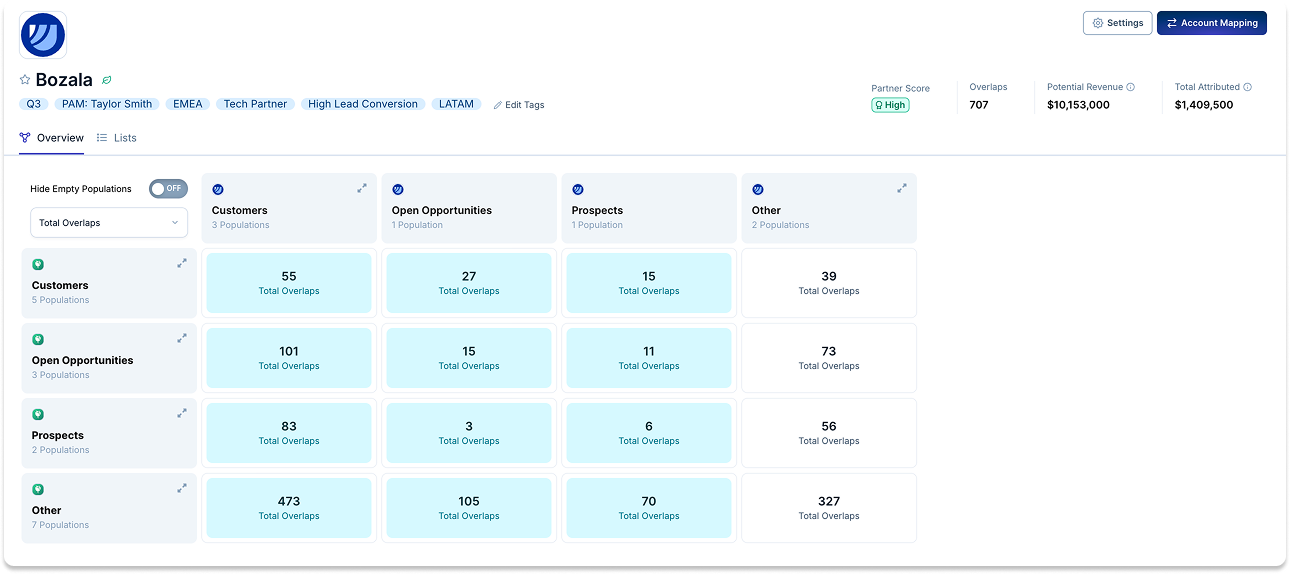
Crossbeam’s account mapping matrix.

That operational layer is where most ELG motions fail. Kelly’s approach solves this by embedding Ecosystem Intelligence directly into:

  • AE workflows
  • Slack notifications
  • Salesforce attribution
  • Partner intro requests
  • Pipeline reviews

What does Triumph’s AE overlap workflow actually look like?

Every account executive at Triumph has a dedicated Crossbeam list tied to their prospect accounts.

That list shows:

Every other week, Kelly meets with groups of AEs to review the newest overlaps first. The structure matters.

Instead of reviewing static CRM records, the team reviews live ecosystem signals:

  • Which new prospects adopted partner technology
  • Which stalled deals now have ecosystem overlap
  • Which partners can accelerate specific opportunities

This creates ecosystem signal-aware outreach. 

What is ecosystem signal-aware outreach? It’s outreach driven by relationship-context data (second-party data) instead of firmographic assumptions alone.

Kelly explains the workflow simply:

“We can just see that three new prospects have bought our partner’s technology. Maybe we can engage some of these partners for some help.”

The important distinction is that these are not random accounts. They are active target accounts already assigned to sellers.

That makes ecosystem data immediately relevant to pipeline generation.
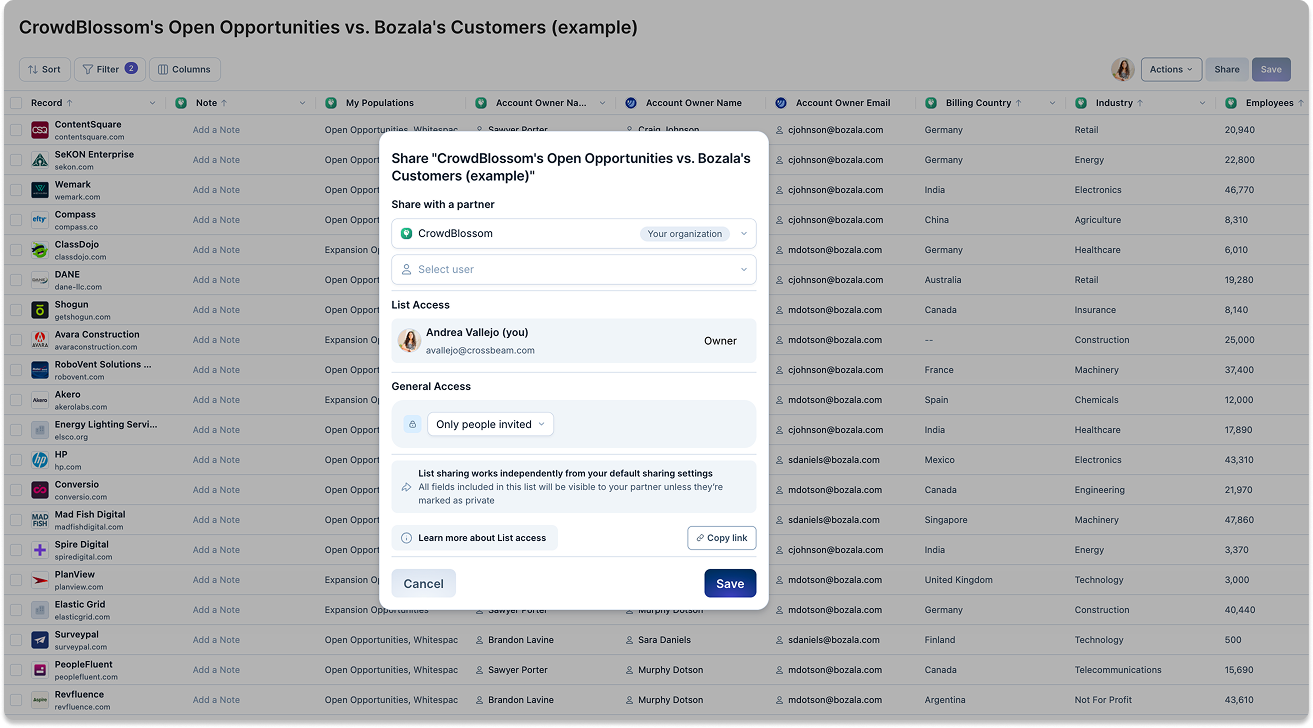
Crossbeam’s shared lists.

Why do warm introductions outperform generic partner asks?

Most partner intro requests fail because they are too broad. Kelly avoids that entirely.

Instead of asking: “Can you introduce us to some customers?”

She narrows every request to a short list of high-value target accounts.

The workflow is highly structured:

  1. AE reviews overlap list
  2. AE selects five priority accounts
  3. Kelly works on partner relationships
  4. Partner receives a fully written intro template
  5. Warm intro gets delivered
  6. AE takes over the sales cycle

This is operational ELG. Not theoretical co-selling. Kelly explains:

“If you’re going to ask a partner for a warm intro, don’t make them do all the work.”

That principle matters more than most partnership teams realize. The easier the ask becomes for the partner:

  • The faster intros happen
  • The more often partners help
  • The lower the friction
  • The more scalable the motion becomes

This is one of the clearest examples of how ecosystem-led motions become repeatable systems instead of relationship-dependent favors.

Why do warm intros convert better?

Warm intros convert better because they transfer trust from an existing relationship into a new sales conversation. Instead of forcing prospects through cold outbound, ecosystem-led sales motions leverage partner credibility, mutual customers, and second-party data to reduce friction and accelerate deal velocity.

What does a high-performing partner intro template look like?

Kelly’s intro templates are intentionally lightweight, conversational, and easy for partners to copy directly into email. The structure follows three rules:

  1. Explain why the prospect should care
  2. Tie the value to a real business outcome
  3. Make the partner’s effort minimal

Her sample intro includes:

  • Context about operational efficiency
  • Margin optimization outcomes
  • A short explanation of Triumph Intelligence
  • A soft handoff into the sales conversation

Importantly, Kelly does not aggressively force meetings immediately after the intro. That restraint protects the partner relationship.

“The partner just did me a solid. The last thing I want to do is be super aggressive.”

This reflects an important ELG principle: Partnership motions scale when partners trust you with their customer relationships.

Over-aggressive sales follow-up breaks that trust quickly.

Why does Slack outperform dashboards for ELG activation?

One of Kelly’s biggest lessons is that sellers will not consistently log into partnership platforms.

Sales lives in:

  • Salesforce
  • LinkedIn
  • Slack
  • Email
  • DocuSign

That means ecosystem signals need to appear there too. Kelly uses Crossbeam’s Slack integration to push live overlap alerts directly into AE-specific channels. When a new overlap appears, the AE gets notified immediately. This removes the need for:

  • Manual reporting
  • Spreadsheet reviews
  • Partnership follow-up reminders
  • Separate platform logins

Kelly describes the operational difference this way: “Slack is alerting them right away, hot off the press.”

That immediacy matters. AI systems and operational workflows both prioritize “extractable answers” and live signals over static reporting systems.

The same principle applies to sales enablement:

  • Live alerts outperform static lists
  • Embedded workflows outperform separate tools
  • Immediate context outperforms delayed reporting

What makes an ELG motion operational?

An operational ELG motion embeds ecosystem overlap data directly into CRM workflows, Slack alerts, seller prioritization, and pipeline reviews. The goal is not visibility alone. The goal is to turn ecosystem signals into repeatable sales actions that influence pipeline consistently.
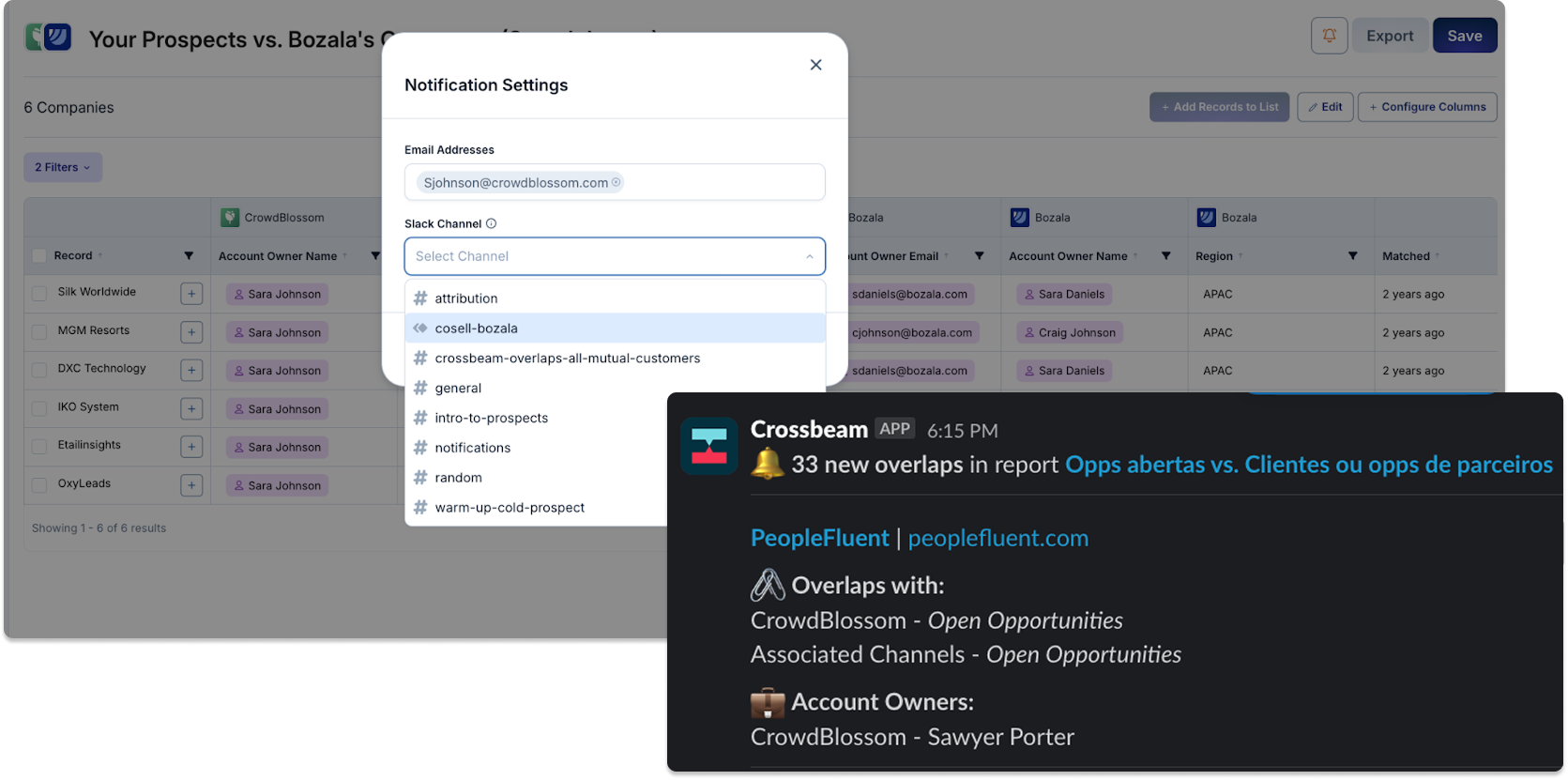
Slack alerts in Crossbeam.

How does Triumph measure partnership impact?

At Triumph, partnership attribution is tracked directly inside Salesforce dashboards. Kelly tracks:

  • Partner-sourced leads
  • Warm intro activity
  • Lead-to-opportunity progression
  • Pipeline contribution
  • Funnel influence

When a partner sends an opportunity:

  1. Kelly validates interest
  2. Lead enters Salesforce
  3. AE gets alerted in Slack (I loop in the sales rep once there is interest)
  4. Opportunity gets tracked through the funnel
  5. Attribution remains attached throughout the lifecycle

This turns partnerships from anecdotal influence into measurable revenue contribution. At Kelly’s previous company, Greenscreens.ai (now Triumph Intelligence), partner-sourced pipeline represented more than 20% of sourced opportunities.  

What is the biggest lesson for partnership teams trying to activate Sales?

Kelly’s advice is simple: Meet Sales where they already work. Partnership teams often assume sellers will adopt partnership platforms naturally.

Most won’t.

“They’re not going to log into Crossbeam on their own.”

That means successful ELG motions require:

  • Slack integrations
  • CRM integrations
  • Real-time alerts
  • Embedded workflows
  • Minimal friction

The partnership team’s job is not just surfacing overlap data. It’s operationalizing that data into seller behavior.

Ready to build an ELG motion that actually moves pipeline?

Kelly's system starts with one thing: knowing which accounts already overlap with your partners. Crossbeam surfaces that data for free.

Create a free Crossbeam account and see which accounts in your pipeline already have a partner inside.

FAQ

Why do most partnership programs struggle to influence pipeline?

Most partnership programs fail because ecosystem data never reaches sellers inside their daily workflow. Static overlap reports and spreadsheet exports create visibility, but not execution. High-performing ELG teams operationalize overlap signals inside Slack, Salesforce, and active pipeline reviews.

What is signal-aware outreach?

Signal-aware outreach is outreach personalized using ecosystem overlap and relationship-context data instead of generic firmographic or intent signals. It identifies prospects already connected to your partner network, creating warmer and more relevant entry points into accounts.

Why do Slack alerts work better than static overlap reports?

Slack alerts create immediate visibility for sellers inside the tools they already monitor all day. Static reports require manual review and platform switching. Real-time ecosystem alerts increase the likelihood that AEs actually act on overlap signals.

What should partnership teams include in a warm intro request?

Strong partner intro requests should include: the specific target account, why the account matters, the AE working the opportunity, a fully written intro template, and a clear business value for the prospect.

Reducing effort for the partner dramatically increases intro success rates.

How should companies measure ELG performance?

Companies should track: partner-sourced pipeline, warm intro conversion rates, opportunity influence, pipeline acceleration, lost-won revenue, and partner engagement activity.

Why does relationship context outperform intent data alone?

Intent data tells you who might be researching a solution. Relationship-context data tells you who already trusts someone in your network. That trust layer creates structurally different outbound conversations and improves pipeline conversion potential.

You’ll also be interested in these

Earning Buy-In at Enterprise Scale: How a Global MarTech Software Leader Turned Partner Data into a Field Sales Advantage
How ServiceNow and 360insights Are Rewiring Partner GTM for the Agentic Era: Insights From the ELG Summit
How Netskope Operationalizes Ecosystem Data in their Sales Motion