Allan Adler, Jill Rowley, Kevin Kriebel: ELG and the C-Suite | Supernode 2023
The 2023 State of the Partner Ecosystem Report
No Opportunities Lost: The Crossbeam Guide to Co-Selling With Tech Partners
How to Buy a Partner Ecosystem Platform
4 Easy Wins: The Crossbeam Guide to Account Mapping
Whale Watching: The Inside Story of the +$100M Microsoft and Facebook Alliance
Map Your Partner’s Org Chart & Boost Partner-Sourced Revenue by 40%
How to Find the Right Integration Partnerships
How This PM Used Nearbound GTM and Reveal to Revamp Reachdesk's Partner Program
Getting Partnership Reporting Right
Crossbeam Has Acquired Partnered: Co-selling Will Never Be the Same
Celebrating Excellence: Announcing the 'Boundies Awards Winners 2023
Co-Sell Orchestration: The New Imperative for Every Partner Team
Breaking Down Silos and Getting a Seat at the Table
Bridging the Gap Between Insights to Outcomes Requires Playbooks + Training
Box’s Partnership Journey: Nearbound, Allbound, Glory-bound
Best Practices in B2B SaaS Tech Partnership Monetization Models - Part 3
Best practices for co-selling with partners using nearbound
Be a Modern Partner Manager and Empower Your Sales Teams to Co-Sell
Nearbound Podcast #128 - Be a Beacon of Customer-Centricity
Nearbound Daily #144: Jill Rowley becomes nearbound.com Chief Evangelist
Diving Into the Co-Sell Orchestration Playbook
Howdy Partners #50: Nearbound Motions for Strategic Tech Partners
Friends With Benefits #13: Being Intentional in Work and Life
The 3 I’s of ELG in action
Partner Ecosystem Can Help You Close Millions in End-of-Quarter Opportunities
The Ultimate Partner Program Guide
The Nearbound Guide
The Nearbound Sales Blueprint
Drive Tech Partner Attribution through Productization
Nearbound Podcast #126: Having the Right Conversations with the Right People
Nearbound Marketing #29: 3 Ways to Market with Your Community Members
Howdy Partners #48: First 8 Months as a Channel Account Manager
Nearbound Daily #136: How to get intel from partners
Nearbound Podcast #125: How Partnerships Build Unshakable Brands
How to Talk to Your CEO About the Ecosystem
Nearbound Daily #133: The long way home
Nearbound Marketing #28: 4 Steps to Execute Survey Co-Marketing
Friends With Benefits #12: Leading with Empathy
EcoOps Framework–Understanding the Partner Operations Big Picture
Do You Know Your Public and Private Ecosystems?
Maureen Little: Building Influence to Drive Impact | Supernode 2023
Nearbound Marketing #27: Activating the Hidden Evangelists Within Your Company
Howdy Partners #47: How to Use Intel, Intro, and Influence to Grow Your Pipeline
Friends With Benefits #11: The Benefits of Community
Nearbound marketing: A trust-driven path in the Who Economy
Nearbound Daily #126: B2B SOS
Nearbound Podcast #123: TrustRadius CEO’s Shocking Take on “4.7 Star Syndrome” & Building Trust
Nearbound Daily #124: The 80/20 principle still stands
Mindmatrix: A Deeply Human Approach to an Increasingly Complex World
Howdy Partners #45: The Journey to Partnership Success
Friends With Benefits #10: Trust Isn’t One Dimensional
Nearbound Daily #119: Don't complicate partnerships
Expanding to a New Persona or Market? Your Partners Can Help You Dive in with Grace
Nearbound Marketing #25: Go Past the 1st Date with Marketing Partners
Nearbound Daily #117: Start tracking impact
Friends With Benefits #09: Building Trust and Adding Value in the B2B Landscape
Better together–Reveal and Reachdesk
Preparing for your nearbound pitch
Nearbound Daily #116: All games get gamed
Nearbound Podcast #121: It’s Math, Not Magic — Why Partner Attach is King
Airmeet Leads the Way on Event-Led Growth via Nearbound
Nearbound Daily #113: It's about more than money
Nearbound Marketing #24: How Partners Made This Event Series More Efficient
Nearbound Daily #112: What's the difference 🤨 channel, partnerships, nearbound
3 Nearbound Use Cases You’ve Never Thought Of
Howdy Partners #44: Setting Up Your Affiliate Program for Success
Friends With Benefits #07: Divorce Avoidance: Your Guide To Healthy Partnerships
Nearbound Daily #110: It isn't rocket science
Nearbound Podcast #120: WTF Is Happening In B2B Sales Right Now?!
Nearbound Daily #109: Authentic intention, the new AI
Nearbound Daily #108: 4 questions to WOW your partners
Nearbound Marketing #23: The 4 Missing Pieces of Your Employee Evangelism Program
Howdy Partners #43: Approaching Strategic Partnerships
Friends with Benefits #35 - Beyond the Microphone: Trust, Values & Engaging Listeners in Podcasting
ELG ABM strategy: Winning the attention of high-value accounts
Nearbound Daily #105: It's not about the funnel
How Pigment Increased Win Rates 5-10% with a Nearbound Overlay & Reveal
Nearbound Podcast #119: The Power of Nearbound
Nearbound Weekend 07/08: What is nearbound?
Howdy Partners #42: Success or Sales? Making Your First Partner Hire
Friends With Benefits #06: If Henry Ford Announced The Model-T Today
Nearbound Daily #099: Nearbound FTW
Nearbound Daily #097: Start giving to new partners
Nearbound Weekend 07/01: Where do you start with partnerships?
Nearbound Marketing #21: Going-To-Market Through Community
Nearbound Daily #095: Let's demystify nearbound
Howdy Partners #41: Key Tips for Leveraging Influencers
Friends With Benefits #04: Everybody Wins If The Customer Succeeds
Nearbound Daily #094: Gain intel, intros, and influence
Nearbound Daily #093: Don't underestimate the fun factor
Nearbound Podcast #117: Channel, Nearbound, and Platform
Nearbound Daily #092: Never go solo
Head of Ecosystems and Partnerships: Driving Business Transformation and Core Outcomes
Hit the Ground Running in Tech Partnerships (Plus: a 30-60-90 Template For New Hires)
Nearbound Daily #091: Try this partnerships hack
Nearbound Weekend 06/24: The early mover advantage
Nearbound Marketing #20: 3 Ways to Market with Creators in Your Niche
Nearbound Daily #090: A path to the promised land
Howdy Partners #40: Strengthening The Foundation
Ecosystem-Led Marketing: Awareness and Demand

‍

How to build a demand generation framework (6-step guide)

by
Crossbeam
SHARE THIS
Build a demand generation framework in six steps using partner ecosystem overlap. Includes scoring rubrics, tiered campaigns, and routing rules.
by
Crossbeam
SHARE THIS

In this article

Join the movement

Subscribe to ELG Insider to get the latest content delivered to your inbox weekly.

A demand generation framework is a repeatable operating model that tells your B2B team which accounts to target, which signals to act on, how to hand accounts to sales, and which metrics prove each stage works. It replaces a pile of tactics with defined stages, owners, and measurements. This guide walks you through building one in six steps, using partner ecosystem data as your targeting signal.

Before you start:

  • Who it's for: RevOps managers, GTM systems analysts, and partner operations specialists who configure the CRM and reporting.
  • What you need: admin access to your CRM (Salesforce or HubSpot), a documented ideal customer profile (ICP), a Crossbeam account with a few connected partners, and optionally an intent provider such as Demandbase or Bombora.
  • What you'll produce: a target account segment, enrichment fields, a scoring rubric, campaign briefs, routing rules, a dashboard spec, and a review cadence.
  • Difficulty and time: intermediate, roughly two to four weeks of part-time work.

What is a demand generation framework?

Ivris Tech defines it as "the system a B2B team uses to create demand, capture it, and convert it into revenue on purpose instead of by accident." The "on purpose" part matters because of buyer timing. The Ehrenberg-Bass Institute's 95:5 rule holds that only around 5% of business buyers are in-market in any given quarter. The other 95% won't buy for months or years.

Buyers also decide early. 6sense's 2025 B2B Buyer Experience Report found that buyers fill roughly four slots on a Day One shortlist and buy from one of those vendors about 95% of the time. Buyers now reach out at about 61% of their journey, up from the 69% mark a year earlier.

So your framework needs two tracks. Demand creation earns a place on the shortlist before anyone is shopping. Demand capture converts the buyers who show intent. A tactic list blends them, but a framework gives each its own goal, channels, and metrics.

How does demand generation differ from lead generation and ABM?

Demand generation is the umbrella system. Lead generation and account-based marketing (ABM) are motions that run inside it. Treat them as interchangeable, and your dashboards will measure the wrong things.

Criteria Demand generation Lead generation ABM
Goal Build and capture market demand Collect contact info from interested people Win named, high-value accounts
Audience Whole market, including the 95% not buying yet Individuals who respond to an offer Pre-selected accounts and buying groups
Typical output Shortlist presence, pipeline Form fills, MQLs, EQLs Account engagement, meetings, opportunities
Typical metric Creation and capture metrics, pipeline influenced Cost per lead, lead-to-SQL rate Account engagement, opportunity creation by account

Swipe to see the full table →

Your framework uses all three. Demand generation sets the stages and metrics. Lead generation feeds the capture stage. ABM focuses spend on the accounts your scoring model puts at the top.

What are the components of a demand generation framework?

Every working framework has stages, and each stage has a goal, inputs, and a metric. This build uses six, and Crossbeam supplies the account-level signal that most frameworks lack. Ecosystem-Led Growth (ELG) is the go-to-market strategy that treats your partner ecosystem as a primary source of pipeline and revenue. Here, it supplies the targeting layer.

Step Stage Goal Crossbeam role Primary metric
1 Identify Build a target set Overlap detection, partner connections Overlap accounts matching ICP
2 Enrich Add timing and roles Overlap fields alongside intent data Accounts with active intent
3 Score Prioritize Overlap strength as a score input Tier distribution
4 Activate Run ABM and co-marketing Partner relationship context Account engagement rate
5 Route Hand off to sales Signals pushed into CRM workflows Time-to-meet
6 Measure Learn and reallocate Performance dashboards Creation vs. capture trends

Swipe to see the full table →

Step 1: How do you identify audiences with ecosystem overlap?

Your first artifact is a target account segment built from ecosystem overlap: accounts that appear in both your CRM and a partner's CRM as customers, prospects, or open opportunities. The partner side of that match is second-party data, meaning data a partner shares with you directly, under controls you both set.

  1. Connect with partners in the Crossbeam Network, starting with those who serve your ICP.
  2. Run overlap detection to surface shared accounts.
  3. Sync results to your CRM and set matching logic: domain first, then company name plus country.
  4. Filter by ICP fit, overlap strength (number of partners, customers, or prospects), and relationship context, meaning which partner knows the account and how close they are.

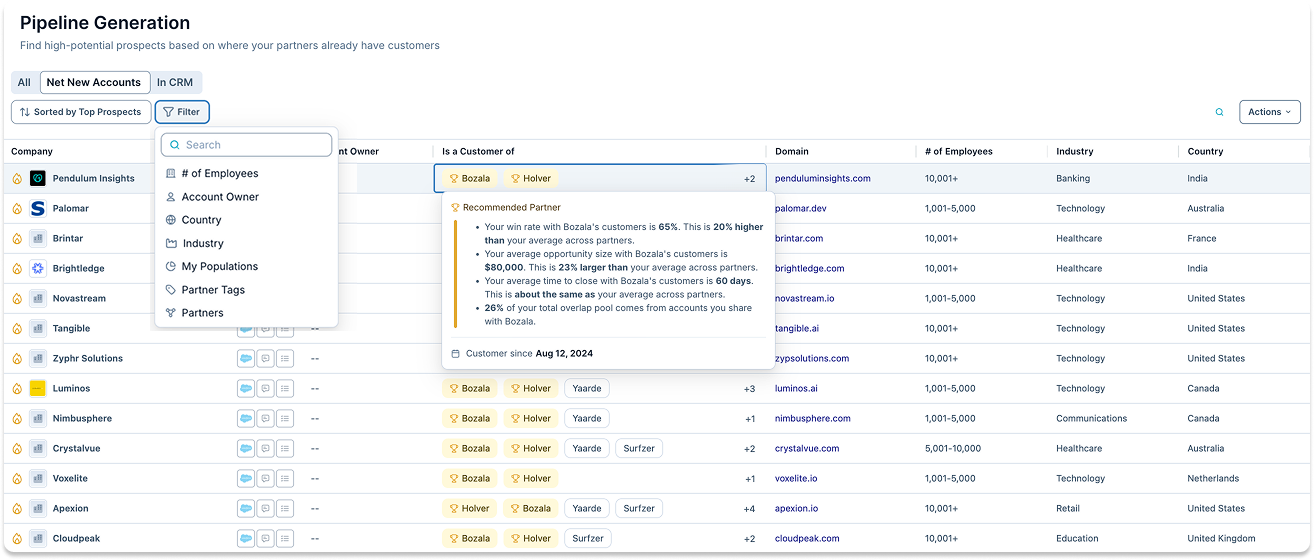
To extend the list past your CRM, Crossbeam's Pipeline Generation surfaces net new accounts, partner-sourced prospects that sit outside your CRM. Pushing overlap fields onto account records is covered under Crossbeam's account enrichment.
Checkpoint: spot-check 20 overlap accounts. Each should exist in your CRM and match your ICP on industry, size, geography, and tech stack.

Warning: overlap alone isn't a target list. Add an ICP filter and a trigger event, such as a funding round, a new executive hire, or someone who recently became a customer of your partner.

Step 2: How do you enrich overlap accounts with intent and buying group data?

Overlap tells you who is adjacent to your ecosystem. Intent data tells you when to move. Bombora's Company Surge signals track when a company's employees consume an abnormal volume of content around specific B2B research topics across a cooperative publisher network. Demandbase Intent monitors online browsing patterns of prospective and current customers.

Pick five to eight topics tied to the problem you solve, then add these fields to the account object:

  • intent_topic
  • intent_last_seen (date)
  • intent_window_days
  • buying_role (economic buyer, champion, technical evaluator)
  • priority_score

Map each intent account to a buying group by listing the two or three roles you must reach. Buyers contact vendors early, so identifying roles before the surge fades matters.

Checkpoint: build a CRM filter for "overlap = true AND intent_last_seen within 30 days AND buying_role is not empty." If you can't express it as a segment, you can't route on it.

Warning: topic mismatch inflates your list. Treat any intent window older than 30 days as stale and drop its points.

Step 3: How do you score, segment, and prioritize accounts?

Your artifact here is a scoring rubric that combines three inputs. These weights are a starting point, so tune them against your own conversion data after 60 days.

Input Max points Scoring rule
Ecosystem overlap 35 15 for one partner, 25 for two or more, +10 if a partner has a warm path or open opportunity
Intent 35 35 if a matching topic surged in the last 14 days, 20 for 15 to 30 days, 0 after 30
ICP fit 30 30 full match, 15 partial, 0 outside ICP

Swipe to see the full table →

Map bands to actions: 80 to 100 is Tier 1 (co-sell outreach), 60 to 79 is Tier 2 (ABM), 40 to 59 is nurture, and below 40 is monitor only.

CRM deliverables: three score fields, one tier field, a "score reason" text field, and segment rules for each tier. Define MQL status here so marketing and sales share vocabulary.

Checkpoint: open a Tier 1 account as a rep would. The overlap partner, intent topic, and score reason should all be visible before any outreach.

Warning: lead-only scoring misses the buying group. Roll contact activity up to the account.

Step 4: How do you run ABM and co-marketing campaigns on your top accounts?

Turn each tier into a play. Co-marketing campaigns work best when the partner already has a relationship with the account, because the invitation carries relationship context instead of a cold pitch.

Tier Audience Channels CTA
Tier 1 Overlap plus fresh intent Partner-sourced intro, personal email, LinkedIn matched ads Meeting with account owner and partner
Tier 2 Overlap or intent, fit confirmed LinkedIn ads, webinar invites, email sequence Joint webinar or workshop
Nurture Fit only Newsletter, ungated guides Subscribe

Swipe to see the full table →

Give every campaign a brief: goal metric, tier, partner, asset, landing page, and UTM set. Add a required "How did you hear about us?" field on forms to capture self-reported attribution that UTMs miss.

Checkpoint: each live campaign has one goal metric and consistent tags in your CRM.

Warning: gate intent assets (ROI calculators, pricing guides, demo requests), and keep early education ungated so it can build shortlist presence.

Step 5: How do you route leads and enable sales co-sell?

An EQL, or Ecosystem-Qualified Lead, enters your funnel through partner overlap rather than a cold form fill. Crossbeam defines it as a partner-vetted contact: ecosystem data and the partner relationship confirm fit before the lead ever reaches your queue. Add a lead source value for EQLs so routing treats them distinctly from other leads.

Write routing as explicit logic. Sample rule: IF tier = 1 AND intent_last_seen is within 14 days, THEN assign to the account owner (or the segment SDR if none) and create a task. Sample SLAs (service level agreements, the maximum time a rep has to act on a routed account): Tier 1 within four business hours, Tier 2 within one business day.

Signal-aware outreach means timing and wording a message from the signals on the account: the partner connection, the intent topic, the role. Push those fields into your sequencing tool, so reps see them.

Playbook A, webinar follow-up: attendee scored, Tier 2 and up routed within one day, email references the session topic and partner.

Playbook B, co-marketing event: partner introduces the account, EQL created within 24 hours, joint follow-up.

Checkpoint: report meeting rate by tier, and confirm every handoff carries the same fields.

Step 6: How do you measure demand creation and demand capture?

Track creation and capture separately. Capture metrics lag, so judging creation by them punishes the work that builds your shortlist position.

Type Metric Formula
Creation (leading) Overlap account engagement rate Engaged overlap accounts / total overlap accounts
Creation (leading) Self-reported share Responses naming partner, community, or content / total responses
Capture (lagging) EQL conversion rate EQLs becoming SQLs / total EQLs
Capture (lagging) Time-to-meet Median hours from routing timestamp to meeting booked
Capture (lagging) Pipeline influenced Opportunity amount where the account had a campaign touch in the prior 90 days

Swipe to see the full table →

Build two dashboard views: creation progress and capture conversion (EQL to SQL, SQL to opportunity, pipeline created). Review stage performance monthly. Each quarter, shift budget toward the tactics that moved creation metrics.

Warning: pipeline-influenced counts touch, so report it next to attributed pipeline, never in place of it.

Which prompts and templates speed up the build?

Paste these into your AI tool of choice and adjust the brackets. If you work in Clay, the Clay MCP brings Crossbeam partner context into the same workflow.
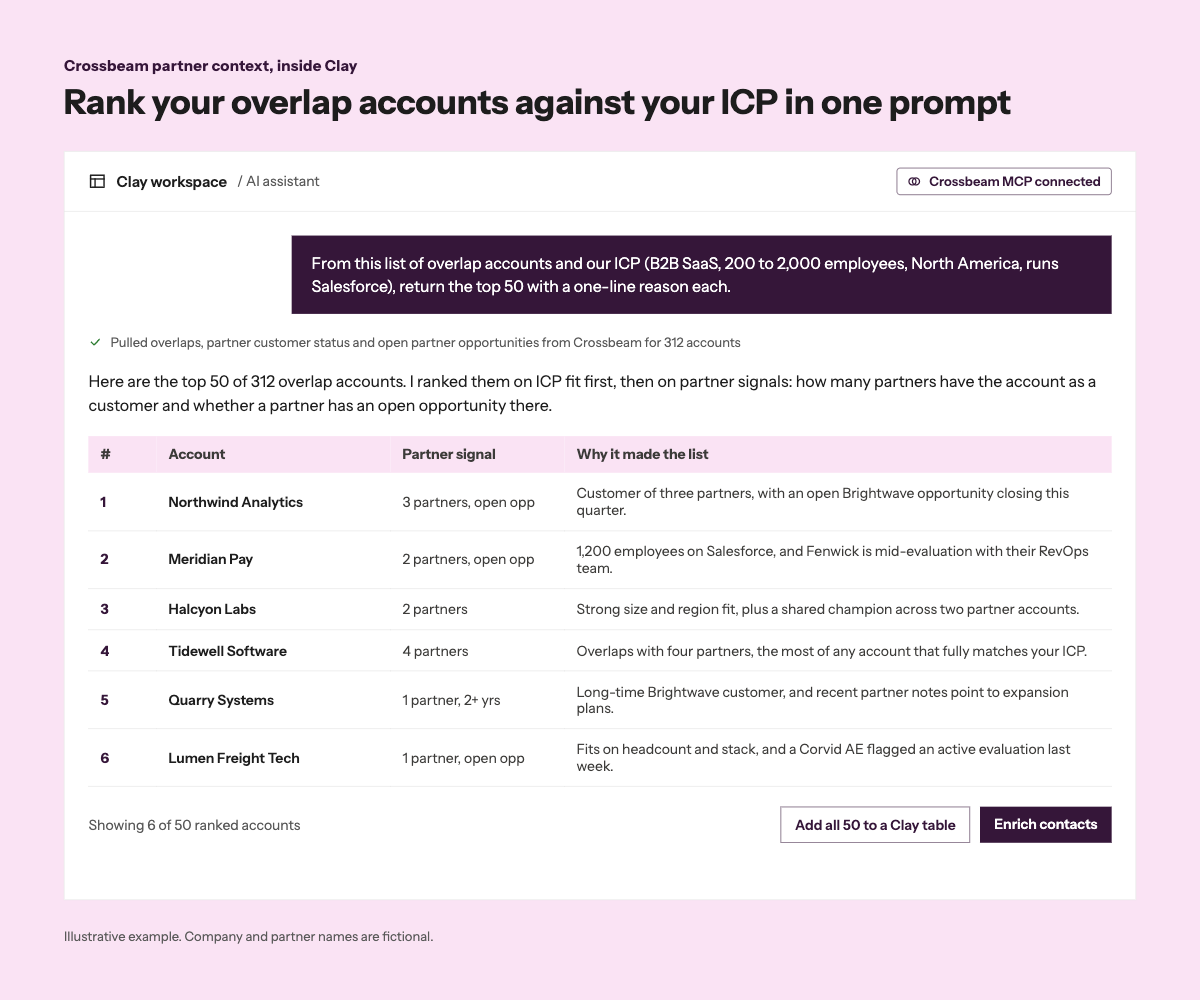
  1. "From this list of overlap accounts and our ICP ([criteria]), return the top 50 with a one-line reason each."
  2. "Write messaging for a [role] at an account with intent on [topic] and a connection through [partner]."
  3. "Draft a co-marketing invite from [partner] to [account type] about [topic], under 120 words."
  4. "Write landing page copy for [webinar], with one headline, three benefits, and one CTA."
  5. "Turn this scorecard into routing rules with owner, SLA, and fallback."

Campaign brief skeleton:

Campaign name:
Tier / segment rule:
Partner:
Goal metric and target:
Asset and landing page:
UTM set (source / medium / campaign / content):
Owner and SLA:
Review date:

What does a completed scorecard look like?

Use one row per account, so reps see the "why" next to the action.

Account

Example Co A

Tier 1
Overlap score35 / 35
Intent score35 / 35
Motion
Partner-sourced co-sell outreach
Owner
Account owner
SLA
4 business hours
Account

Example Co B

Tier 2
Overlap score25 / 35
Intent score20 / 35
Motion
ABM plus webinar invite
Owner
Segment SDR
SLA
1 business day
Account

Example Co C

Nurture
Overlap score15 / 35
Intent score0 / 35
Motion
Ungated content
Owner
Marketing
SLA
Weekly review

What should you do when your framework stalls?

  1. SymptomOverlap accounts don't appear in CRM
    Likely causeDomain mismatch or duplicates
    FixStandardize domains, dedupe, rerun matching
  2. SymptomTier 1 list is too long
    Likely causeWeights too generous
    FixRaise the Tier 1 cutoff or shorten the intent window
  3. SymptomReps ignore routed accounts
    Likely causeMissing context
    FixShow the score reason and partner on the record
  4. SymptomMeetings aren't converting
    Likely causeOutreach ignores the signal
    FixAdd partner and topic to the first line
  5. SymptomCreation looks flat
    Likely causeJudging with capture metrics
    FixReview leading indicators separately

What have you built, and what comes next?

You now have a six-stage framework: an overlap-based target segment, intent and buying-role fields, a weighted scoring rubric, tiered campaigns, routing rules with SLAs, and a dashboard that separates creation from capture.

Next, run the model on one tier for 60 days, compare scores against actual meeting and opportunity rates, and adjust weights. Then add partners to the Crossbeam Network to widen your overlap set.

Ready to wire ecosystem signals into your CRM? Register on Crossbeam for free.

Frequently asked questions about demand generation frameworks

What is the definition of a demand generation framework in B2B marketing?

It's the system a B2B team uses to create demand, capture it, and convert it into revenue on purpose. It defines stages, channels, owners, and metrics so results are repeatable.

What are the main demand generation framework components?

Audience identification, enrichment, scoring and segmentation, ABM and co-marketing activation, routing to sales, and measurement. Each has a goal and metric.

What is the difference between demand creation and demand capture?

Creation builds awareness and shortlist presence among buyers who aren't shopping yet. Capture converts buyers already showing intent. Measure them with separate leading and lagging metrics.

How long does it take to build a demand generation framework?

A first version usually takes two to four weeks of part-time work. Expect to adjust scoring weights after 60 days of real conversion data.

You’ll also be interested in these

From Overlaps to Outcomes: Turning Ecosystem Data into Pipeline, Faster
Generating Net-New Pipeline with Ecosystem Intelligence
15 Crossbeam MCP Use Cases for Partnerships and GTM Teams