


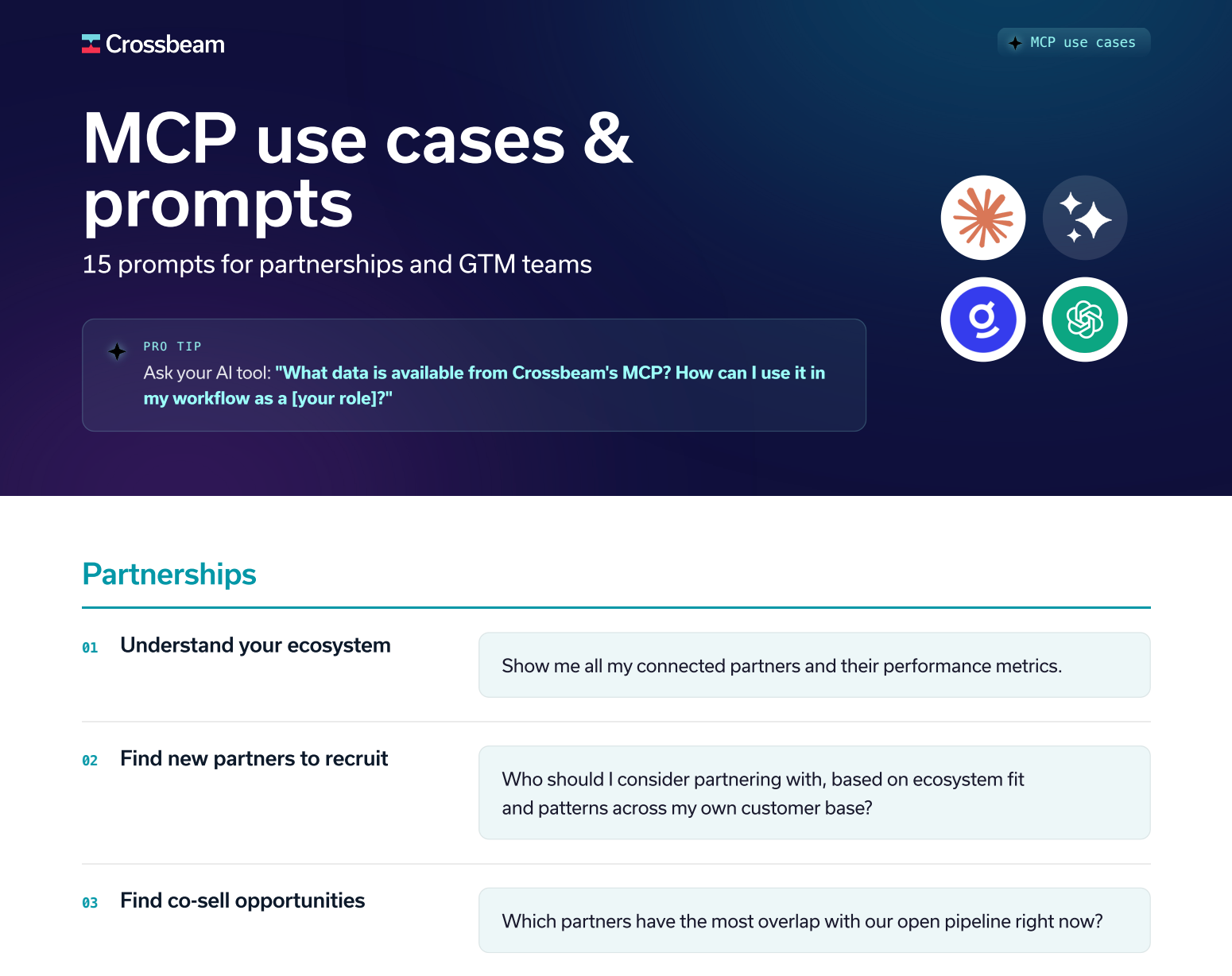
See 15 real prompts for using the Crossbeam MCP server in Claude and ChatGPT, from net new account discovery to joint opportunity planning.

MCP stands for Model Context Protocol, an open standard that enables companies to integrate AI agents like Claude and ChatGPT into their own tools and data, similar to how APIs allow software-to-software integration.
Say you're a rep prepping for a call and want to know if the account is already a customer of one of your partners. Normally, that means logging into Crossbeam or your CRM, pulling up the account, and checking who overlaps with it before you can bring that context into the conversation.
With the Crossbeam MCP server, you can just ask your AI tools. Connect Crossbeam to Claude, ChatGPT, Glean, and more, and your AI agent pulls that same ecosystem data straight into the conversation: who overlaps, who's been active on your accounts recently, and all the intel partners are already sharing on an account. No manual lookups, no code, just a normal question, the same way you'd ask a teammate, and get live account insights shared from your partners' CRMs.
Below are 15 ways you can start working with Crossbeam in your AI tools today, across partnerships, sales, and marketing use cases.
A quick note on setup and prompting
Full connection steps for Claude, ChatGPT, and Glean live in our documentation. Once connected, a good first move is asking your AI tool directly:
Prompt: "What data is available from Crossbeam's MCP? How can I use it in my workflow as a [your role]?"
It'll walk you through what it can pull, plus suggestions based on the Ecosystem-Led Growth best practices we've baked in.
Be specific about the accounts, partners, or lists you're working with. The more context you give it — a segment, a time window, a specific partner, your goal — the more useful the output. If a prompt doesn't seem to be pulling from Crossbeam, tell your AI agent directly to use the Crossbeam connector.
One more thing worth knowing: To get the most value, you'll also need an account data source connected in Crossbeam (CSV, CRM, Data Warehouse, etc.) and at least one partner connection to have data to pull in. Don't have partner connections yet? Our 40+ Open Data Partners get you instant account mapping, no partner connection needed. Beyond that, your plan and seat type decide what's available, but the easy way to think about it is: if you can see it in Crossbeam today, and it’s available as a tool via our AI connectors, you can ask your AI tool to pull in and analyze that data.
See and download our prompt inspiration guide
Use cases for sales
1. Find net new accounts through ecosystem wins
Prompt: “Are any of my partners winning deals with companies that fit our ICP but aren't in our pipeline yet?” Or “Show me net new accounts in the US or Germany with 201 to 500 employees.”
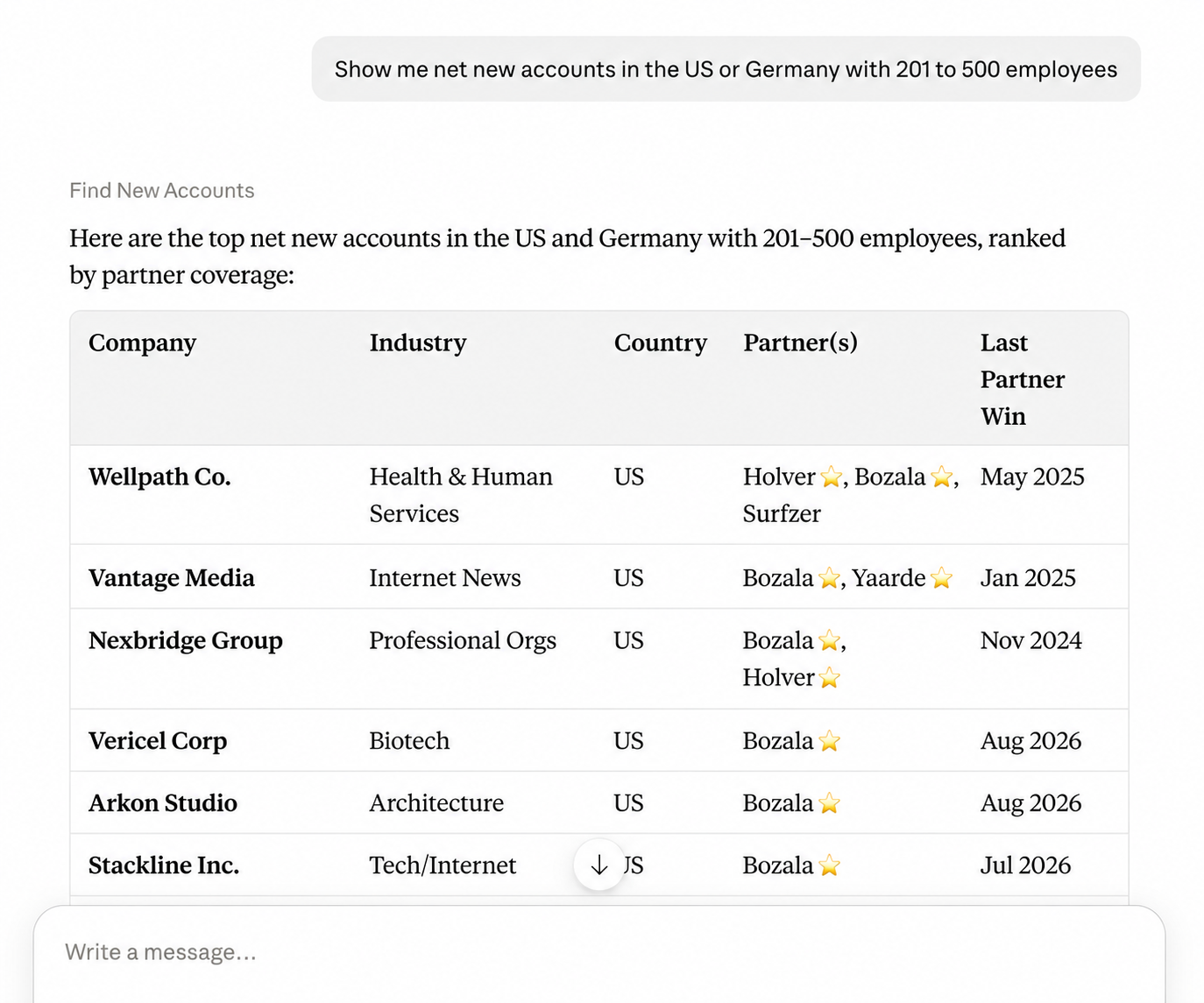
This prompt pulls straight from Crossbeam's Pipeline Generation and Net New Accounts features: companies your partners are already selling to, some of which may not even exist in your CRM yet, filtered by firmographics so you can narrow them down. That's a warmer, higher-confidence starting point than a cold list.
2. Prioritize and enrich a target account list with Ecosystem Signals
Prompt: “I have a list of target accounts, and I want to know which ones to prioritize based on recent partner activity. Use the Crossbeam connector to check each account and rank them by where the most meaningful partner deal activity is happening right now, and enrich them with any partner-shared details and contacts.”
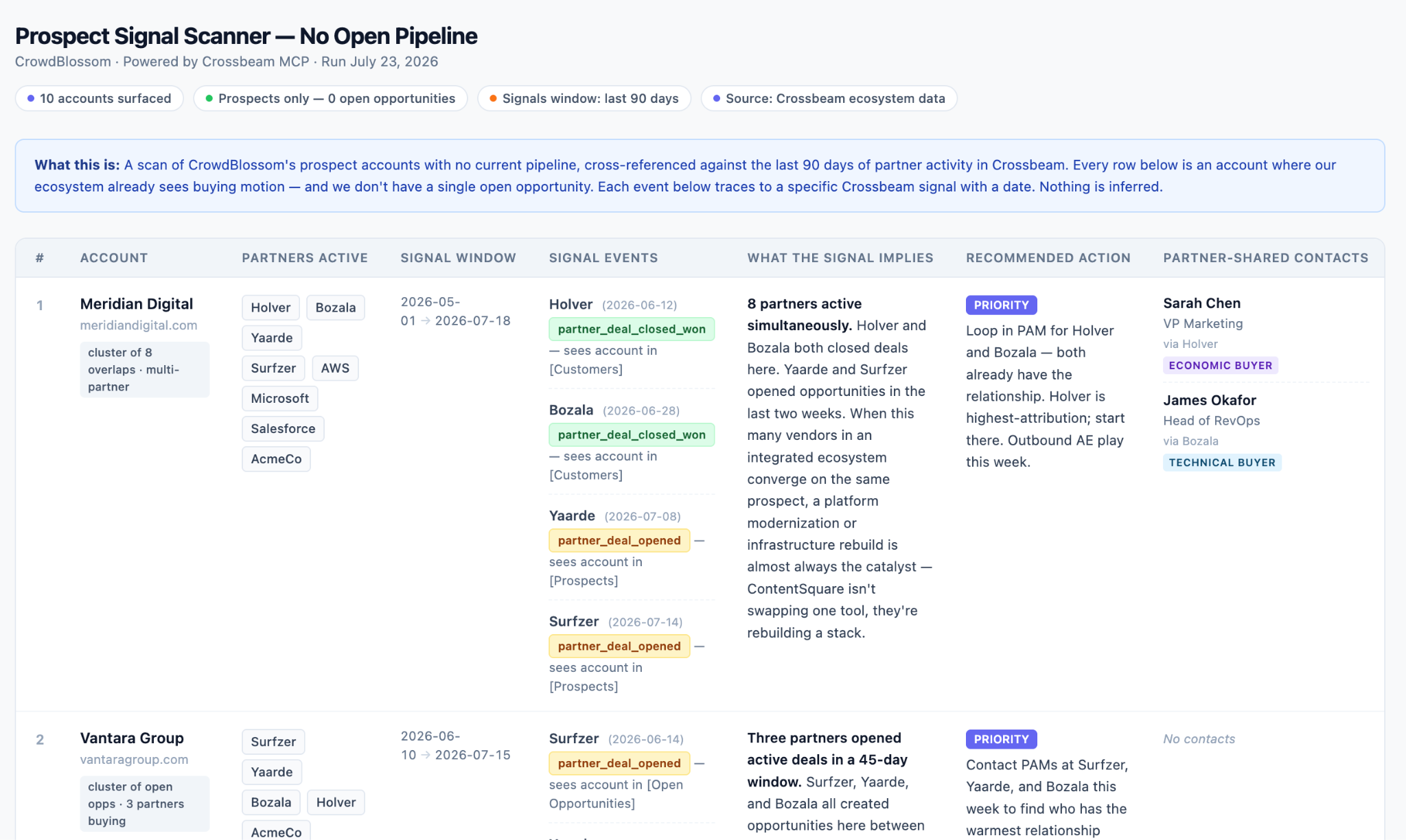
Before an account enters your pipeline, you have to decide if it's worth pursuing at all. Firmographic data and intent signals tell you who fits your ICP and who's in market. But none of that tells you whether a partner already has a relationship there and what they already know about the account.
This prompt takes any list of target accounts and scans Crossbeam's ecosystem data to surface additional account intelligence and highlight where partner activity suggests a warm path in or buying signals your team hasn't seen yet.
3. Pre-call account brief
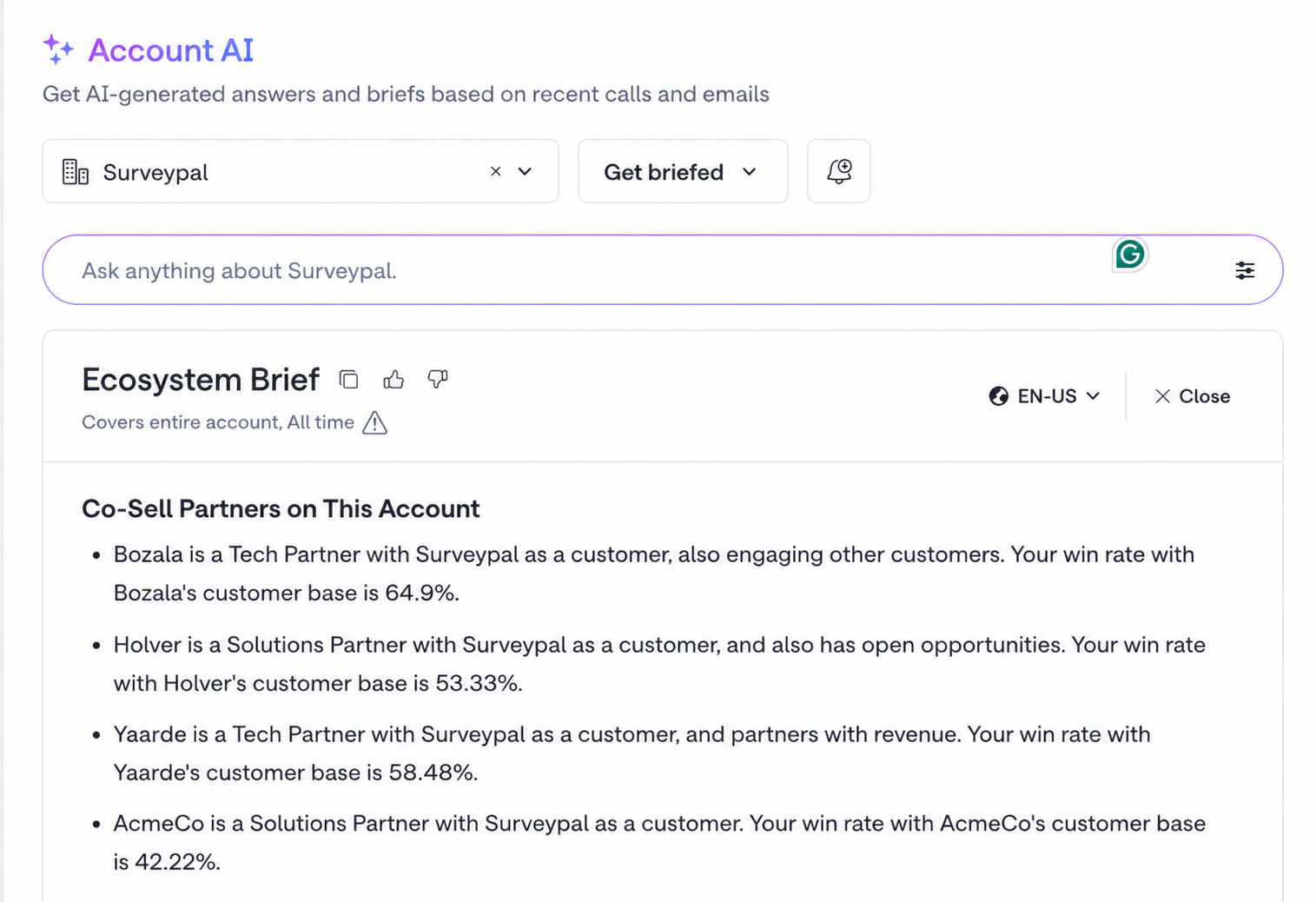
Prompt: “Brief me on [Account Name], including whether any of our partners have recently closed or have an open opportunity there.”
With Crossbeam connected, you get account intelligence that can actually change how you reach out or walk into a conversation. That means everything a partner is sharing with you, including standard and custom fields.
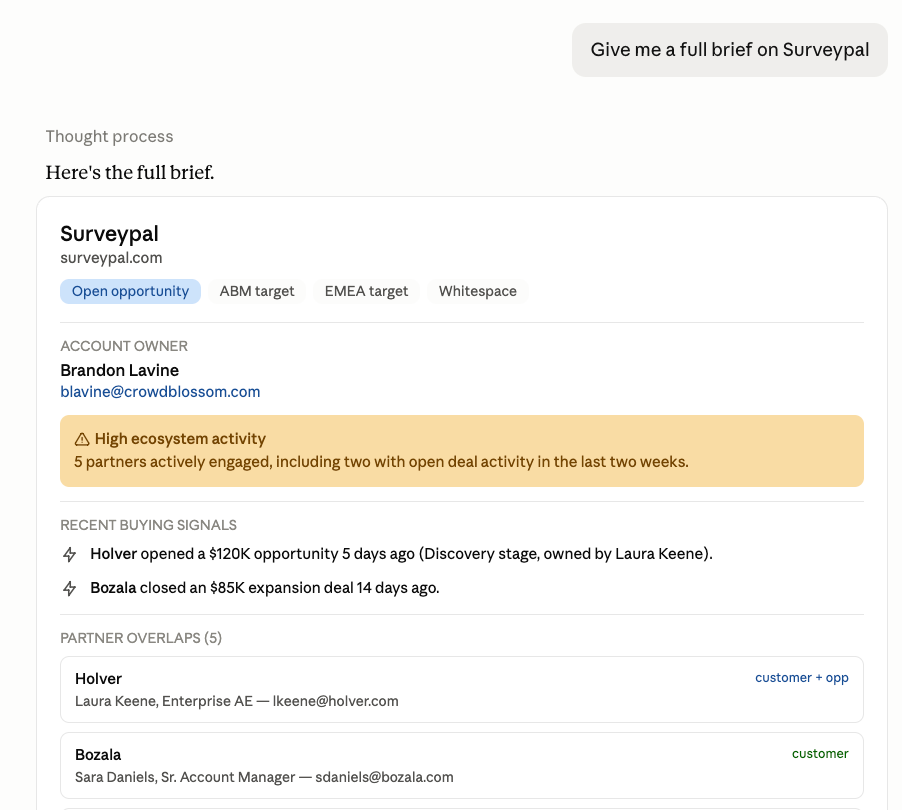
If your team is interested in or already leveraging AI Account Briefs, our guide on getting an AI account brief with ecosystem context includes a more in-depth account brief prompt that you can set up from scratch or include in your current account briefs.
There's also a way to bring this same context into your AI Briefer in Gong, learn how here.
4. Prioritize Pipeline
Prompt: “Which accounts in our prospects list have the strongest signals to convert to pipeline by leveraging partners? Rank them by partner relationship strength and recent partner activity.”
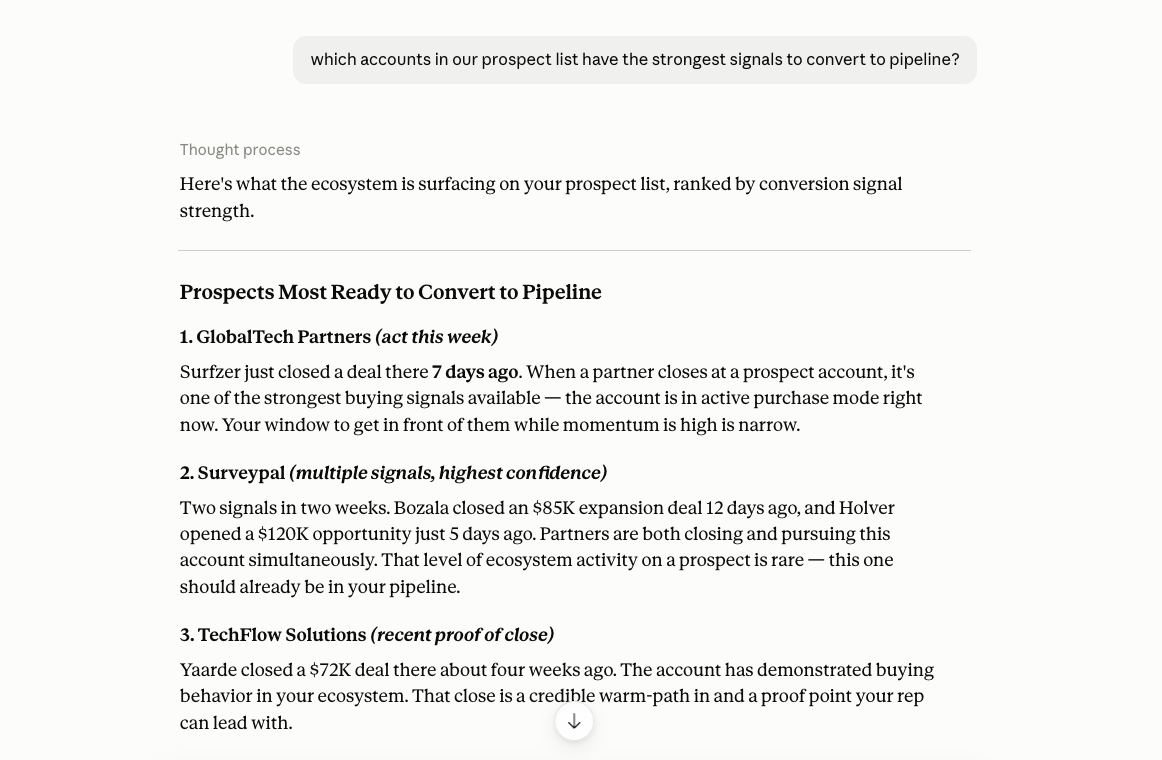
Helps you decide where to spend your time, based on where a partner relationship might actually accelerate the deal.
5. Deal acceleration
Prompt: “Which partners should I bring in on the [Account Name] deal? Who's actually been winning in this space?”
The right partner at the right moment can move a deal forward. This prompt draws on the same signals from Crossbeam's Deal Navigator in-app: recent partner wins, new contacts added, or a long-standing customer relationship, so you're bringing in the partners best positioned to help move the deal forward.
6. Draft ecosystem-informed outreach
Prompt: “Which of my open opportunities are also customers of [Partner Name]? For each match, draft a short outreach email that leads with the mutual value of our integration.”
This turns overlap data into an actual first draft you can send, not just a list you still have to act on. Use it alongside other data and knowledge sources, like better-together messaging documentation you have on the mutual value of your integration with the partner, to tailor the draft further.
7. Enrich accounts with partner-shared account context and contacts
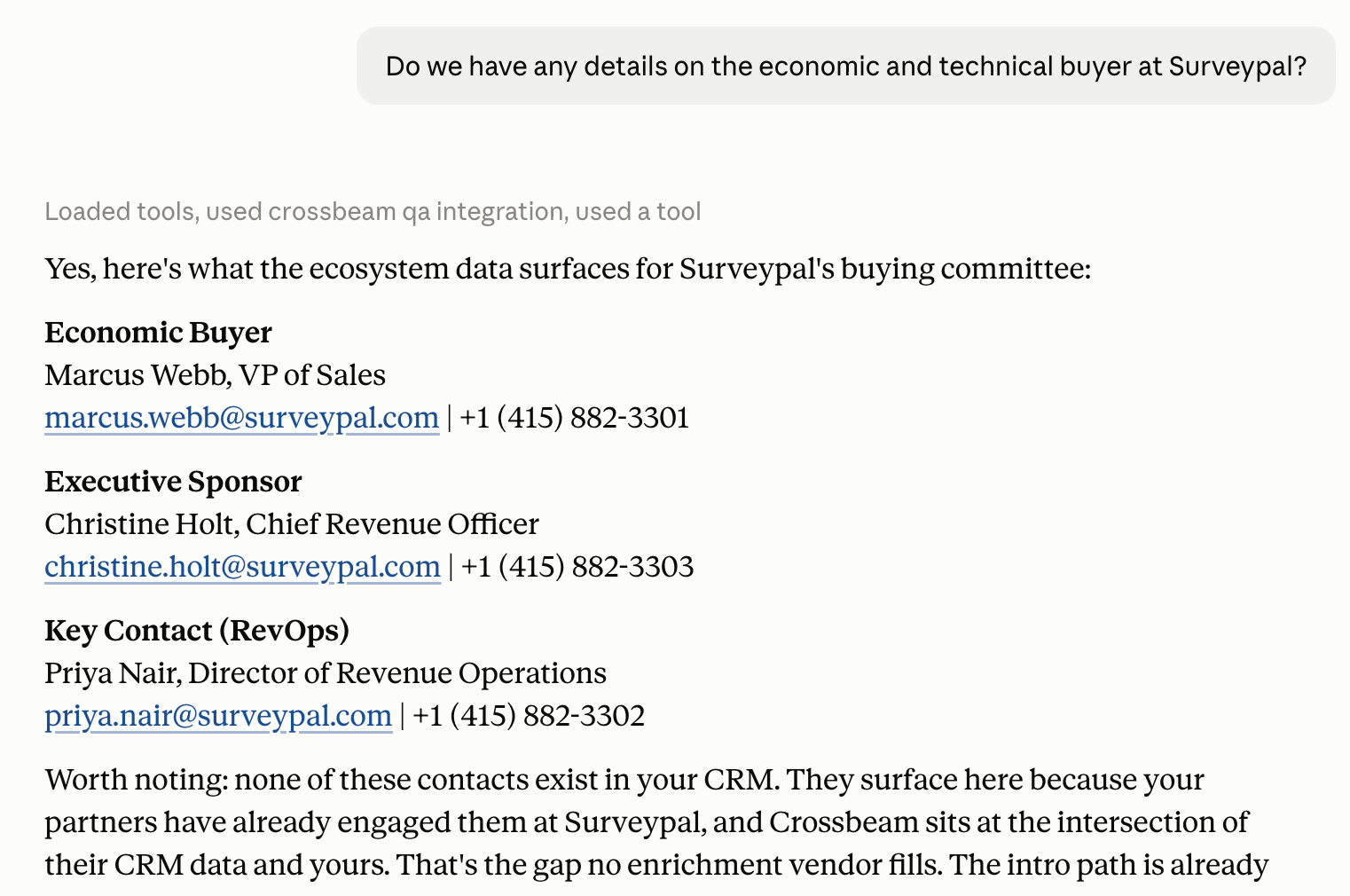
Prompt: “Do we have any details on the economic and technical buyer at [Account]?”
If your partners are sharing contact-level data with you, this can be useful when you're trying to figure out who to loop in on the buying committee. If your partner already has that context, you can too.
Use cases for partnerships
8. Understand your ecosystem
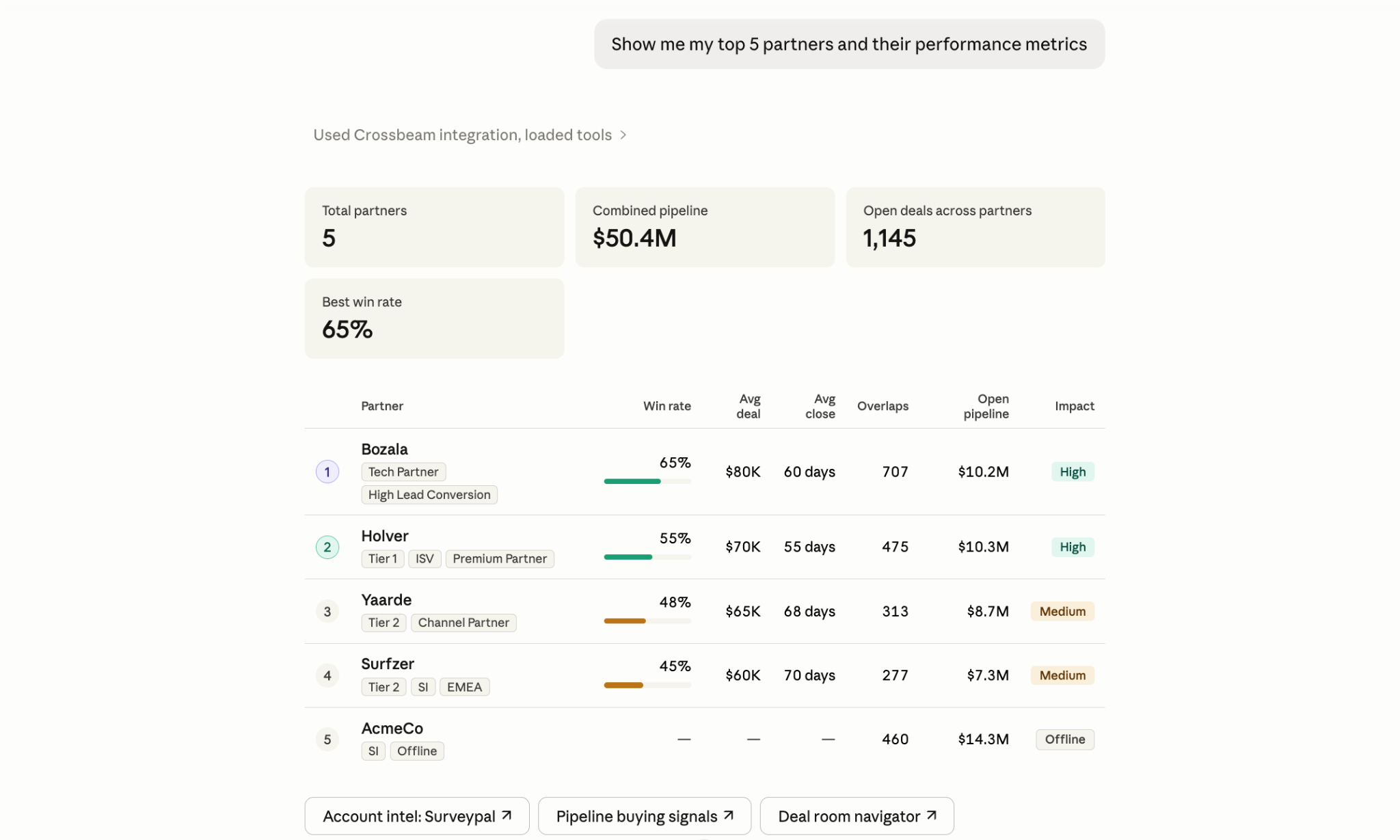
Prompt: “Show me my top 5 partners and their performance metrics.”
This gives you a baseline read on who you're connected to and how active each relationship is before you start asking more specific questions.
9. Find new partners to recruit
Prompt: “Who should I consider partnering with?”
Useful when you're building your partner recruitment pipeline and want a data-backed starting list instead of guessing who to approach next. These suggestions draw on partnership data that Crossbeam sources and maintains from public, third-party information, categorized as tech (an integration) or channel (everything else). It won't be exhaustive, but it's a real starting point, not a shot in the dark.
10. Find co-sell opportunities
Prompt: “Which partners have the most overlap with our open pipeline right now?”
This surfaces where a partner relationship could actually move deals forward today, not just where overlap exists. If you want to take this further and turn the overlap into an actual joint opportunity plan, our playbook on building a shareable joint opportunity plan in a few prompts walks through the full flow.
11. Build a joint-opportunity plan
Prompt: "We're planning with [Partner]. Our primary goal is [new pipeline / deal acceleration / both]. Pull our mutual overlap from Crossbeam. For new pipeline: return accounts where we're both pursuing them as prospects. For deal acceleration: return accounts where one of us has an open opportunity and the other has a customer relationship or active presence."
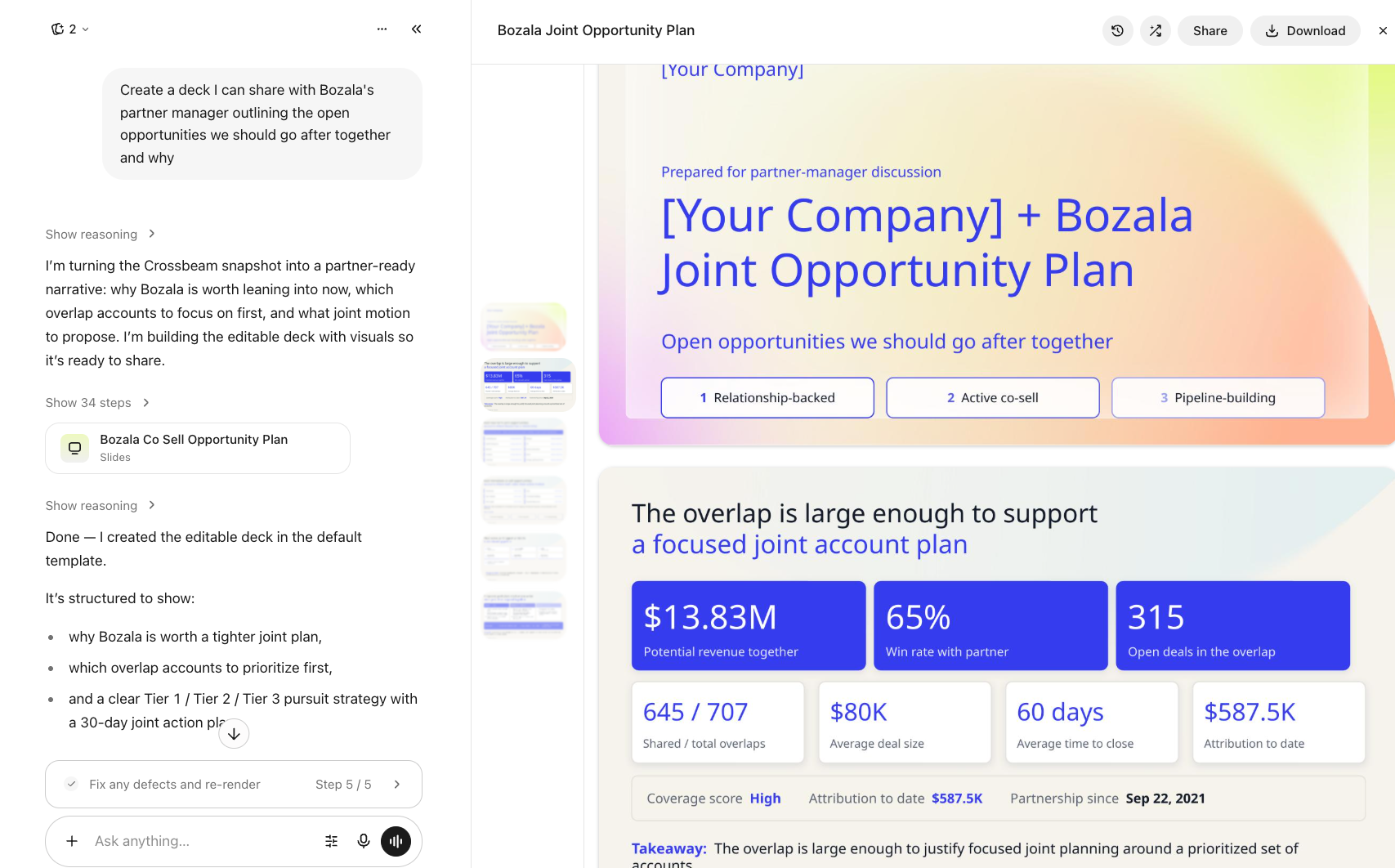
Partner QBRs, co-sell kickoffs, and joint campaign planning happen all the time. But the work of pulling the data, deciding which accounts to prioritize together, and putting together something shareable usually takes days. You can now use AI to collapse that analysis and process into a few prompts.
The result: a joint opportunity plan grounded in real second-party data — which accounts you're both pursuing, where the strongest co-sell plays are, and what to go after first.
For the full prompt and walkthrough on turning this into an actual asset, see the full playbook here.
Use cases for marketing
12. Build an account-based marketing target list
Prompt: “Which accounts are prospects for us and also prospects for [Partner Name/s]? I want to build a target list for a joint ABM campaign.”
This is a great starting point for any co-marketing campaign that wants to target shared prospects instead of running two separate lists.
13. Build a mutual customer co-marketing list
Prompt: “Build a list of mutual customers between us and [Partner Name]. Help me think through a campaign to drive integration adoption.”
Good for surfacing customers who'd benefit from knowing about an integration they may not be using yet.
14. Find joint case study candidates
Prompt: “Which of our customers are also customers of [Partner Name]?”
A quick way to source candidates for a joint case study without combing through two separate customer lists by hand.
15. Rank target accounts by partner overlap strength
Prompt: “[Pull in or paste target accounts] Which ones overlap with multiple partners, and how should I rank them by strength of those relationships and recent signals?”
Especially useful for a larger target account list you need to prioritize down to something actionable. Our playbook on scoring and tiering a target account list using Crossbeam data covers a more advanced version of this you can turn into a recurring workflow.
Take it further
AI-Powered Ecosystem Playbook: Real workflows from GTM teams already using Crossbeam data in their AI tools. Six step-by-step plays from partnerships leaders at Glean, Infobip, Quantum Metric, and more.
Crossbeam Skills for Partnerships and GTM Teams: Ready-made AI agent instructions for partner activation, pipeline prioritization, ecosystem-informed account briefs, and more.
Get the full prompt guide: 15 prompts in one downloadable guide.
Connect the Crossbeam MCP server. Find Crossbeam in the Claude, ChatGPT, or Glean marketplace, or connect any other MCP-compatible tool.
FAQs
What is the Crossbeam MCP server?
It connects Crossbeam's ecosystem data directly to AI tools like Claude, ChatGPT, and Glean using the Model Context Protocol, an open standard for integrating AI agents with company data. Instead of logging into Crossbeam or a CRM to check partner overlap, you can just ask your AI tool.
What do I need to start using it?
An account data source connected in Crossbeam (CSV, CRM, or data warehouse) and at least one partner connection. If you don't have partner connections yet, Crossbeam's 40+ Open Data Partners give you instant account mapping without one. What's available also depends on your plan and seat type.
Which AI tools does it work with?
Claude, ChatGPT, Glean, and any other MCP-compatible tool. You can find Crossbeam in each platform's marketplace to connect it.
How do I get better results from my prompts?
Be specific about the accounts, partners, or lists you're working with. The more context you give it, like a segment, time window, or specific partner, the more useful the output. If a prompt isn't pulling from Crossbeam, tell your AI agent directly to use the Crossbeam connector.
How can sales teams use it?
For finding net new accounts through partner wins, prioritizing target lists with ecosystem signals, building pre-call account briefs, ranking pipeline by partner relationship strength, identifying partners for deal acceleration, drafting ecosystem-informed outreach, and enriching accounts with partner-shared contacts.
How can partnerships and marketing teams use it?
Partnerships teams can get a baseline ecosystem read, find new partners to recruit, spot co-sell opportunities, and build joint opportunity plans. Marketing teams can build ABM target lists, mutual customer co-marketing lists, joint case study candidates, and rank accounts by partner overlap strength.