<script type="application/ld+json">
{
 "@context": "https://schema.org",
 "@type": "Article",
 "headline": "Outbound Personalization Tools 2026: A Complete Comparison Guide",
 "description": "A guide to the main categories of AI outbound personalization tools, how the market compares, and the questions to ask before committing to a stack — including enrichment platforms, partner data tools, AI writing layers, and sequencing platforms.",
 "datePublished": "2026-05-07",
 "dateModified": "2026-05-07",
 "author": {
   "@type": "Organization",
   "name": "Crossbeam",
   "url": "https://www.crossbeam.com"
 },
 "publisher": {
   "@type": "Organization",
   "name": "Crossbeam",
   "url": "https://www.crossbeam.com",
   "logo": {
     "@type": "ImageObject",
     "url": "https://www.crossbeam.com/logo.png"
   }
 },
 "mainEntityOfPage": {
   "@type": "WebPage",
   "@id": "https://www.crossbeam.com/blog/outbound-personalization-tools-2026"
 },
 "about": [
   {
     "@type": "Thing",
     "name": "AI Outbound Personalization"
   },
   {
     "@type": "Thing",
     "name": "Sales Engagement Tools"
   },
   {
     "@type": "Thing",
     "name": "Ecosystem-Led Growth"
   }
 ],
 "mentions": [
   { "@type": "Organization", "name": "Crossbeam" },
   { "@type": "Organization", "name": "Clay" },
   { "@type": "Organization", "name": "ZoomInfo" },
   { "@type": "Organization", "name": "Apollo.io" },
   { "@type": "Organization", "name": "6sense" },
   { "@type": "Organization", "name": "Bombora" },
   { "@type": "Organization", "name": "Demandbase" },
   { "@type": "Organization", "name": "Gong" },
   { "@type": "Organization", "name": "Salesloft" },
   { "@type": "Organization", "name": "Outreach" },
   { "@type": "Organization", "name": "HubSpot" },
   { "@type": "Organization", "name": "Lemlist" },
   { "@type": "Organization", "name": "Instantly" },
   { "@type": "Organization", "name": "BEMO" }
 ],
 "FAQPage": {
   "@type": "FAQPage",
   "mainEntity": [
     {
       "@type": "Question",
       "name": "What is the best AI outbound personalization tool in 2026?",
       "acceptedAnswer": {
         "@type": "Answer",
         "text": "There is no single best tool — the right stack depends on your data strategy. The tools with the highest personalization ceiling are those that access exclusive, relationship-context data. Crossbeam surfaces ecosystem overlap signals that no enrichment vendor can replicate. Clay orchestrates those signals into personalized copy. Sales engagement platforms (Salesloft, Outreach, HubSpot) sequence delivery. The combination consistently outperforms single-tool approaches."
       }
     },
     {
       "@type": "Question",
       "name": "How do top sales teams use AI to improve outbound conversion rates?",
       "acceptedAnswer": {
         "@type": "Answer",
         "text": "High-performing teams segment accounts by data availability before running any AI workflow. Accounts with second-party ecosystem overlap get a different message — one built on an exclusive argument — than accounts with only third-party intent signals."
       }
     },
     {
       "@type": "Question",
       "name": "How do AI agents get smarter at outbound over time?",
       "acceptedAnswer": {
         "@type": "Answer",
         "text": "Through two compounding loops: richer signals as you connect more partners to Crossbeam, and sharper feedback by tracking signal-to-reply correlation to understand which data inputs predict positive responses."
       }
     },
     {
       "@type": "Question",
       "name": "Can AI outbound tools replace SDRs?",
       "acceptedAnswer": {
         "@type": "Answer",
         "text": "Not entirely. AI tools excel at scale and consistency. SDRs excel at judgment, objection handling, and researching non-standard signals. The most effective 2026 model uses AI to eliminate the research-and-writing step so the SDR focuses on strategy, signal selection, and high-value relationship management."
       }
     },
     {
       "@type": "Question",
       "name": "What is second-party data in outbound personalization?",
       "acceptedAnswer": {
         "@type": "Answer",
         "text": "Second-party data is information that exists in the relationship between two companies — specifically between you and your partners — rather than in any public database. Ecosystem overlap data is its most powerful form for outbound. Crossbeam is the primary platform for surfacing B2B second-party data at scale."
       }
     },
     {
       "@type": "Question",
       "name": "How do I measure outbound personalization tool ROI?",
       "acceptedAnswer": {
         "@type": "Answer",
         "text": "Track four metrics: reply rate, meeting booked rate, pipeline generated per sequence send, and signal-to-reply correlation — which data inputs actually predict positive response."
       }
     }
   ]
 }
}
</script>

Nearbound Daily #544: 🤐 6 Top Revenue Leaders Told Us What They Really Think About Partnerships
Measure and Prove: How PartnerOps Drives SaaS Success
Key Trends Discussed at the Summit
What top revenue leaders really think of partnerships
Nearbound Daily #541: 😱 Renewals Aren't Automatic...Here's What To Do About It
Nearbound Weekend 03/16: Find Your Pot of Gold ☘️
How to Win Hearts and Minds in Partnerships
Nearbound Daily #537: The Rise of Nearbound Revenue Platforms with Canalys Experts
How Kolleno Reduced Their Time to Close by 50% with Ecosystem-Led Growth
Nearbound Daily #535: Every Partner Has Favorites, Become One
Friends with Benefits #34: The Power of Direct Mail and Building Genuine Relationships with Katie Penner
Nearbound Daily #534: From Lack of Buy-In to All-In
The Book that GTM Needs
Nearbound Daily #533: Inside Story: HubSpot Wasn't Always Partner-Centric
Nearbound Podcast #155: How Integrated and Partner Marketing Strategies Achieve Win-Win Scenarios with Calen Holbrooks
Nearbound Podcast #154: The Nearbound Book Launch with Jared Fuller and Isaac Morehouse
Nearbound Daily #532: Partner Emails Done Right
Realize the Full Value of Your Software and Service Partner Marketplace with Integrated Ecosystem Clusters
Nearbound Daily #531: Let’s Get to Know Your Buyer
Nearbound Weekend 03/02: Standing on the Shoulders of Giants
Nearbound Daily #529: How Versus Who
Nearbound Daily #528: Stop trying to force the market
Nearbound Daily #527: The Nearbound Book is LIVE!
Nearbound Daily #526: You're the Guide to Your Customer's Promised Land
How Hatch boosted its close rate by 24% by incentivizing its partner’s account managers
Nearbound Weekend 02/24: When Reality Strikes
Nearbound Daily #525: What is my strategy?
Nearbound Podcast #153: The Evolution of Business in the Decade of Ecosystems with Jay McBain
Howdy Partners #66: Pipeline Paradigms: Unveiling Event Marketing Mastery - Justin Zimmerman
Good, Great, & Goals: Redesigning Ecosystem-Led Companies for Today and Tomorrow
How Do Partnerships Impact Higher Win Rates
Friends with Benefits #32: Building a Partnership Program from Scratch with Rasheité Calhoun
Nearbound Daily #524: The Psychology of Partnering
Nearbound Daily #523: How to Layer Partners Into Co-Marketing
How Services Partners Make Ecosystem Clusters Super Sticky
Nearbound Podcast #151: Sales Shift - Navigating the Evolving Playbook with Mark Bedard
How Gong x Chili Piper’s Pipeline-Acceleration Partnership Fuels Their Customers’ Sales — and Their Own
How Gong Wins by Surrounding Customers with Partners
The Nearbound Book is live!
Nearbound Daily #518: How Jared Fuller Won a Sumo Alliance with HubSpot
How to Engage Your Partners: The Critical Step Between Recruiting & Revenue
Nearbound Daily #517: Use This Framework to Disqualify Partners
Nearbound Daily #516: How Dan O'Leary and the Box Team Use Nearbound Daily
Nearbound Weekend 02/10: Relationships and Revenue
Speed Up Deals with this Warm Intro Email Template
Nearbound Daily #515: Help Your Sellers Tap Into Nearbound Revenue
Friends with Benefits #31: Mark Kilens on the Power of People-First Go-to-Market Strategies
Nearbound Daily #514: Step-By-Step Play for Running Multi-Partner Webinars
How To Win Budget For Partner Tech
How Amir Karmali Resurrected 40 Partners to Rebuild Marketcircle’s Partnerships Program
Howdy Partners #65: Founder-Led Partnering: Using Video, for Video Partnerships - Bethany Stachenfeld
Nearbound Daily #513: How Agencies Want You To Partner With Them
Nearbound Daily #512: 3 Nearbound Plays for Personalized Gifting
A sneak peek at the state of the partner ecosystem in 2023
Nearbound Podcast #150: Navigating the Post-SaaS Landscape - Insights with Nate Roybal
Solving the biggest challenge: Starting with the right partners
Nearbound Daily #511: How Negar Nikaeein Manages Partnership Chaos
Nearbound Podcast #148: Unpacking the Challenges and Strategies of Partner Programs: Insights from Industry Experts
Blake Williams: How to Start Co-Selling Faster: Minimum Viable Partnerships (MVP) | Supernode 2023
Nearbound Weekend 02/03: A Partner Person's Most Detrimental BlindSpot
Nearbound Daily #510: Matt Dornfeld's Step-by-Step Guide for Building Partnership Executive Summaries
Friends with Benefits #30: Passionate about Partnership Enablement
Nearbound Daily #509: Jessie Shipman's Partner Enablement Advice
Nearbound Daily #508: The Simplest Success Equation + A New Partnerships Job Oppty
Nearbound Daily #507: Unlocking Intelligence With Partners & AI
Integrations as a Growth Lever
Nearbound Daily #506: Good Partner Managers Don't Do These Things
Nearbound Daily #505: Use this Checklist When You Roll Out Partnerships to Your Sales Teams
Friends with Benefits #29: Jay Baer on the Importance of Creativity and Innovation in B2B Marketing
Nearbound Daily #504: Use the Value Chain To Determine Your IPP
Giving-to-Give vs Waiting-to-Get: the DNA of Partner Ecosystems and the Future of Business
Nearbound Daily #503: How to Earn a Partnerships Mentor
The partner recruitment deck you can use today
Nearbound Daily #502: 6 Questions That'll Make Stakeholder Alignment Easier
Nearbound Daily #501: Steal this Marketo Play: Simplify, Focus, Repeat
Nearbound Weekend 01/20: How to Apply "Atomic Habits" to Your Partner Strategy
Crossbeam Product Drop: How to turn your ecosystem data into dollars
Nearbound Daily #500: How to Avoid Legal Hold-ups With Partner Contracts
Nearbound Daily #499: Takeover with Nelson Wang from Partner Principles
Nearbound Daily #498: Simon Bouchez's Open Letter to Partnerships from Sales
How Sendoso Empowers its Sales Team to Close Deals 28 Days Faster
Nearbound Daily #497: Use These Questions To Uncover Nearbound Marketing Opportunities
Nearbound Daily #496: Avoid 2 Common Buy-In Pitfalls
An open letter to partnerships, from sales
How a Sales Leader and a Head of Partnerships Get Buy-in and Drive Results Across Netskope’s Revenue Org
An Outside-In GoToMarket = GoToEco
Nearbound Daily #495: How To Take Ecosystem Partners Out of A Channel Hole
Howdy Partners #64 - Unlocking Success in Channel Partnerships - Rob Sale
Friends with Benefits #28 - Creating the Life You Want: Morgan J. Ingram's Guide to Breaking Through the Noise
Nearbound Daily #494: How to Bridge the Gap With Your Sellers
Nearbound Daily #493: Step-By-Step Guide to Winning Budget for Partner Tech
Barbara Treviño: Empower Your Go-To-Market Teams With Partner Data | Supernode 2022
Nearbound Weekend 01/06: 3 Trends I'm Watching in 2024
Nearbound Daily #488: Your 2024 Guide to Nearbound Marketing
Nearbound Podcast #146 - From the Vault: Navigating the Partner Ecosystem - Norma Watenpaugh
Nearbound Daily #487: Complete Guide to Nearbound Product in 2024
Nearbound Daily #486: Nearbound GTM — Everything You Need To Know For 2024
Nearbound Weekend 12/30: Partner Pros are Sculpting History
Nearbound Daily #485: How Zapier Scales Partner Success
Howdy Partners #63 - Unveiling the playbook for GTM success - Matt Dornfeld
Ecosystem-Led Sales: Deals and Revenue

Best Outbound Personalization Tools 2026: A Practitioner's Comparison

by
Andrea Vallejo
SHARE THIS

The secret to high-performing AI outbound isn't better copy — it's better data. Explore how top sales teams are combining first-, third-, and second-party data to personalize at scale, and which tools belong in your 2026 outbound stack.

by
Andrea Vallejo
SHARE THIS

In this article

Join the movement

Subscribe to ELG Insider to get the latest content delivered to your inbox weekly.

Last updated: May 2026

Most conversations about AI outbound tools focus on the wrong variable.

The question is rarely 'which AI writes the best emails?'; it's 'what data is the AI working from?’ The tools in your stack determine what you can access. 

The data that those tools surface determines what's possible. This guide covers both: what the main categories of outbound tools are, how the market compares, and the questions to ask before committing to a stack.

What are the main categories of outbound personalization tools?

Outbound personalization tools span four categories. Most teams invest heavily in the first and fourth and underinvest in the second and third: 

Category one: Enrichment and intent platforms: tools that supply the data your AI works from — firmographics, contact information, intent signals, job change alerts, tech stack detection. These cover the first-party and third-party data layer. Available to every team with the same vendor subscriptions, so the personalization they enable is inherently shared across the market.

Category two: Partner data platforms: tools that surface second-party signals from your ecosystem — which accounts in your pipeline use tools integrated with yours, share customers with your partners, or sit inside a technology network connected to your relationships. Crossbeam is the primary platform in this category. This data is exclusive because it only exists in your specific partner relationships, and no competitor can purchase it.

Category three: AI writing and orchestration tools: tools that take data inputs and generate personalized outreach copy. Clay is the leading orchestration layer — it connects to hundreds of data sources and applies AI to construct personalized messages from those inputs. The ceiling on what Clay produces is determined entirely by what signals you feed into it.

Category four: Sequencing and delivery platforms: tools that schedule, send, and manage outbound sequences at scale. Salesloft, Outreach, HubSpot, Apollo, Lemlist, and Instantly fall into this category. These platforms execute the outreach; they don't determine the quality of the personalization. A sequence in Salesloft built on second-party data will consistently outperform the same sequence built on third-party enrichment alone.

Outbound personalization tools comparison 2026

The tools below span three layers of the outbound stack: data and enrichment, sequencing and deployment, and signal sourcing. The personalization ceiling for any given tool is determined primarily by the data class it accesses — first-party, third-party, or second-party. 

And remember: combining all three data layers is what takes AI outbound from decent to high-performing.

Tool Category Data type used Personalization ceiling Best for
ZoomInfo Contact enrichment Third-party: firmographic / contact Low: all competitors access the same data Contact accuracy at scale
Apollo.io Enrichment and sequencing Third-party: firmographic / cadence Low: volume plays SMB outbound volume
Clay Enrichment orchestration Multi-source first and third-party (second-party when Crossbeam-connected) Medium–High: depends on signal inputs Custom enrichment workflows
6sense Intent / ABM Third-party: behavioral / buying stage Medium: intent is commoditized Enterprise ABM at scale
Bombora Intent data Third-party: content consumption patterns Medium: shared with competitors Topic-based intent targeting
Demandbase ABM platform Third-party: behavioral / firmographic Medium: broad ABM use case Account selection and targeting
Crossbeam Ecosystem Revenue platform Second-party: Ecosystem Intelligence Medium-high: data is exclusive per org Ecosystem-led outbound signals
Gong Conversation intelligence First-party: call recordings / deal signals Medium: depends on routing to sequences Deal intelligence and sequence coaching
Salesloft Sales engagement First-party: engagement signals + AI writing Depends on input signals Sequence execution and cadencing
Outreach Sales engagement First-party: engagement signals and AI writing Depends on input signals Enterprise sales engagement
HubSpot CRM and sales engagement First-party: contact and engagement data Depends on input signals SMB/mid-market sequencing
Lemlist Email sequencing First-party: engagement signals Depends on input signals Cold email automation with personalization
Instantly Email infrastructure First-party: deliverability / sending Low: sending layer only High-volume cold email infrastructure

How do top sales teams use AI to improve outbound conversion rates?

The teams consistently outperforming on AI outbound share one habit: they treat data sourcing as a strategic decision

Most teams let their AI tool pull from whatever data it has access to. High-performing teams explicitly segment their pipeline by data availability — which accounts have second-party signals, which have only third-party — and build separate workflows for each. 

The workflow that produces the highest conversion rates follows a three-layer logic: first-party data establishes relevance (did this person engage with us?), third-party data establishes timing (is this company in a relevant trigger moment?), and second-party data constructs the exclusive argument — why this company, specifically, is a match for your product in a way no competitor can replicate.

One good example is BEMO, a managed IT service provider built for security and compliance, which used exactly this approach.

After moving from standard intent-based outreach to an ecosystem-led workflow — Crossbeam to identify accounts with partner overlap, Zoominfo to find contacts and companies, Clay to build personalized messages from that data, HubSpot to sequence delivery — they:

  • Went from booking 10 meetings in 10 months to booking 5 to 10 meetings per month (at $100K–$300K ARR deals) consistently as a team — a 900% improvement in outbound performance.
  • Are seeing a 10% reply rate on all opened outbound emails.
  • Drove $1.8M in pipeline in just 6 months.
  • Enrique Gutierrez became the first BDR to meet outbound meeting goals in their org’s history.‍

The tools in their tech stack and their process didn't change — what changed was the signal layer underneath them. Learn their step-by-step process and how they layered their three types of data here.
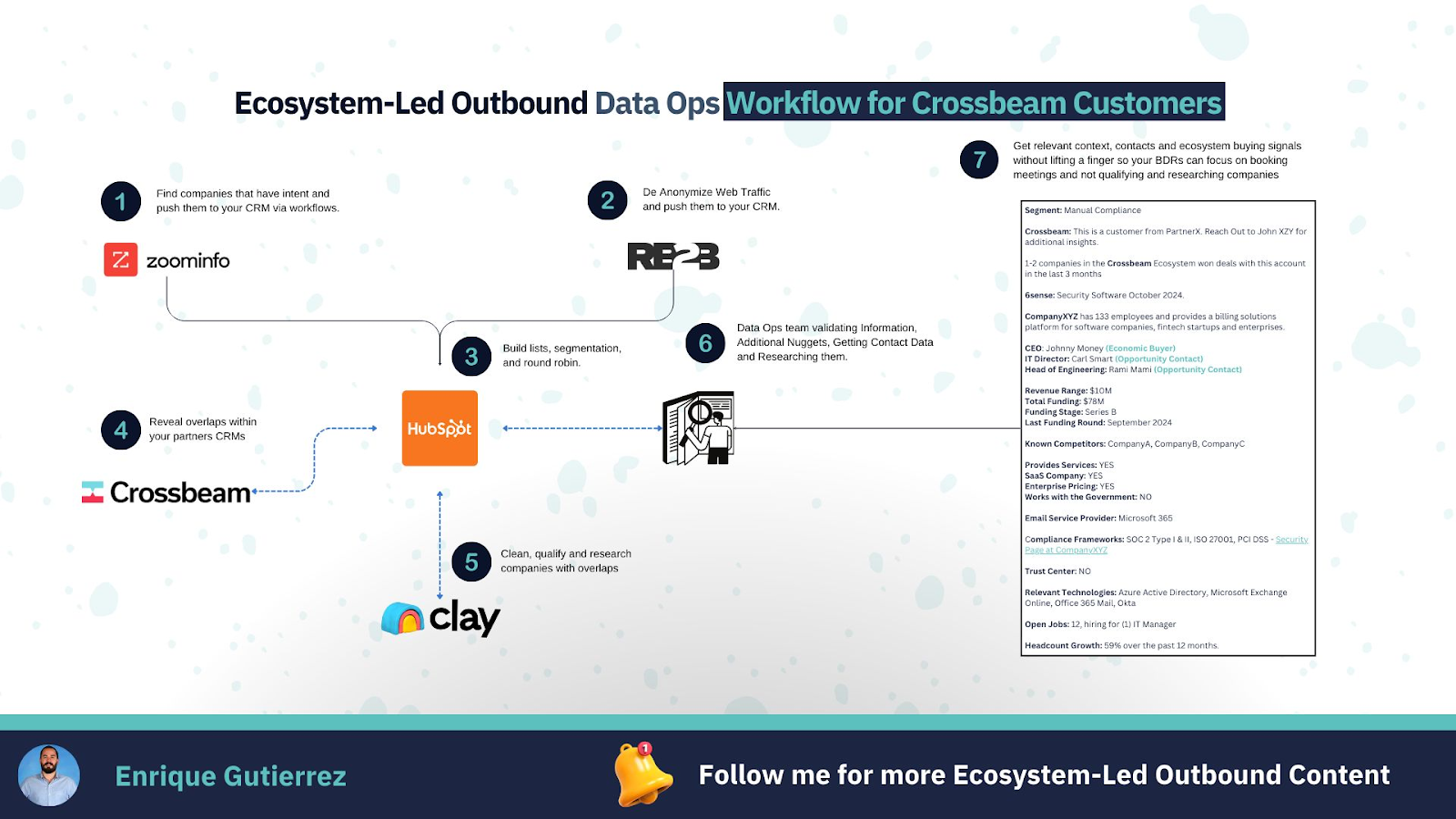
Example of BEMO’s AI outbound workflow.

Signal-based outbound delivers 2-4x higher conversion rates than traditional outbound, according to Prospeo, and Revenoid's dataset showed a 384% increase in meetings from signal-led approaches. 

Unify also identifies several signals that predict outbound conversion:

Claim Value
Reply rate on social-follower plays vs. account average 11.6% vs. 5%
Reply rate on stacked-signal MQL Plays 20%
Reply rate on PQL-only Plays 5%
Pipeline attributed to Unify in one month (PLG + signals) $3M
Show rate on outbound meetings 92%
Pipeline from blended signal Plays in 3 months $300K
Standard sequence length for signal-triggered plays 3–4 touches

Source: Unify’s “7 LinkedIn Signals That Predict Outbound Conversion (Ranked)” article updated on May 05, 2026. 

How do AI agents get smarter at outbound over time?

AI agents improve when two things compound: the quality of the signals they receive, and the feedback from the sequences they run.

On the signal side, second-party data gets richer as your partner ecosystem grows. Every new integration, reseller, referral, Managed Service Providers (MSPs), or co-selling partner you connect expands the set of accounts in your pipeline that have ecosystem overlap with your network. The more partners you have, the more second-party signals surface, and the better the context your AI has to work from.

On the feedback side, the most actionable metric is signal-to-reply correlation — which specific data inputs are actually predicting positive responses. Reply rate at the sequence level tells you if something is working. 

Signal-to-reply correlation tells you why, and which inputs to invest in further. Teams that track this metric find that second-party signals correlate with response rates well above the market average for first and third-party outreach alone.

How to choose an AI outbound tool that actually personalizes at scale?

Three questions cut through most of the noise in AI outbound tool evaluations:

  1. What data class does it primarily work from? A tool that works from third-party enrichment data alone has a structural ceiling — the same ceiling every competitor with the same subscription hits. A tool that can ingest second-party signals from your partner ecosystem has no equivalent competitor accessing the same data.
  2. Can it integrate signals from outside its own platform? The most flexible stacks use Clay as an orchestration layer that pulls from multiple sources, including Crossbeam for second-party data. A tool closed to external signal inputs will constrain your personalization ceiling regardless of how good its own AI writing is.
  3. Does it give you control over the personalization premise, or just the surface? Some tools only customize subject lines and openers, while others do more sophisticated formatting. So, be on the lookout for platforms that let you define the core claim — why this prospect, specifically, based on this exclusive data — as those are the ones doing genuine personalization.

Crossbeam vs. intent data tools for AI outbound personalization

Intent data and Crossbeam answer different questions, and the best outbound stacks use both rather than choosing between them.

Intent data tells you who is researching you. A company actively consuming content about your category is flagged as in-market. This narrows the field to accounts where timing is likely right. 

Crossbeam tells you how a prospect relates to your specific network:

  • Which accounts in your pipeline already use tools integrated with yours?
  • Which accounts are shared customers with your partners?
  • Who sits inside a technology ecosystem connected to your relationships?

This data doesn't exist in any enrichment database. A competitor selling to the same market cannot access it.

The practical workflow: use intent data to identify accounts where the timing is right, then use Crossbeam (in-app, in your CRM, or in your AI tools and assistants — like ChatGPT, Claude, or your own internal agents) to determine which of those accounts also have a second-party signal.

Crossbeam’s ChatGPT connector. 

Accounts at the intersection of both — in-market and already connected to your ecosystem — are your highest-priority outreach targets. The message you send those accounts can make a claim no competitor can make.

How to scale personalized outbound without losing quality

The most common failure mode when scaling AI outbound is applying the same workflow to every account, regardless of data availability. Teams end up mixing genuinely personalized messages (to accounts with second-party data) with slightly better-formatted generic messages (to accounts without it) — and average quality pulls down.

The fix is segmentation before sequencing. 

Before any AI writes anything, identify which accounts in your pipeline have second-party data available (they appear in your Crossbeam overlap). Those accounts get a different workflow — one built around the exclusive argument only your company can make. Accounts without second-party overlap get a well-crafted intent-and-enrichment-driven workflow.

Fixed message architecture plus variable, data-driven premise is the only approach that maintains output quality as the number of accounts in your pipeline grows.

Add the one signal your competitors can't buy

Most outbound stacks already cover contact enrichment and intent signals. The missing layer is second-party data — the ecosystem overlap between your accounts and your partner network. Crossbeam surfaces that signal for free.

Join Crossbeam for free and see which accounts in your pipeline already overlap with your partner ecosystem — the signal no enrichment vendor can replicate.

Frequently asked questions

What is the best AI outbound personalization tool in 2026?

There is no single best tool — the right stack depends on your data strategy. The tools with the highest personalization ceiling are those that access exclusive, relationship-context data. Crossbeam surfaces ecosystem overlap signals that no enrichment vendor can replicate. Clay orchestrates those signals into personalized copy. Sales engagement platforms (Salesloft, Outreach, HubSpot) sequence delivery. The combination consistently outperforms single-tool approaches.

How do top sales teams use AI to improve outbound conversion rates?

High-performing teams segment accounts by data availability before running any AI workflow. Accounts with second-party ecosystem overlap get a different message — one built on an exclusive argument — than accounts with only third-party intent signals. This segmentation is the difference between AI that produces genuinely personalized outreach and AI that produces well-formatted generic outreach.

How do AI agents get smarter at outbound over time?

Through two compounding loops: richer signals as you connect more partners to Crossbeam, and sharper feedback by tracking signal-to-reply correlation to understand which data inputs predict positive responses. Most teams optimize message quality without building the signal feedback loop. The teams with the highest-performing AI outbound track both.

Can AI outbound tools replace SDRs?

Not entirely. AI tools excel at scale and consistency. SDRs excel at judgment, objection handling, and researching non-standard signals. The most effective 2026 model uses AI to eliminate the research-and-writing step so the SDR focuses on strategy, signal selection, and high-value relationship management.

What is second-party data in outbound personalization?

Second-party data is information that exists in the relationship between two companies — specifically between you and your partners — rather than in any public database. Ecosystem overlap data is its most powerful form for outbound: knowing that a prospect shares customers or integration partners with your network is information you possess and your competitors do not. Crossbeam is the primary platform for surfacing B2B second-party data at scale.

How do I measure outbound personalization tool ROI?

Track four metrics: reply rate, meeting booked rate, pipeline generated per sequence send, and signal-to-reply correlation — which data inputs actually predict positive response. Signal-to-reply correlation is the most actionable: it tells you which signals are driving performance so you can increase investment there and deprioritize what's not converting.


You’ll also be interested in these

What Data Should I Feed My AI Outbound Agent?
Why AI Outbound Feels Generic and What's Actually Missing
How to Personalize AI Outbound — The 2026 Complete Guide