Channel Sales in the Age of Rev AI: How Ecosystem Intelligence Is Reshaping Partnerships



Learn how leading GTM and partnership teams at Mountain Branch Consulting, Gong, and Arena PTC are adapting channel sales for the Rev AI era. Discover how Ecosystem Intelligence, relationship-context data, MCP integrations, and operational ELG motions are transforming co-sell workflows, attribution, and partner-driven pipeline generation.
Last updated: June 2026
AI isn’t replacing channel sales. But it is forcing partner teams to prove value in a fundamentally different revenue environment.
That was one of the clearest themes from Crossbeam and Gong’s recent Ring the Gong webinar, where Heatherly Bucher (Head of Alliances & Partnerships, Arena by PTC), Richard Steeves (Founding Managing Partner, Mountain Branch Consulting), and Mike Davis (Regional Vice President, Large Enterprise and Strategic Sales, Gong) unpacked what Rev AI means for channel, co-sell motions, and the future of indirect revenue.
The conversation made one thing clear:
AI-augmented sales teams are getting faster at prospecting, research, pipeline prioritization, and account analysis. But those gains are also exposing a new reality: partner teams can no longer rely on marketplace listings or loosely coordinated co-sell motions.
The ecosystem teams winning in 2026 are operationalizing relationship context directly inside the revenue workflow.
Or as Mike put it:
“The expectations of direct sellers are increasing as it relates to the capabilities technology can make easier for them. But it’s only highlighting the importance of the stuff that isn’t going to be commoditized — relationships, context, and the actual process change management.”
Why are traditional channel motions struggling in the Rev AI era?
The biggest misconception in AI-driven revenue right now is that automation alone creates differentiation.
It doesn’t.
AI tools are rapidly commoditizing:
- Account research
- Prospecting workflows
- Basic personalization
- Sequence generation
- Competitive summaries
- Call analysis
As Heatherly explains, “AI can support this, can help us be more efficient at identifying opportunities and joint customers. But it is not going to create that better together reality.” Most sellers now interact with AI daily through platforms like Gong, Salesforce, Microsoft Copilot, and Claude.
The problem is that many organizations still operate partner programs using analog workflows:
- Static account lists
- Spreadsheet tracking
- Manual partner outreach
- Delayed attribution
- Disconnected systems
Meanwhile, direct sellers are moving faster than ever. That creates friction.
What happens when partner workflows stay manual?
When Ecosystem Intelligence stays trapped in dashboards, partner teams become invisible to the revenue motion.
AI-driven sales reps optimize around speed, workflow convenience, immediate context, and automated prioritization. If partner insights require extra effort to access, sellers simply bypass them.
That’s why modern ELG motions increasingly focus on embedding ecosystem overlap data directly into:
- CRM workflows
- Slack alerts
- account briefs
- AI-generated summaries
- forecasting systems
The goal is operational visibility, not passive access.
What is second-party data?
Second-party data is the layer of Ecosystem Intelligence showing which accounts already overlap with your partners, customers, or network. Unlike firmographic or intent data, second-party data reveals existing trust pathways into target accounts, making outbound outreach more relevant and structurally differentiated.
Why are ecosystem signals becoming more valuable than commodity AI data?
Most AI outbound systems pull from the same data layers. They use firmographics, intent signals, public web research, job title changes, and funding events. That means most AI-generated outreach increasingly sounds the same.
What AI cannot easily replicate is Ecosystem Intelligence:
- partner overlap
- shared customers
- mutual relationships
- co-sell history
This is where partnerships become strategically important again.
“The reason you would work with partners is that you’re better together. Part of that better together story is your counterpart having some type of information, relationship, or capability that ChatGPT can’t just pull off the web and summarize for you,” explains Mike. “The expectations of direct sellers are increasing as technology makes more capabilities easier. But it’s only highlighting the importance of the things that aren’t going to be commoditized.”
That shift changes the role of partnerships entirely. The future of channel sales is no longer just relationship management. It’s relationship-context orchestration.
Why does partner attribution become harder in AI-driven revenue motions?
AI introduces a new attribution challenge: more touches, more automation, and more invisible influence across the funnel. According to the panel, attribution confusion is becoming one of the biggest operational tensions inside modern GTM organizations.
Many organizations still lack:
- clear definitions for partner-sourced revenue
- influence scoring frameworks
- standardized attribution models
- integrated ecosystem visibility
That creates internal conflict between sales, partnerships, marketing, and revops.
How are mature ecosystem teams solving attribution?
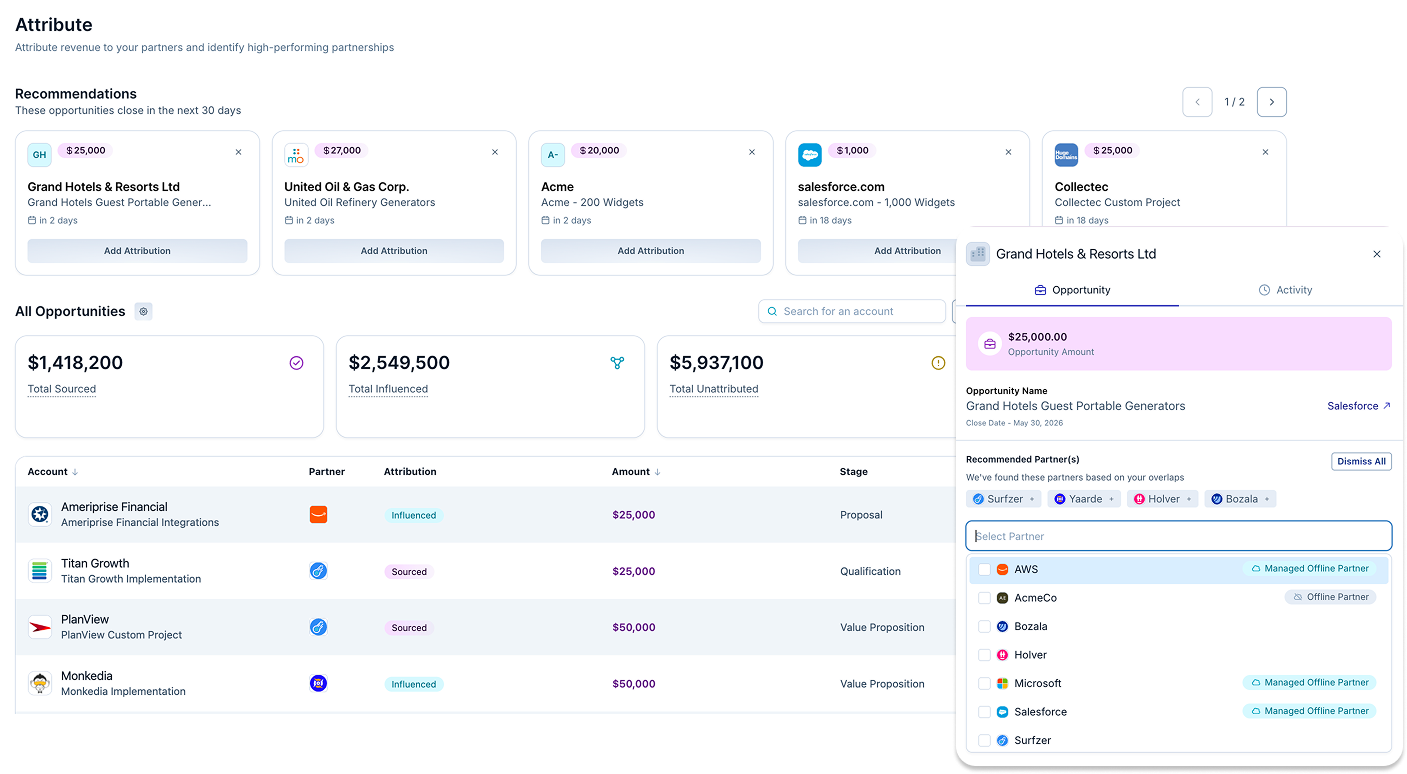
The most mature organizations operationalize attribution before scaling the program.
Heatherly explained that Arena by PTC established formal sourcing definitions, attribution SOPs, and CRM workflows early to reduce ambiguity across global markets.
The strongest ecosystem teams:
- Define sourced vs. influenced revenue clearly
- Align leadership on attribution models
- Embed ecosystem data into CRM workflows
- Automate influence detection through AI
- Track partner engagement across the full sales cycle
How are high-performing partner teams operationalizing AI today?
The strongest teams aren’t adding AI everywhere. They’re embedding AI where users already work.
Heatherly explains that Arena PTC consolidated partnership intelligence into a single partnership agent inside Microsoft Teams rather than forcing sellers to navigate multiple disconnected AI systems.
The agent pulls from:
- Gong
- Crossbeam
- internal SOPs
- partnership documentation
- approved ecosystem information
The result: sellers access the partnership context without leaving their workflow.
“The best way to create habits in the workspace is to simplify and keep it where people are,” Heatherly explains.
What makes an operational ELG motion different?
An operational ELG motion embeds ecosystem overlap data directly into CRM workflows, Slack alerts, seller prioritization, and pipeline reviews. The goal is to turn ecosystem signals into repeatable sales actions that influence pipeline consistently.
Why are MCP integrations changing ecosystem workflows?
One of the biggest themes from the conversation was the growing importance of MCP integrations.
MCPs allow companies to bring Ecosystem Intelligence directly into AI workflows rather than forcing users to switch between disconnected systems.
For example:
- Crossbeam ecosystem data can appear inside Gong account briefs
- Partner overlap can surface inside Claude conversations
- AI agents can combine CRM, revenue, and Ecosystem Intelligence together
That creates a much richer operating environment for sellers.
Richard explains that “things are starting to move beyond going to another vendor’s site and engaging with their agent there. The game is changing because teams want to bring those experiences locally into their own contextual environment.”
The implication is significant: AI-native GTM motions increasingly depend on connected ecosystem infrastructure.
What does a modern AI-ready partner program actually look like?
According to Richard, the strongest ecosystem programs are investing heavily in what he calls “signal architecture.”
What is signal architecture? It is surfacing Ecosystem Intelligence earlier, improving ecosystem discovery, embedding recommendation systems, operationalizing relationship data, and integrating ecosystem signals directly into seller workflows.
Top tip: Tools like Revic can support this shift by helping revenue teams move from static account planning to more dynamic account prioritization, using real conversion signals, pipeline potential, and execution readiness to identify which accounts deserve focused action.
How to adapt your partner program for the rev AI era
1. Embed Ecosystem Intelligence where sellers already work. Do not force sellers into separate partner dashboards. Push overlap signals into:
- CRM
- Slack
- account briefs
- forecasting tools
- AI assistants
2. Define attribution models early. Operationalize sourced revenue, influenced revenue, partner-driven pipeline, and co-sell engagement scoring. Misalignment here creates organizational friction later.
3. Build around relationship context. Commodity AI data creates generic outreach. Second-party data creates differentiated outreach. To leverage it, prioritize:
- ecosystem overlap
- mutual customers
- co-sell history
4. Consolidate AI experiences. Too many disconnected AI agents create adoption fatigue. Create centralized workflows where Ecosystem Intelligence, revenue intelligence, sales workflows, and AI copilots operate together.
5. Operationalize partnerships inside the revenue motion. Partnerships should appear in:
- pipeline reviews
- account planning
- forecasting conversations
- AI-generated summaries
- seller workflows
AI is commoditizing prospecting, research, and personalization. What it can't replicate is your ecosystem. Crossbeam surfaces the partner overlap, shared customers, and relationship context that gives your sellers a reason to reach out that no competitor can copy.
Join Crossbeam for free and see which accounts in your pipeline already have ecosystem signals, before your next co-sell conversation.
FAQ
Why are partnerships becoming more important in the AI era?
AI automates research and outreach, but it cannot replicate trust, relationships, and ecosystem context. As direct sales motions become more automated, partner teams increasingly provide the unique relationship intelligence that differentiates one GTM motion from another.
What is an operational ELG motion?
An operational ELG motion embeds Ecosystem Intelligence directly into seller workflows, CRM systems, Slack alerts, forecasting, and account planning. The goal is transforming partnership data from passive visibility into active pipeline influence.
Why are MCP integrations important for partnerships?
MCP integrations allow Ecosystem Intelligence to flow directly into AI workflows and revenue systems. Instead of switching between disconnected platforms, sellers can access partner overlap, relationship context, and account intelligence inside the tools they already use daily.
What are the warning signs that a partner program is falling behind?
Common warning signs include:
- Ecosystem data trapped in spreadsheets
- Static partner directories
- Disconnected AI tools
- Unclear attribution models
- Partner intelligence absent from seller workflows
- Low sales engagement with co-sell motions