


.jpg)


.png)




.jpg)


.jpg)

.webp)


.webp)


New Data: Involving Partners in Deals Increases Win Rate for Nearly Every Ecosystem Size and Type


Data from the Crossbeam network gives new insight into how partner involvement in deals lifts your sales team's win rate compared to deals without partners.

Ecosystem Intelligence can give you all kinds of actionable insights to help you win deals, including which strategies are working and how well.
Win rate is a key revenue metric, so to look at that element of the effectiveness of Ecosystem-Led Growth, we wanted to dig into how it’s affected by involving partners in deals.
And we found good news: Across the thousands of companies on the Crossbeam network that have win rate data both with and without partners*, the average lift in win rate when partners are involved in deals is 11.7%.

Of course an average is only one view of an outcome, especially across thousands of companies with different characteristics. To drill down further, we wanted to see if the lift in win rate with partners varied significantly by how many partners there are in an organization’s connected ecosystem on the network.
It’s important to emphasize that when we talk about partner count, we’re not looking at a company’s total number of partners — we’re looking at the number of partners with whom companies are account mapping and sharing data on Crossbeam or Reveal. In other words, any correlation between win rate lift and ecosystem size only applies to an organization’s connected ecosystem.
We put companies in five groups based on the number of connected partners they have in Crossbeam, and found the average win rate lift for each group:

When we did this, we found that win rate lift averages are still positive for every connected ecosystem size, meaning no matter how big or small your ecosystem is, you are still likely to increase your win rate by involving partners in more deals. And the more partners you're connected to, the better your win rate lift from partners gets — EXCEPT, there’s a valley at 5-10 partners. Curious!
The rest of the graph suggests that a bigger connected ecosystem means more opportunities to leverage Ecosystem-Led Growth, which translates to higher win rates for deals with partners than without. Why would win rate lift steadily climb from 9.4% with 1-5 partners to a whopping 37.1% win rate lift with a large connected ecosystem of 50+ partners, but drop to only 2.5% with 5-10 connected partners?
Win rate lift averages are positive for every connected ecosystem size, meaning no matter how big or small your ecosystem is, you are still likely to increase your win rate by involving partners in more deals.
We hypothesized that maybe it wasn’t just ecosystem size that correlated with win rate lift, but the relationship between company size/sector and ecosystem size as well. After all, partners need management and engagement, so a tiny company wouldn’t necessarily be able to effectively leverage a huge ecosystem.
We sliced the data further to look separately at SMBs and Enterprise companies within each partner-count “bucket”. And ta-da, our first negative number, right there in the 5-10 partners group.
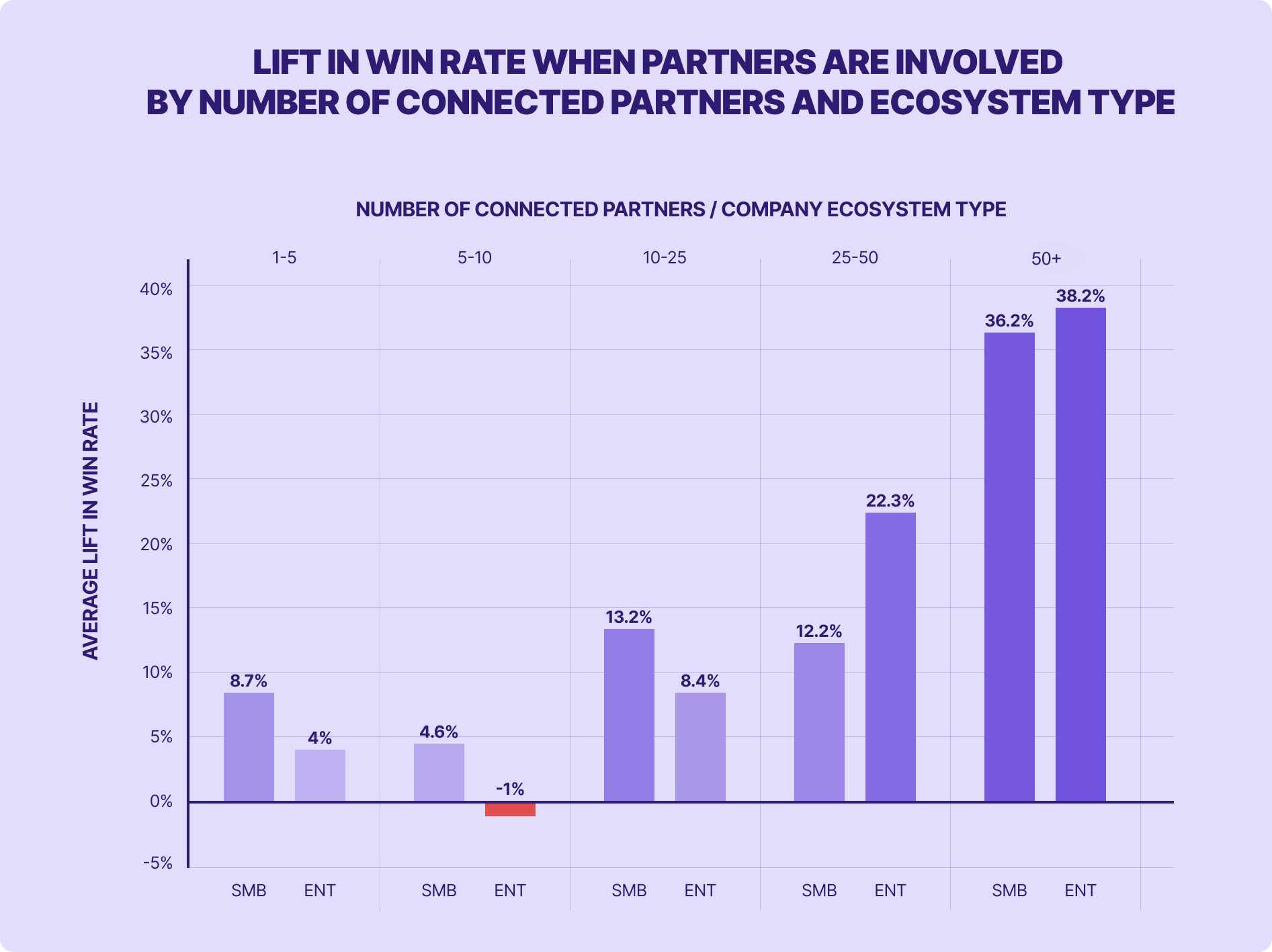
But it turns out the explanation isn’t really SMBs biting off more than they can chew. There is a small drop in average win rate lift when SMBs go from 1-5 partners (8.7%) to 5-10 partners (4.6%), and another one when they go from 10-25 partners (13.2%) to 25-50 partners (12.2%). But then their win rate lift skyrockets to 36.2% when they grow their ecosystem to 50+ partners.
The effect of ecosystem maturity
A possible explanation for this is ecosystem maturity — there are some growing pains when SMBs are building their ecosystems, such that partnership management and collaboration hits a few alignment and efficiency walls. But by the time their partnerships program is mature enough to have 50+ connections in Crossbeam or Reveal, they’ve established a flywheel that efficiently uses partner data and ELG motions to win deals. And even before then, they’re still seeing better win rates for deals involving partners than for those that don’t
The only group that actually sees slightly lower average win rates for deals involving partners than for deals without them (win rate drop of 1%) is Enterprise companies with 5-10 partners in their connected ecosystem.
When we talk about partner count, we’re looking at the number of partners with whom companies are account mapping and sharing data on Crossbeam or Reveal. In other words, any correlation between win rate lift and ecosystem size only applies to an organization’s connected ecosystem.
Enterprise companies that are sharing data with only a handful of partners are very early in their ecosystem maturity and aren’t anywhere close to fully utilizing ELG in their revenue process
Given their likely customer base and ARR, these companies are probably missing out on millions driven by the lift in win rate that partners can bring to deals. When they do bring partners into deals, they likely aren’t very aligned or strategic in how they’re doing it, so they’re seeing very little payoff in terms of win rate.
The win rate power of ELG for the sales team
Now that we had a sense of ecosystem factors that affect the win rate lift of involving partners in deals, we were curious about the impact of direct sales team involvement in the ELG motion.
The way we measured this was by looking at companies on the Crossbeam network that 1) have win rate data with partners and without in Crossbeam, 2) have purchased at least one seat on Crossbeam for Sales, our platform’s tool built specifically for sales teams to easily use partner ecosystem data and Ecosystem Intelligence throughout the sales cycle.
Of course as we all know, buying doesn’t necessarily mean fully using — so we grouped these companies by percentage of Crossbeam for Sales seats filled by a user.

The results here are striking. Companies using 75-100% of their sales seats see an average lift in win rate of 58.6% for deals involving partners versus deals that don’t. Filling 50-75% of Crossbeam for Sales seats has an average win rate lift of 43.2%.
Companies that have filled less than 50% of their sales seats have average win rate lifts ranging from 16.2% to 30.3%. Remember that this is compared to an overall average of 11.7% for all companies on the network with comparable win rate data, meaning that even companies that have filled few or none of their purchased sales seats are seeing far higher win rate lift with partners than other companies sharing data on Crossbeam.
While full or almost-full usage of sales team tools in Crossbeam clearly unlocks the biggest win rate lift, it’s not hard to understand why much lower or zero usage might also correlate with high win rate lift: The companies that have gotten to the stage of buying seats for their sales teams are invested in Ecosystem-Led Growth and are already effectively using their partner network and ELG playbooks to win more deals. Once they have all their sales reps on board, they'll be turning up the closed-won fire and unlocking even more revenue with their partner ecosystem.
*Based on Crossbeam network data as of October 28, 2024


